Complete collection of scientific sweet potato cultivation techniques, videos and pictures
I. Select good sweet potato varieties: Choose high-yielding varieties according to the characteristics of the sweet potato variety and the cultivation purpose. In spring sweet potato areas, it is advisable to choose medium-maturing varieties that are tolerant to fertilizer, recover quickly after transplanting, set tubers early, produce many and uniform tubers, and have a long duration of tuber enlargement. For example, in areas mainly for food use, Sushu 8, Anping 1, Xushu 34, Xushu...
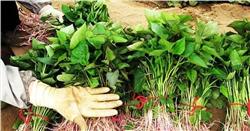
I. Select good sweet potato varieties:
Choose high-yielding varieties according to the characteristics of the sweet potato variety and the cultivation purpose. In spring sweet potato areas, it is advisable to choose medium-maturing varieties that are tolerant to fertilizer, recover quickly after transplanting, set tubers early, produce many and uniform tubers, and have a long duration of tuber enlargement.
For example, in areas mainly for food use, varieties such as Sushu 8, Anping 1, Xushu 34, and Xushu 23 can be selected; in areas mainly for starch processing, Meiying 1, SL-19, Yushu 12, and Yushu 13 can be selected; for dual-purpose use, Yushu 9 and Jishu 10 can be selected; for special uses such as fruit or feed, Yushu 10, which has high carotene content, high moisture, and high yield, can be selected.
II. Carry out deep plowing to improve the soil or ridge planting:
In early spring, apply organic fertilizer in the opened furrows, then cover with soil to preserve moisture. When preparing the land in spring, turn the center of the furrow into the center of the ridge. When making ridges, first apply nitrogen, phosphorus, and potassium fertilizer on the ridge center, then make tall, plump ridges 35 cm high, 90-100 cm wide at the base, and about 20 cm wide at the ridge surface. For sweet potato fields with clay-type soil, coal cinder, coal ash, and fine sand can be added during land preparation to improve the soil.
III. Timely early planting and reasonable planting density:
To achieve a yield of more than 5,000 kg per mu in sweet potato cultivation, a growth period of about 180 days is generally required. Therefore, early planting must be carried out well, and harvesting should be appropriately delayed to maximize the use of natural growth conditions and extend the growth period. The suitable planting time in our province is around April 15, with planting completed by April 25 at the latest. To plant as early as possible, plastic film mulching cultivation techniques can also be used, which can advance the planting time by more than 10 days.
In terms of planting density, there are two ways for sweet potato to achieve high yield: one is to rely on dense planting to give play to the population's yield-increasing effect and obtain high yield, with dense planting fields planting 5,000 plants per mu; the other is to rely on wide spacing with large mounds to fully tap the individual yield potential and obtain high yield, with sparse planting fields planting only about 500 plants per mu.
Planting density is closely related to variety. Short-vine varieties such as Yushu 6 and Yushu 10 are suitable for planting 4,000-4,500 plants per mu; medium- and long-vine varieties such as Xushu 22, Yushu 13, and SL-19 are suitable for planting 3,000-3,500 plants per mu. Single-row planting is conducive to tuber enlargement. In terms of planting methods, horizontal shallow planting or boat-shaped planting can be used, with the buried part at a depth of about 3 cm, so that the day-night temperature difference varies greatly, which is conducive to tuber formation and results in many and uniform tubers.
IV. Apply fertilizer reasonably and promptly control excessive vine growth and premature aging:
Sweet potato growth requires the most potassium, followed by nitrogen, and less phosphorus. According to high-yield fertilization experience for sweet potato in various places, in northern sweet potato areas, spring temperatures are low and the duration of consecutive high summer temperatures is short, so the principle should be to have slightly higher soil nutrients in the early growth stage, not excessive in the middle stage, and no fertilizer deficiency in the late stage.
At the same time, it is also necessary to consider soil fertility: where the fertility base is poor, more fertilizer should be applied; consider the weather: in flood years, appropriately control the amount of nitrogen fertilizer; consider the growth appearance: if it is below the growth indicators for each stage, appropriately apply more fertilizer to promote growth; otherwise, control fertilizer. Consider the variety: short-vine fertilizer-tolerant varieties should be appropriately given more fertilizer, while long-vine varieties should have fertilizer controlled. The types of fertilizer applied should be mainly farmyard manure, supplemented by chemical fertilizer, with nitrogen, phosphorus, and potassium fertilizers applied in combination.
Sweet potato fertilization amounts: for medium-fertility land, apply 4,500 kg of farmyard manure, 40-100 kg of superphosphate, 150-250 kg of plant ash or 30-40 kg of potassium sulfate per mu; for high-fertility land, apply 7,500-10,000 kg of farmyard manure, 40-50 kg of phosphate fertilizer, 250 kg of plant ash or 40 kg of potassium sulfate, and 10-15 kg of ammonium carbonate per mu.
Sweet potato fertilization methods: base fertilizer should be dominant, combined with deep plowing and deep fertilization, and applied in layers, with the amount of base fertilizer accounting for 75%-80% of the total. Topdressing should be done skillfully. At planting, dissolve 3 kg of urea and 2 kg of monopotassium phosphate in 1,000-1,500 kg of water and pour it into the planting holes. Using hole fertilizer instead of seedling fertilizer can promote strong seedlings and early growth. In early June, when the stem and leaf growth per mu is less than 300 kg, appropriately apply nitrogen fertilizer or special sweet potato fertilizer as tuber-setting fertilizer. From late August to early September, when the dry weight of stems and leaves decreases too rapidly, by more than 20 kg per mu per day, dissolve 1 kg of urea and 1 kg of monopotassium phosphate in 100 kg of water and spray it per mu. High-yield fields should undergo timely chemical regulation, preferably from the round-plant stage to the ridge-closing stage, by spraying once with 15% paclobutrazol on the leaves.
How to fertilize sweet potato for high yield
Topdressing methods for sweet potato during the tuber enlargement stage