How long does the sunflower bloom last? How long can it generally continue
How long is the sunflower's blooming period? How do you manage the sunflower's blooming period? Is there any netizen who knows about this who can help introduce it? The main blooming period of planted sunflowers is generally from mid-July to mid-August and late August. The sunflower blooming period means that when 75% of the sunflower's ray florets have opened, it enters the flowering stage. The sunflower's blooming period can last up to two weeks...
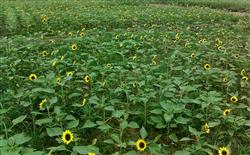 How long is the sunflower's blooming period? How do you manage the sunflower's blooming period? Is there any netizen who knows about this who can help introduce it?
The main blooming period of planted sunflowers is generally from mid-July to mid-August and late August. The sunflower blooming period means that when 75% of the sunflower's ray florets have opened, it enters the flowering stage. The sunflower's blooming period can last more than two weeks, so netizens have enough time to arrange to view them.
The sunflower blooming period is divided into the bud stage, flowering stage and maturity stage. Zhongdi.com has organized management methods for the above three stages, listed below for netizens' reference.
One,Management methods for the sunflower bud stage:
A star-shaped body 1 cm in diameter appears at the top of the sunflower, commonly known as budding. From budding to flowering generally takes about 20 days. It is a period when vegetative growth and reproductive growth proceed together, and it is also the most vigorous stage of its life. During this period, sunflowers need the most fertilizer and water, accounting for about 40%-50% of the total fertilizer and water requirement. If the need for water and fertilizer cannot be met in time during this period, the yield will be seriously affected.
Two,Management methods for the sunflower flowering stage:
When 75% of the plants in the field have opened ray florets, they enter the flowering stage. It generally takes 6-9 days for one flower head to go from the opening of the ray florets to the completion of the opening of the tubular florets. From the second day to the fifth day is the full blooming period of this inflorescence. The number of flowers opening during these 4 days accounts for about 75% of the total number of opened flowers. The flowers mostly open from 4 to 6 in the morning, and pollination and fertilization occur the next morning. Unfertilized stigmas can remain without wilting for 7-10 days.
The seed-setting rate of sunflower self-pollination is extremely low, only about 3%; the seed-setting rate of cross-pollination is high. However, if the temperature is high, there is a lot of rain, humidity is high, light is insufficient, or the soil is dry, the seed-setting rate will be greatly reduced;
Therefore, adjusting the sowing date, timely fertilization and watering, preventing and controlling pests and diseases, and adopting measures such as releasing bees or artificial supplementary pollination can increase the seed-setting rate.
Three,Management methods for the sunflower maturity stage:
From flowering to maturity, it takes 25-55 days for spring sowing and 25-40 days for summer sowing. Different varieties differ. About 15 days after flowering and pollination is the seed formation stage. During this period, clear weather, a relatively large temperature difference between day and night, and suitable soil moisture are needed.
Water and fertilizer management during the sunflower blooming period:
From budding to the basic end of flowering, the sunflower is in the key period for forming seeds and the flower head. During this period, the plant's water requirement accounts for more than 60% of its lifetime water requirement. If the water supply is insufficient, it will cause poor seed development and increase the rate of empty shells. Therefore, during this period, a sufficient water supply should be ensured, and appropriate topdressing can be applied together with watering, with 5-10 kg of urea and 10 kg of diammonium phosphate applied per mu.
Pollination methods during the sunflower blooming period:
Sunflower is an insect-pollinated flower and a cross-pollinated crop. Under natural conditions, it relies on bees and insects to complete pollination and seed setting. When bee sources and insects are insufficient, artificial supplementary pollination can also be used to increase the pollination and seed-setting rate of sunflowers.
For artificial pollination of sunflowers, a cardboard box can be cut into a disc the same size as the flower head, padded with cotton so that the central part is slightly convex, wrapped with flannel or gauze, and a handle tied on the back to make a pollination puff. When pollinating, hold the pollination puff with pollen in one hand and hold the flower head with the other, press the pollination puff onto the flower head with slight pressure and gently pat it a few times so that the pollen falls onto the stigma.
Artificial supplementary pollination should be carried out around 9 a.m., after the dew has dissipated and before 12 o'clock, when there are many pollen grains and their vitality is strong. Generally, it should be carried out two or three times in succession. The first time is when half of the flowers on the flower head have opened, and the second and third times are when the flowers in the center of the flower head have opened.
Control methods for borers during the sunflower blooming period:
The sunflower moth, also known as the sunflower borer, is an important pest on sunflowers. Its larvae mainly bore into and feed on sunflower seeds, causing damage and forming many crisscrossing tunnels. The bitten fragments and feces fill the tunnels and cause serious contamination. After rain, the flower head and seeds become moldy and rot, reducing marketability.
The sunflower blooming period is the activity period of the moth adults. Usually they hide during the day and begin activity in the evening, feeding on nectar, mating and laying eggs on the sunflower flower head. The egg stage is 3-4 days before hatching into larvae.
For the control method of sunflower moth larvae, after 50% of sunflowers have bloomed, use 100 g per mu of Bacillus thuringiensis insecticide with 8000 units/mg, diluted with talcum powder into a dust formulation and sprayed for control.
Click to get more sunflower cultivation techniques
Click to get more food crop cultivation techniques