Causes of Poor Corn Emergence in Spring and Solutions
What should you do about poor corn emergence in spring? What causes poor corn emergence in spring? Experienced growers are asked to help explain. Because spring weather varies greatly, periodic low temperatures and spring waterlogging easily occur. If corn seeds remain in this low-temperature, high-humidity environment for a long time, it can very easily lead to missing plants and broken rows in corn, and death after emergence...
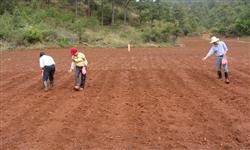 What should you do about poor corn emergence in spring? What causes poor corn emergence in spring? Experienced growers are asked to help explain.
Because spring weather varies greatly, periodic low temperatures and spring waterlogging easily occur. If corn seeds remain in this low-temperature, high-humidity environment for a long time, it can very easily lead to problems such as missing plants and broken rows in corn and death after emergence. Zhongdi Network has compiled the causes of poor corn emergence and the solutions, listed below for growers' reference.
Causes of poor corn emergence:
1. Sowing too deep, exposure to a cold, wet environment, limited soil-cracking ability, and severe missing plants; this is related to the type of hole-punching tool.
2. Spring waterlogging causes herbicide damage to corn seedlings: in normal years, the film of pre-emergence herbicide is at 0-1.5 cm, but after continuous rain the herbicide film moves downward, causing the already germinated corn seeds at 4-5 cm to suffer herbicide damage. The corn seedlings have no root hairs, and the water and inorganic salts that depend on root hairs cannot be transported, so the leaves turn yellow. If not treated in time, they wilt and die.
3. Corn varieties differ in stress resistance: in the same field, different varieties show very different emergence; in adjacent fields, one variety emerges uniformly with green leaves, while another variety has missing plants and yellow leaves. For example, seeds with more starchy content, when the two unfavorable conditions of high humidity and low temperature alternate, will suffer severe missing plants.
4. Soil caused by climatic factors: white pulp soil with greater clay content and better moisture retention has poor emergence because it has poor aeration, the herbicide layer concentrates near the roots with rainwater, and white pulp soil has poor drainage, so the seeds remain in a high-humidity, low-temperature environment for a long time, which is unfavorable for seed emergence; while sandy soil and loam soil drain and aerate well, so emergence is clearly better.
5. Caused by cultivation and ridging method: flat planting without ridges has poor emergence because drainage is poor and soil temperature is low, while ridged land is just the opposite.
6. Caused by corn sowing time: generally around mid-April, several consecutive days of high temperature appear, giving the false impression that the weather is warm and planting can be done early. Some farmers, seeing the good weather, start planting around April 15. Later, according to farmer surveys, the emergence rate for planting around April 22 reached only about 80%, while the emergence rate for planting around April 29 reached as high as over 95%.
Solutions for poor corn emergence:
1. For those with yellowing above ground and no root hairs on pulled corn seedlings due to herbicide damage, spray a plant growth regulator containing trace elements; after three days, most of the yellowed corn seedlings can turn green again.
2. For fields with severe missing plants, quickly dig out the seeds to check the cause. Those that leaf out underground but cannot emerge from the soil, or whose sprouts have died, mostly suffer from herbicide damage, and reseeding should be done at the proper time.
3. In choosing corn varieties, be sure to choose varieties with strong sprout vigor and strong stress resistance. Especially for new varieties, since little is known about their stress resistance, choose cautiously.
4. Be sure to do a germination test, observing sprout vigor, sprout rate, and whether the sprouts are thick and strong, and do not plant based on luck. Luck may mean little problem in a normal year, but once low temperature and continuous rain occur, problems will arise. Therefore, seeds with poor sprout vigor and sprout rate should never be planted, so as to avoid the adverse consequences of poor emergence and serious yield losses.
5. Sowing time should be appropriately delayed, and do not rush to plant early. When low temperature and continuous rain occur, seed rotting easily happens. The best sowing period is after Grain Rain.
Video on growing sweet corn
Methods for high-yield sweet corn