How do you grow summer soybeans to achieve high yields?
How do you grow soybeans in summer to get a high yield? We also ask experienced readers to help list the detailed steps. Soybean is both a food crop and an industrial raw material and feed crop. Its nutritional value is second only to meat, milk and eggs, with a protein content of around 40%, and its branches and leaves can also fertilize and enrich the soil and build up soil fertility, so...
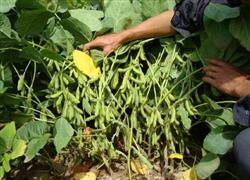 How do you grow soybeans in summer to get a high yield? We also ask experienced readers to help list the detailed steps.
Soybean is both a food crop and an industrial raw material and feed crop. Its nutritional value is second only to meat, milk and eggs, with a protein content of around 40%, and its branches and leaves can also fertilize and enrich the soil and build up soil fertility. Therefore, Zhongdiwang has compiled the methods for increasing soybean yields, and they are listed in detail below for readers to refer to.
Method one, choosing soybean varieties:
For soybean seed, choose seed that is high-yielding, stable-yielding, high-quality, strongly stress-resistant, widely adaptable, with great yield potential and that meets variety standardization, such as Xudou No. 9, Zhonghuang 13, Hedou No. 1, Yudou 22, 25, etc. Seed purity should be no less than 98%, and the germination rate should be above 85%. Sow after careful selection and treatment.
Method two, applying formula fertilization:
The fertilization rate for soybean can be, per mu, organic fertilizer (2000 kg), phosphate fertilizer 30-40 kg, urea 10 kg (of which base fertilizer accounts for 60% of the total, and 40% is applied as a top dressing at flowering), for plots lacking potassium apply 10 kg of potassium sulfate per mu, and apply trace fertilizers such as boron, molybdenum and zinc appropriately as foliar top dressing; fertilization should be mainly base fertilizer.
Method three, sowing soybean early at the right time:
Because sowing early at the right time can increase the protein content of soybean. The suitable moisture content for sowing soybean is 19%-20%. If the soil moisture is insufficient, you should build up moisture or seize the moisture to sow when rain comes; if there is too much water, you should properly drain off moisture before sowing. The sowing depth should be uniform, generally 3-5 cm, the seeds should be evenly distributed, and sowing should be done as early as possible, no later than June 25.
Method four, precise and even sowing:
For soybean, use precise hill sowing, even drill sowing or machine sowing, with a row spacing of 25-40 cm; or use wide-narrow row planting, with wide rows 50 cm and narrow rows 25 cm, sowing depth 3-4 cm, and after sowing level the soil and cover it to preserve moisture, then promptly spray a pre-emergence herbicide evenly to control weeds at the seedling stage.
Method five, management during the soybean seedling stage (mid-June to mid-July, about 20 days):
During the soybean seedling stage, thin and finalize the seedlings in time. Thinning means pulling out surplus seedlings after full emergence and removing weak and diseased seedlings. Finalizing means the last thinning according to the planned row and plant spacing and the number of plants to be retained. Generally thin 2-3 times.
Thinning soybean generally increases yield by 15%-20% compared with no thinning, and especially in years with a large sowing rate, fertile soil and more rain, the increase is even greater. Soybean thinning should be done early rather than late, generally when the soybean cotyledons emerge above the ground and the cotyledons open. Do deep intertillage and weeding to reduce the consumption of soil nutrients by weeds, and at the same time it can cut off soil capillaries, preserve moisture and prevent drought, loosen the soil to promote root development, and has the effect of cutting roots to control excessive growth. Pay attention to controlling bean stem maggot, aphids and red spiders, etc.
Method six, management during the soybean flowering and pod stage (mid-to-late July to early-to-mid August, about 20-30 days):
The flowering and pod stage is when soybean vegetative growth and reproductive growth proceed together and is the most vigorous period of growth and development in the whole life of soybean, requiring large amounts of nutrients and water. Water in time to prevent drought, increase flowers and preserve pods. The soil moisture content is required to be no less than 75-85% of field capacity. Combined with watering, apply 3-4 kg of urea per mu as a top dressing. At the same time, pay attention to controlling bean hawk moth, bridge worm, bean pod borer and fruit borer.
Method seven, management during the soybean seed-filling stage (early-to-mid August to mid-September, about 35-40 days):
During the soybean seed-filling stage, irrigate well for high yield. The main task is to regulate fertilizer with water, nourish the roots and protect the leaves from premature aging. Irrigate and drain reasonably, resisting drought and draining waterlogging.
In the early seed-filling stage, the soil moisture content is required to remain at about 70%-80% of maximum field capacity. If it is below this level, irrigate in time; do not wait until the leaves wilt to irrigate. After heavy rain and rainstorms, clear the ditches and drain in time to prevent poor soil aeration from affecting normal development. At the same time, do foliar fertilizer spraying well to benefit soybean seed filling. Also continue to control bean hawk moth, bridge worm, etc., to protect the leaves from less damage.
Causes of shriveled seeds in soybean
The role of pinching the tops of soybean