What is Bottle Gourd? How to Pinch and Prune When Growing Bottle Gourd
Bottle gourd is also called hu gua (calabash). Bottle gourd is a very popular vegetable, so do you know how it is grown? Would you like to learn about it?
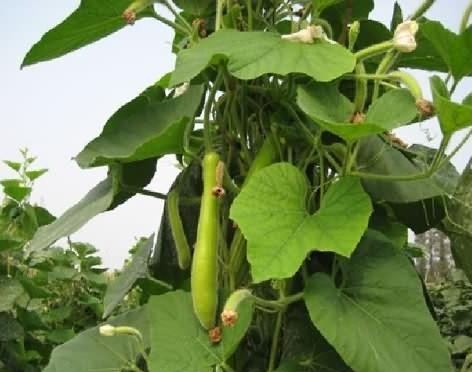
1. Cultivation season: Although bottle gourd can be cultivated year-round in Taiwan, China, the central and northern parts are best planted in March to April, while the southern part is best planted between December and January of the following year, because at this time the temperature gradually rises, and plant development and reproduction are better than with autumn planting, with higher yields as well.
2. Raising seedlings: The seed coat of bottle gourd is relatively thick and light, and does not absorb water easily, so the seeds should first be soaked to promote germination. After soaking the seeds for 48 hours, mix them with a medium, wrap them in a moist towel, and place them at 25 to 30 °C. After 2 to 3 days, when the young sprouts emerge from the seed coat, sow them into a seedling tray to raise the seedlings. The sowing depth should be such that the medium just covers the seeds. When the seedlings have unfolded 3 to 4 true leaves, they can be transplanted to the field.
3. Land preparation and bed making: Bottle gourd cultivation methods include creeping cultivation, horizontal trellis cultivation, single-net vertical frame cultivation, and net-house horizontal trellis cultivation. The row and plant spacing varies depending on the cultivation method. For creeping cultivation, the row and plant spacing is 5.4 to 6 × 1.5 to 2 m, with one-way planting; for horizontal trellis cultivation, the row and plant spacing is 4.8 to 5.4 × 1.2 to 1.8 m. The trellis can be set up in the same way as that for bitter gourd or luffa.
4. Pinching and pruning: To make female flowers appear earlier, pinching should be carried out. The flowering and fruiting habit of bottle gourd is that female flowers are not seen on the main vine (occasionally found above node 30), and the female flowers on the secondary vines are also numerous but do not set fruit. Its main fruiting occurs on nodes 1 to 3 of the tertiary vines and nodes 1 to 2 of the quaternary vines. Therefore, during cultivation, pinch the mother vine once it has 6 to 7 leaves to encourage several secondary vines to develop. When the secondary vines have 5 to 6 leaves, carry out the second pinching. On the tertiary vines, leave 3 to 4 leaves beyond the fruit-setting position and pinch again. On the quaternary vines, leave 2 leaves beyond the fruit-setting position and pinch again. Usually it is better to leave one fruit per vine. For trellis cultivation, after the mother vine is trained up onto the trellis, pinch in the same way.
5. Fertilization and irrigation/drainage: Bottle gourd has a very strong ability to absorb and tolerate fertilizer. Before transplanting, apply 2500 kg per fen of land as base fertilizer, and thoroughly mix 25 kg of ammonium sulfate, 30 kg of superphosphate, and 20 kg of potassium chloride as top dressing. The first top dressing is applied 8 to 10 days after transplanting, with 1/5 of the total amount applied in a ring beside the plants; the second application is after pinching, with 1/5 of the total amount; the third application is during the fruit-swelling stage, with 2/5 of the total amount; the remaining 1/5 is applied as top dressing during the harvest period, while also applying an appropriate supplementary amount on the bed surface depending on growth conditions. As for irrigation and drainage, bottle gourd is drought-tolerant and moisture-tolerant, but to obtain high-yield, high-quality calabash, attention should still be paid to field irrigation and drainage, and the soil should not be allowed to become too dry or too wet.
6. Pest and disease control: Common diseases of bottle gourd include downy mildew, powdery mildew, anthracnose, and viral diseases. Insect pests include aphids, fruit flies, melon borers, and thrips. For control methods, please refer to the plant protection manual.
7. Harvesting: For calabash used as a fresh-eating young fruit, the suitable harvest standard for long bottle gourd young fruit is about 22 cm long, about 7 cm thick, and about 600 grams in weight. Leave 1 to 2 cm of the fruit stalk when cutting it off. If harvesting is too late, not only will the flesh become coarse and loose and the seeds become coarse and hard, resulting in poor quality, but it will also waste the plant's nutrients and affect the plant's growth vigor.