What Is the Water Chestnut? A Detailed Guide to Water Chestnut Cultivation and Deep-Water Planting Methods
Water Chestnut Planting Site Selection The water chestnut, also known as ling, belongs to the genus Trapa in the family Trapaceae and is an annual aquatic crop. The water chestnut is suited to surviving in hot, humid swamp or paddy field environments. So how exactly is it planted? Let's take a look together and try growing it yourself!
Water Chestnut Planting Site Selection: In tropical regions, low-lying swamps, ponds or paddy fields with a water depth of about 15-60 cm are all suitable for planting. The optimum temperature for growth and fruiting is 25°C to 36°C, and fertile loam with a pH of 5.6 to 6.8 is most suitable for water chestnut growth. Water chestnuts grown in running water taste the most delicious! The main varieties fall into two systems: blunt-horned short-spined and sharp-horned long-spined.
Water Chestnut Seeds - Seed Saving: Water chestnuts are grown from seed, and must be sown from seed every year. The quantity of seed required per unit area is large, with 5-7 kg of water chestnuts needed per 0.1 hectare. Selecting superior water chestnut seeds for saving will determine the quality and yield of the water chestnuts the following year. Fruits that are fully mature have a high germination rate, and large, intact, plump and well-filled fruits are the most important point in saving water chestnut seed. It is best to select them using a moderate saltwater specific gravity (about 1.2), keeping the water chestnuts that sink, and then carry out selection by water chestnut shape. If only a small amount of seed is to be saved, experienced farmers often pick out seeds for saving by hand at the end of the harvest season.
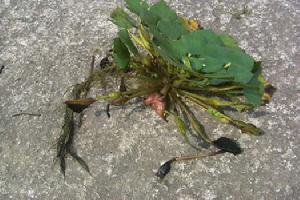
Water Chestnut Sowing and Seedling Raising: Place the selected high-quality mature water chestnuts into the water of the water chestnut field and wait for them to germinate. A germ pore will grow an hypocotyl, which then grows into a stem that extends upward, emerges above the water surface and grows leaves. The division method can also be used. Place the superior seed saved in November-December of the previous year in a large water-storage container, changing the water every 3-4 days to prevent rotting, or place it in a mesh bag stored at the bottom of a pond where the water level can be maintained. In Taiwan, China, the natural low-temperature period is short, and the low-temperature requirement for breaking dormancy of water chestnut seed is also not high. Water chestnuts placed in shallow water areas can germinate successively as early as January, and when they are about 5 cm they can be transplanted into a small shallow-water nursery. Care must be taken to mark them with bamboo sticks to prevent volunteer seedlings from leftover water chestnuts of the previous year from mixing in.
Water Chestnut Field Land Preparation and Transplanting: In current cultivation, mostly after the previous rice harvest is finished, from late April to mid-May, a large tractor is used to plow the field, and one week after irrigation, transplanting can be carried out. The nursery seedlings are multi-branched clustered shoots; take 3-5 vines, tie them into a bundle and press-plant them into the subsoil to fix them. 300-500 plants can be transplanted per 0.1 hectare. Except that poor soil fertility tends toward dense planting, different planting densities make little difference to the total harvest and quality over the whole period. Dense planting gives higher early yields, and early purchase prices are higher, making production more profitable. It was previously thought that excessively high planting density was the main cause of the severe occurrence of anthracnose in recent years, but experimental investigation results show that its effect on water chestnuts is not great.
Water Chestnut Field - After Fertilization: The water chestnut planting period lasts more than half a year, and fertilization technique has a deep influence on water chestnut yield and quality. Generally, before plowing, 1,000 kg of decomposed compost should be mixed in per 0.1 hectare. In the early stage of transplanting, fertilizer should not be applied heavily to prevent rapid growth of algae, and excessive vegetative growth will delay harvest and reduce flowering and fruiting of water chestnuts, reducing yield. When the water chestnut mat is about to cover the water surface, depending on the condition of the plants, some urea can be applied in spots to promote vegetative growth, until the mat becomes dense and gradually enters the water chestnut harvest period. At this time the water chestnut plants bear many fruits, so after each harvest a compound fertilizer can be applied (such as Taiwan Fertilizer No. 43, 8 kg; the water chestnut fruits grown this way will be much plumper than the rest), with at least six fertilizer applications, and at the late stage a further appropriate amount can be applied. Although spraying urea on the leaves is also suggested to facilitate rapid absorption of nitrogen fertilizer, care must be taken that excessive nitrogen fertilizer is easily accompanied by severe anthracnose and reduces water chestnut quality.
Water Chestnut Field Irrigation Water Source: In the early stage of planting water chestnuts, a relatively low water level should be maintained. When the plants grow until the water chestnut mats densely touch one another, the paddy field water chestnuts should maintain a water depth of 60 cm. In summer, if the water level is too shallow, the water temperature rises rapidly, and excessively high water temperature easily causes insufficient dissolved oxygen in the water, obstructing root respiration and indirectly affecting nutrient absorption and plant growth. In the late stage of plant growth, keep the water level stable, and it is advisable to change it little. In areas where water supply is not a concern, using running water for planting, or moderately changing the water in the late planting stage, will help improve yield and quality and can extend the harvest period.