Eggplant Verticillium Wilt: Symptom Identification and Control Methods
Verticillium wilt is one of the major diseases in the growth of eggplant, and this disease is becoming more and more serious, and the worsening of this disease has also seriously affected the yield and quality of eggplant. Therefore, chemical control should be carried out according to the characteristics of the occurrence of this disease. How exactly should it be done? Let's take a look together below.
I. Occurrence Pattern
Verticillium wilt of eggplant is caused by infection with the fungus Verticillium dahliae. The pathogen overwinters in the soil as dormant mycelium, chlamydospores and microsclerotia along with diseased plant residues, becoming the primary infection source for the following year. The pathogen can survive in the soil for 6 to 8 years. The pathogen spreads to disease-free fields through fertilizer mixed with diseased plant residues, contaminated soil and solanaceous weeds, and by wind, rain, people, livestock and farm tools. The optimum temperature for the disease to develop is 19°C to 24°C, and the mycelium and sclerotia are killed after 10 minutes at 60°C. Generally, when the temperature is low, root wounds heal slowly at transplanting, which favors pathogen invasion; from transplanting to the flowering stage, when the daily average temperature stays below 15°C for a long time, the disease occurs early and severely; low-lying terrain, application of undecomposed organic fertilizer, improper irrigation and continuous cropping plots all lead to severe disease.
II. Symptom Identification
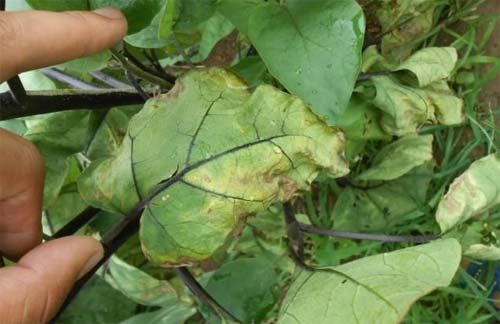
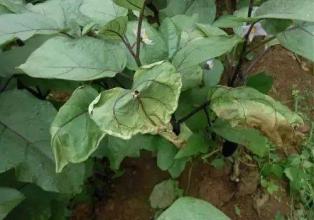
Eggplant Verticillium wilt can occur soon after transplanting; when transplanting is done under low temperatures, the disease occurs early and severely, but the largest affected area and the most severe condition occur after fruit set. At the initial stage of the disease, the leaf margins near the petiole and the areas between the veins on the lower leaves of one side of the plant turn yellow, and the leaf margins curl slightly upward. Sometimes the lesions are limited to one side of the leaf, causing the leaf to distort. In the early stage, affected eggplant plants appear wilted and can recover in the morning and evening or after rain, after which the leaves turn brown, the whole plant wilts, the leaves drop completely, and the entire plant dies. When the disease develops rapidly, the whole leaf often turns yellow and wilted, then brown and dies. This disease mostly affects the whole plant. A few plants still retain some healthy branches. When the disease occurs, it usually develops gradually from the lower part of the plant upward, and in severe cases all the leaves of the whole plant drop off. Affected plants are short, with a non-spreading plant shape and small fruits, and long fruits are sometimes curved. When the root and stem are cut longitudinally, the vascular bundles of the xylem can be seen to be discolored, appearing yellow-brown or brown.
III. Control Techniques
1. Seed soaking before sowing. Before sowing, soak the seeds with 30% Junwujun emulsifiable concentrate at 1000 times dilution for 5 to 6 hours.
2. Chemical treatment before transplanting. When transplanting eggplant seedlings, soak the seedlings in 50% Binghaijue wettable powder at 2500 times dilution; if raising seedlings in nutrient pots, spray evenly with 50% Binghaijue wettable powder at 2500 times dilution before transplanting.
3. Control at the seedling stage. Apply chemicals for control at the initial stage of the disease, for 3 consecutive times, and you may use 50% Binghaijue wettable powder at 2000 times dilution, 30% Junwujun emulsifiable concentrate at 2000 times dilution, and 10% Shajunyou aqueous solution at 1500 times dilution alternately.
4. Control at the fruiting stage. From the initial stage of the disease until the end of fruit harvest, spraying must be continued for control, with an interval of 7 days each time. For application, spray with 5% Binghaijue wettable powder at 1500 times dilution, 10% Shajunyou aqueous solution at 1000 times dilution, 12% Lujunling oil at 1200 times dilution, etc. When controlling Verticillium wilt, in combination with spraying, attention should be paid to foliar topdressing; add 30 grams of monopotassium phosphate and 50 grams of urea to each sprayer bucket of the chemical solution, which can enhance the stress resistance of the crop and improve the quality of the eggplant.
We cannot prevent this disease from occurring, but we must know how to prevent and manage it, so that we can ensure better quality of the eggplant.