How to prevent and control bacterial wilt in tomatoes? Detailed explanation of the best treatment methods
Tomato bacterial wilt is a very serious disease in tomato cultivation. If it is not managed well, it can easily cause major damage. So how should it be managed? Let's take a look together.
Pathogen:
This disease is caused by Pseudomonas solanacearum. The bacterium belongs to the non-fluorescent pseudomonad (non-fluorescent pseudomnonad), is Gram-negative, rod-shaped, 0.5-0.7×1.5-2.5μm in size, mostly non-motile, but a few have polar flagella, and the cells accumulate poly-β-hydroxybutyrate (poly-β-hydroxybutyrate) granules. On TZC medium it forms irregular round or oval, sticky comb-like colonies with a red center and white surroundings. This colony morphology can be used for simple identification of the bacterial wilt pathogen. The bacterial wilt pathogen is highly variable. According to differences in pathogenicity or infected host, it can be divided into four or five races. The pathogens isolated in Taiwan, China all belong to race 1, that is, the race with the widest host range, capable of infecting many solanaceous plants, but within this race, it is further subdivided into at least eight pathotypes according to differences in the host species harmed. In addition, based on differences in physiological and biochemical characteristics, the bacterial wilt pathogen can be divided into four biovars. The bacterial wilt pathogen isolated in Taiwan, China belongs to biovar III or IV, but very few strains are biovar II.
Symptoms:
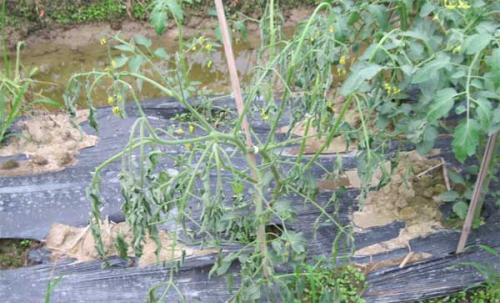
The symptoms of this disease are affected by plant age, the speed of disease progression and environmental factors, but the main symptoms are rapid wilting, stunting and leaf yellowing. In spring and summer, when temperatures are high and humidity is abundant, and tomatoes are growing vigorously, it is often seen that after rain clears, originally emerald-green tomatoes have drooping leaves within a few days and rapidly wilt and die, but the diseased plants still remain green, showing wilt symptoms, hence the disease is called "bacterial wilt". If the tomato plants are older or environmental factors are unsuitable, causing slower disease progression, leaf epinasty can first be seen, with heart leaves curling, then leaves wilting from top to bottom, and adventitious roots appearing on diseased stems; sometimes the disease progresses halfway and suddenly stops, causing the plant to become stunted, leaf veins to turn black, and leaves to slowly yellow. If the diseased stem is cut open, the vascular bundles can be seen turning brown. If the diseased stem is squeezed by hand, white ooze will overflow from the cut surface of the diseased stem (Ooze). The most convenient and reliable method to diagnose this disease is to cut the diseased stem into small sections, then split them lengthwise into two halves, throw them into a transparent glass filled with water, and after standing for several minutes, milky-white smoke-like streaks can be seen coming out around the diseased stem. This milky-white smoke-like streak is composed of the pathogen of this disease. If the above phenomenon is present, it can be judged as tomato bacterial wilt.
Disease cycle and outbreak environment:
This pathogen is a soil-borne pathogen. The pathogen surviving in the soil can invade the plant through wounds on the host roots, and multiply in large numbers in the xylem of the vascular bundles, producing slimy polysaccharides (Slimy polysaccharide) that block the vessels, impede water transport, and cause tomato plants to wilt and die. This pathogenic bacterium reproduces in the plant body and survives the winter in plant residues and soil. According to literature, this pathogen can survive for as long as ten years in soil continuously planted with non-host plants, and can also persist for more than four years in fallow fields. Soil temperature of 25~30°C and pH 6.2~6.6 moist soil are good environments for the survival of the pathogen. Diseased plants can also release large amounts of the pathogen from the roots into the soil, thereby infecting the roots of nearby healthy plants. This root-to-root disease transmission has been confirmed to occur in the field. This mode of transmission may be one of the reasons why, if only some plants in the field are harmed, the disease can gradually spread and cause most plants to become diseased. Seedlings raised in propagation beds contaminated with the pathogen may sometimes appear disease-free but may already be latently infected by the pathogen. After transplanting into the main field, the disease can spread along with the seedlings. In addition, shoes and farm tools with attached soil may also transmit the pathogen. It is generally believed that the bacterial wilt pathogen can survive in soil for a long time, but the length of survival varies among different strains and is also affected by soil environmental factors. Moist soil is suitable for the survival of the pathogen, while dry and flooded soil are unfavorable for its survival; acidic soil is also less suitable. The occurrence of the disease is closely related to temperature and soil moisture. High temperature and humidity are most suitable for disease development. Usually, disease does not occur much when the temperature is below 20°C, and low soil moisture is also unfavorable for disease development. Therefore, tomatoes planted in summer or in hot and humid seasons have a high disease rate and severe damage, while those planted in winter have fewer occurrences. Soil texture seems to have no relationship with the occurrence of the disease, and the soil pH in most cultivated crop fields in Taiwan, China is also suitable for the occurrence of this disease. If root-knot nematodes are present in the soil, they can promote the infection rate of the pathogen and increase disease occurrence.
Host range: The host range of the bacterial wilt pathogen is very broad, and it can infect more than two hundred kinds of plants. In Taiwan, China, the common hosts are solanaceous plants, such as tomato, tobacco, sweet pepper, eggplant, potato, etc. It can also harm groundnut, bird of paradise, strawberry and perilla.
Control methods: Cultivate disease-resistant varieties: Tomato lines differ in susceptibility to the bacterial wilt pathogen. Disease-resistant varieties are currently available, but highly resistant cultivated varieties still need to be bred. Resistance breeding must be carried out locally to breed varieties with resistance to local strains. Disease-resistant varieties bred abroad do not necessarily have resistance locally.
Use healthy transplant seedlings: Avoid using field soil containing the pathogen as a seedling bed.
Crop rotation: Rotate with non-host crops, especially with rice, which is most effective. Usually, when rice is the previous crop, it can reduce the concentration of the pathogen in the soil and reduce disease occurrence.
Apply soil amendments: Greenhouse tests have confirmed that SH soil amendment can effectively control bacterial wilt. Field trials still need to be conducted. If it has the same effect, it will be great news for the control of bacterial wilt.
Biological control: Antagonistic bacteria on the roots have a strong inhibitory effect on the bacterial wilt pathogen. If practical antagonistic strains can be selected, biological control can also achieve disease prevention effects. For biological control to become practical, long-term research and development are needed.
Other cultivation measures: Choosing autumn and winter cultivation, plowing and sunning or flooding the soil during fallow periods, removing remaining diseased plants and weeds in the field, avoiding replanting in diseased fields, and avoiding introducing irrigation water from diseased fields can all prevent or reduce disease occurrence.