With apple-growing skills, returning home to grow apples beats a 10,000-yuan monthly salary
Li Qingjun often spends time with fruit growers, discussing apple-growing knowledge. Photo provided by the interviewee. Our reporter Li Jing. He once worked at a listed company in Shenzhen, engaged in securities and investment and financing work, with a monthly salary of over 10,000 yuan. This white-collar worker whom everyone envied chose to return
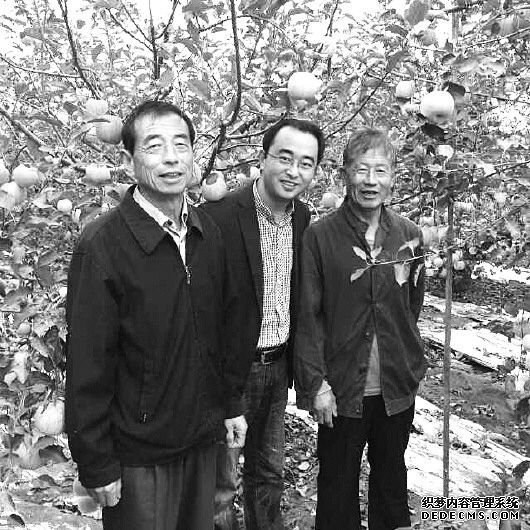 |
Li Qingjun often spends time with fruit growers, discussing apple-growing knowledge.
Photo provided by the interviewee
Our reporter Li Jing
He once worked at a listed company in Shenzhen, engaged in securities and investment and financing work, with a monthly salary of over 10,000 yuan. This white-collar worker whom everyone envied chose to return to his hometown to farm after the company went public. He is Li Qingjun, a member of the "post-80s" generation, who has been promoting the Yantai apple industry. In 2012 he resigned and came to Qixia to start his apple dream. After several years of exploration and hard work, he launched an orchard trusteeship service. He wants to build a link for the apple industry and complete the integration of resources across the entire apple industry chain.
Giving up white-collar work to go home and farm
When the reporter recently met Li Qingjun, he was in a suit and leather shoes, making it hard to imagine him usually slogging away in the orchard all day, covered in mud. The reason he was dressed like that was simply that he was going to Beijing to attend a meeting of the China Good Apple Producing Area Alliance. He said that to do a good job in the apple industry, one must communicate more with others.
After graduating from Northwestern Polytechnical University in 2007, Li Qingjun chose to go to Shenzhen to make his way, joining a technology company in Shenzhen. From a human resources position to securities affairs representative, over five years he rose from the grassroots to middle-level leadership, with a monthly salary of over 10,000 yuan. Because he participated in the entire process of the company's listing, he also became one of the company's core management. Just when everyone thought his future was bright, in July 2012 he resolutely resigned and went home to farm.
"Many people say I am foolish, and some elders even think my education was all for nothing." Li Qingjun said the pressure at the time was great, but what he saw was the longer-term development prospects of the Yantai apple industry. "Yantai apples are good in quality and deeply loved by everyone, but there is a lack of brand awareness, and no standardization or commercialization has been formed."
During a holiday one year, Li Qingjun returned to Qixia, saw that the apples were big and red, and took some photos to post on WeChat Moments. Unexpectedly, after friends saw them, they asked him one after another to help buy some on their behalf. After receiving the apples, friends praised the authentic taste, which in turn prompted other friends to rush to buy them. After this back-and-forth, Li Qingjun thought: since so many people want to eat authentic Qixia apples, why not specially open up a reliable quality sales channel?
Selling apples via WeChat, attracting 20,000 followers in one day
After resigning, Li Qingjun came to Yantai and plunged into the orchard, beginning a life in the mountains and fields. From pruning, branch bending, flower thinning, and fruit thinning to fertilizing, watering, and preventing insects and birds, from bagging, bag removal, and mulching to picking, storage, packaging, and logistics... for two years he was either in the mountains and fields or on the way to them, coming and going among the mountains.
After returning to Yantai, Li Qingjun at first learned about apple market conditions through various channels, rushing to various apple trading markets, watching fruit growers and vendors bargaining, and gauging what price levels apples of different grades were at. He searched online to see how online shops operate and sell. After exploration and learning, he positioned himself on the WeChat platform and began his entrepreneurial path in November 2012.
Li Qingjun named himself "Apple Prince." By the end of 2012, after nearly two months of operation, his personal WeChat account had more than 2,000 followers. "These followers were mostly friends from QQ and WeChat, and many were friends and acquaintances, so the level of trust was higher than that of customers on platforms like Taobao." Li Qingjun said that when conditions were better, the personal WeChat account he operated achieved monthly sales of more than 100,000 yuan.
On December 12, Li Qingjun led the planning of "12 Apples," gathering apples from 12 domestic producing areas for unified packaging and sale in Yantai. Within 24 hours, 5,200 boxes of apples were sold via WeChat and Weibo, gaining the attention of more than 20,000 followers, becoming a model of innovative fresh-produce sales on the mobile internet.
Registering a company and establishing a cooperative
Through his exploration, Li Qingjun found that his energy was limited and that one person simply could not handle everything. In April last year, Li Qingjun officially formed his own team and established Yantai Aiguole Ecological Agriculture Technology Co., Ltd.
"There are many fewer varieties available now, and most are concentrated in Red Fuji. Varieties like Ralls Janet are rarely seen on the market." Li Qingjun said that today's apple orchards, after years of soaking in chemical fertilizers and pesticides, make it hard for the taste to return to what it was 20 years ago. There is a great need for a group of new farmers who insist on ecological planting, to pass on the true taste of the place of origin through them.
“In Singapore apples are sold individually; their apples have already achieved commercialization and standardization." Li Qingjun said that currently there is no standard for selling apples, and there are no universal specification standards for size, sweetness, skin finish, and so on. "In terms of sales methods, the main ones are wholesale markets, supermarkets, and fruit chain stores. Internet fresh-produce e-commerce has also just started, and at the same time it is very troublesome that standardized suppliers cannot be found, with no 'standard parts' like Xiaomi phones." Li Qingjun said that the aging of fruit growers is very obvious, and it is difficult to make major changes in orchard management methods and standardized selection.
After investigation and research, Li Qingjun launched the orchard trusteeship model. "Simply put, the fruit growers hand the orchard over to us, and only need to pay us some management fees. We carry out unified watering, fertilizing, pruning, and picking, manage the whole process, build a brand, and finally sell the apples directly to customers through our sales channels, cutting out the intermediate links and transferring the profits to the fruit growers." Li Qingjun said that in this way, with the apple industry as the core, the focus is on providing orchard field management services. So far, in the Qixia cooperative, there are 268 fruit-growing households, 1,980 mu of apples, and 360 mu of cherries. (Source: Qilu Evening News)