-
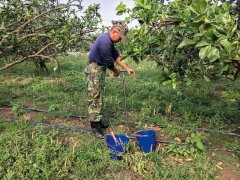
How Is Soil Fertility Tested? Fertility Characteristics of Soils with Different Textures and Rational Fertilization
Soil is the foundation of crop growth. During cultivation, applying too much fertilizer not only wastes fertilizer resources and pollutes the environment over the long term - for example, nitrogen fertilizer polluting groundwater and excessively high nitrate concentrations in plants - but also easily causes the soil to become "sick" and degraded, making it difficult to provide
-

A Detailed Guide to the Cultivation Techniques and Management Key Points of the Rose Apple
The rose apple is highly adaptable and can be planted in all kinds of soil. It mostly grows beside water and in river valley wetlands, and also grows well on sandy soil. Fertile, deep and moist soil is best. I. Regional Selection: A location with ample sunlight and a hot, humid environment; choose fertile, loose,
-
Which Chinese medicinal herbs are suitable for different soils?
Our country has a vast territory and abundant land resources, and there are many kinds of soil in different regions, such as pure sand, semi-sandy soil, loess, Northeast black soil, clay, etc. However, the planting of Chinese medicinal herbs also depends on the soil, and medicinal herbs should be planted according to local conditions. Choosing suitable varieties to plant in different soils can achieve twice the result with half the effort, and the yield will also increase.
-
How can fertilizer be applied effectively when soils differ in nutrient-holding capacity, nutrients, and acidity or alkalinity?
Applying different fertilizers and adopting different fertilization methods according to the properties of the soil is called soil-specific fertilization, so how can fertilizer be applied effectively to soils that differ in nutrient-holding capacity, nutrients, and acidity or alkalinity? The most basic and effective methods are: 1. The nutrient-holding capacity and nutrient-supplying characteristics of the soil
-
Improving the Effect of Phosphorus Application on Newly Reclaimed Red Soil Fields and the Feasibility of High-Rate Phosphorus Application on Phosphorus-Deficient Soils
Newly reclaimed red soil fields have a low total phosphorus content (generally below 0.4 g/kg) and high iron and aluminum contents. The phosphorus in the soil exists mainly as iron and aluminum phosphate compounds, which are not easily absorbed and utilized by crops. Therefore, when planting crops and economic forest trees in newly reclaimed red soil fields, emphasis should be placed on increasing phosphorus application.
-
What types of calcium fertilizer are there? These soils and crops are prone to calcium deficiency
The calcium fertilizers commonly used in production at present include quicklime, containing 94%-96% calcium (CaO); hydrated lime, formed by quicklime absorbing water, containing 64%-7526 calcium; carbonate lime, made by grinding limestone and marl, whose main component is calcium carbonate; and gypsum, whose main component is calcium sulfate.
-
Where in our country are alpine desert soils distributed? What is suitable for growing there?
Alpine desert soil, also called cold desert soil, has as its parent material mainly residual and slope deposits from the weathering of various rocks, and also some glacial till. Organic matter accumulation in the soil is weak, 0.4-0.6%, salt content 0.5-1.6%, and calcium carbonate accumulation is obvious. White salt efflorescence and crusts are seen on the surface, mostly
-
Where in China are alpine meadow soils distributed, and what is suitable for growing on them?
Alpine meadow soil refers to soil developed under meadow vegetation above the closed canopy line of alpine forests. In China it was once called grass felt soil. Its main features are: the surface is layered or mound-shaped due to frequent frost cracking and soil sliding; the surface layer is a soft and tough grass felt layer interwoven by grass roots. Alpine
-
Where in China are brown calcic soils distributed, and what crops are suitable for growing there?
Brown calcic soil is an arid soil that forms a transition from chestnut soil in the temperate dry steppe zone to gray desert soil in the desert zone. Its formation is dominated by the humus accumulation process and calcic process of steppe soils, and it also has some characteristics of desert soil-forming processes. It has a thin humus loamy
-
Where in China are chestnut soils distributed, and what are they suitable for growing?
Chestnut soil, as the name suggests, is a chestnut-colored soil formed under a temperate semi-arid climate and the natural vegetation of dry steppe. It has a soft surface horizon and a calcic horizon somewhere within 1 m. The typical profile configuration is Ah-Bk-C. The entire profile is base-saturated,
条件筛选