How Is Soil Fertility Tested? Fertility Characteristics of Soils with Different Textures and Rational Fertilization
Soil is the foundation of crop growth. During cultivation, applying too much fertilizer not only wastes fertilizer resources and pollutes the environment over the long term - for example, nitrogen fertilizer polluting groundwater and excessively high nitrate concentrations in plants - but also easily causes the soil to become "sick" and degraded, making it difficult to provide
Soil is the foundation of crop growth. During cultivation, applying too much fertilizer not only wastes fertilizer resources and pollutes the environment over the long term - for example, nitrogen fertilizer polluting groundwater and excessively high nitrate concentrations in plants - but also easily causes the soil to become "sick" and degraded, making it difficult to provide elements for crops to absorb, which in turn affects yield and quality.
Therefore, agricultural authorities strongly promote rational fertilization, which can avoid excessive fertilizer application and also benefits the sustainable use of farmland. Rational fertilization means that farmers adjust the amount and method of fertilizer application according to the growth characteristics of the crop variety, the soil conditions and characteristics, the types and characteristics of fertilizers, and the growth response of crops after the fertilizer is applied to the soil.
But how exactly should rational fertilization be carried out in practice? Huang Jui-chang, associate researcher in the Crop Environment Division of the Tainan District Agricultural Research and Extension Station (hereinafter referred to as the Tainan Station) under the Council of Agriculture, Executive Yuan, known as a "soil nutritionist," explains that rational fertilization includes 3 steps: first, sample the soil for fertility analysis; next, fine-tune fertilization according to crop growth conditions and climate changes; finally, because fertilizer is not 100% absorbed and utilized by crops after application, efforts must be made to improve fertilizer use efficiency.
Soil Fertility Analysis Report: An Important Basis for Rational Fertilization; In today's world, where science and data are increasingly valued, the "soil fertility analysis report" is an important reference for farmers when adjusting fertilizer application rates and improving fertilizer application efficiency during rational fertilization. At present, agricultural research institutes and extension stations provide free soil fertility analysis services, and they write articles and hold workshops to teach farmers how to sample. Farmers can also pay at their own expense to entrust institutions with laboratory accreditation to conduct testing.
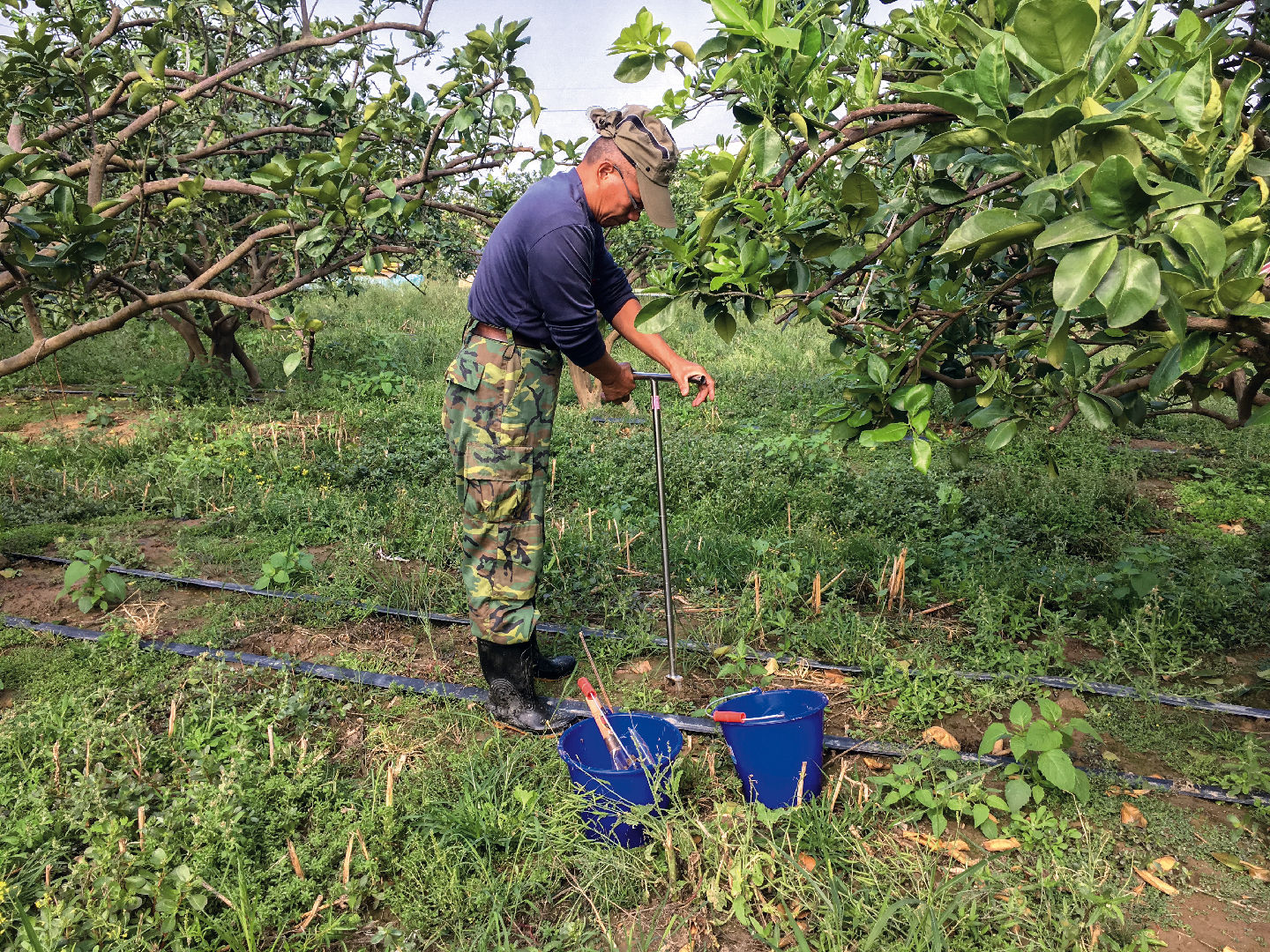
Huang Jui-chang reminds farmers that when sampling, tools such as round-point shovels, transplanting trowels or soil augers must be cleaned thoroughly. Remember that the soil should not be too wet, and try to send soil samples to the testing unit 3 to 4 weeks before applying base fertilizer. Regarding sampling frequency, short-term crops such as leafy vegetables should be sampled and submitted for testing at least once a year, and it is not necessary to sample every crop season; for long-term crops such as fruit trees, sampling and submission can be done once every 1 to 2 years.
To hold the soil sample, you can use sample bags made by the extension station, or use a clean plastic bag, and write your name, address, contact phone number, crop type, section and parcel number, etc. on the sample bag. After sending it to the agricultural research institute or extension station, you can receive the soil fertility analysis report in about 2 to 3 weeks.
Agricultural authorities provide thoughtful annotations, so farmers can understand the report at a glance
The soil fertility analysis report contains 7 categories of items: soil electrical conductivity (EC), soil pH, soil organic matter, soil available phosphorus, potassium, calcium and magnesium. Huang Jui-chang adds that some farmland is saline land, and agricultural extension stations will additionally test sodium, so that sodium ions in the soil do not affect soil aggregate structure and hinder crop absorption of potassium and calcium ions and root growth. When farmers receive the soil fertility analysis report, in addition to listing the test values of the 7 categories of items, values that are too high are marked in red, while blue indicates that the value is relatively low and can be further strengthened. The report also includes fertilizer recommendations for the grown crop from agricultural extension station researchers, so farmers are no longer confused when interpreting the report.
Different nutrients have antagonistic effects. If certain elements are difficult to absorb, the deficient elements can also be supplemented through foliar fertilizer. Huang Jui-chang says that for general short-term crops, referring to the soil fertility analysis report and improving fertilizer application efficiency is sufficient; if farmers want to understand the absorption status and nutritional disorders of long-term crops such as fruit trees, they can further conduct plant tissue (leaf) nutrient diagnostic analysis. For the sampling position and timing of different crops, they can refer to information on the websites of agricultural research institutes and extension stations, or call to ask.
As for insufficient soil organic matter in the report for growing small-fruit tomatoes, it will reduce soil aggregate structure and nutrient availability. Huang Jui-chang says that if it is sandy soil, good drainage is less of a problem. It is recommended to apply low-nutrient organic compost with high plant crude fiber content, such as bark compost, bagasse compost, cow manure compost, straw or rice husk compost, at about 600 to 800 kg per fen; however, the disadvantage of sandy soil is that it does not easily retain fertilizer, so fertilizer must be applied in small amounts many times, and the recommended fertilizer amount should be increased by 10% to 20%.
Because each piece of farmland has different characteristics, researchers at agricultural research institutes and extension stations must act like detectives, considering local soil characteristics, whether farmers use open-field or protected cultivation, and based on crop type and commonly used fertilizers, unraveling the details one by one and evaluating each value before making the most suitable fertilization recommendation. Huang Jui-chang also uses another small-fruit tomato farmer's soil fertility analysis report as an example. The report shows a pH of less than 5.5, electrical conductivity of 2.3 dS/m, phosphorus of more than 500 mg/kg, and potassium of more than 1,500 mg/kg. Not only is the soil acidic, but electrical conductivity, phosphorus and potassium are also much higher than normal values.
"It may be that the farmer over-applied phosphorus and potassium fertilizer to make the fruit sweeter, creating 'false acidity'; true acidity would show relatively low calcium and magnesium." Huang Jui-chang says this situation is very common in protected cultivation, because without rainwater leaching, fertilizer easily accumulates excessively, so magnesia lime cannot be used to improve it, lest electrical conductivity become even higher. Instead, farmers should be advised to wash salts to leach out acid radical ions, and the pH will naturally rise again.
In order to give farmers a basis before fertilizing, agricultural research institutes and extension stations now almost all try to send soil fertility analysis reports to farmers within about 2 weeks. Huang Jui-chang says that usually during autumn crops or spring crops, the number of soil samples submitted for testing is larger. Because the jurisdiction of the Tainan Station covers agricultural counties and cities such as Yunlin, Chiayi and Tainan, in September to October this year, for example, it received more than 1,000 samples per month on average, and the time farmers wait for reports may be extended to 3 weeks.
The 7 categories of fertility analysis items are analyzed by instruments to obtain data, and professionals check whether the data are normal, then compile them into a soil fertility analysis report, which is handed to experts responsible for different crops to write fertilization recommendations and send to farmers. Only then is the task complete. Taking the Tainan Station as an example, it has different experts responsible for rice, small-fruit tomato, muskmelon, coarse grains, flowers and organic crop cultivation. They are assigned to write fertilization recommendations according to their respective expertise, and contact phone numbers are attached. If farmers still have questions after reading the report, they can call to ask, or join the agricultural extension station's dedicated social media group. For example, the Tainan Station has a LINE@ life circle, where farmers can immediately upload photos or write messages to ask about crop nutrition and pest and disease management methods.
Of course, after farmers receive the soil fertility analysis report, it does not mean everything will be foolproof from then on. Huang Jui-chang says the report cannot predict the climate and crop growth conditions 2 to 3 months later. Farmers should still continue to accumulate experience, fine-tune fertilization according to crop growth conditions and climate changes, and usually attend agricultural workshops to increase relevant knowledge.
The soil fertility analysis report can be said to be the painstaking work of laboratory personnel at agricultural research institutes and extension stations. A reliable report depends on correct soil sampling methods, sample pretreatment, operation and maintenance of analytical instruments, and interpretation of figures. Through soil health checks, farmers can be helped to discover and adjust soil problems early and move increasingly toward the goal of rational fertilization.