-

How to prevent and treat root rot in orchid cultivation? Sharing practical methods
How to prevent and treat root rot in orchid cultivation? Please explain the causes and methods. Main causes of orchid root rot: first, improper watering, too much rain, or an unreasonable potting soil structure with poor drainage, and sometimes pathogen invasion can also cause root rot. Root rot causes orchid leaves to turn yellow, shrivel, and drop, and sometimes even the pseudobulb (base of the stem) rots away,...
-
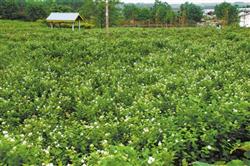
How to manage jasmine during its flowering period? Sharing practical care tips
How to manage jasmine during its flowering period? Please give an introduction and guidance. Jasmine begins to bloom successively from early summer, and with proper management, it can produce three peak bloom periods. In early June, jasmine successively produces early flowers, but these flowers are generally small and few and should be removed promptly; otherwise they consume too many nutrients, which will affect the quality and quantity of later blooms, and ...
-

How to prevent and treat rose rot? Sharing practical methods
Roses have brilliant colors and a pleasant fragrance. They are a famous raw material for fragrances, and also a flavoring raw material for smoking tea, making wine, and various sweet foods. Their value is very high, and on the international market, the price is higher than gold. Roses like sunlight, so the cultivation site should be chosen in a sunny, dry place; they do not bloom easily in shaded areas. As for soil and climate...
-

How to deal with root rot in Cymbidium orchids? Sharing practical remedies
How to handle root rot in Cymbidium orchids
-

How to prevent and control lily bulb stalk rot? Sharing practical tips
(1) For soil preparation, choose loose, fertile loam soil with good drainage. During soil preparation, broadcast fully decomposed organic fertilizer at 5 cubic meters per mu, and deep plow 30-35 cm. Then make beds at a width of 110-120 cm with 50 cm walkways, and then broadcast 10-15 kg of calcium superphosphate, 4-6 kg of potassium sulfate and 0.8-1.0...
-

-

How to Grow Orchids? Sharing Two Practical Care Tips
I. Notes on Overwintering Management of Orchids Orchids generally need to be moved indoors or into a greenhouse for cultivation by mid-November; if moved too late, they are prone to frost damage or even freezing injury. In daily management, besides strengthening general overwintering measures, attention should also be paid to treating different varieties according to their specific characteristics. 1. The ancients had the experience of "exposing orchids in cold weather"; orchids are best placed on a south-facing sunny windowsill or table. The suitable growing temperature for orchids is 15-25°C, and overwintering in a low-temperature room at around 10°C is generally ideal. If
-
How to grow azaleas at home? Sharing my growing experience
I have been growing azaleas for over ten years, and now I will write down some of my insights for everyone's reference. Potting soil preparation: Home potted azaleas include four types: spring azalea, summer azalea, Western azalea and hairy azalea, all requiring acidic soil with a pH of 4.5-5.5 (Western azaleas are slightly more tolerant, but must not exceed 6.5). If alkaline soil is used, they will certainly die. You can use garden soil, rotted sawdust, charcoal dust, decomposed cake fertilizer powder, bone meal, etc., mixed evenly in a ratio of 10:2:3:0.5:0.5 (volume ratio) to make a soil with a pH of about 5.
-
How to care for floribunda roses? Sharing practical tips
Floribunda roses are plants that love sunlight very much, with rich flower colors, a long blooming period, and relatively strong cold tolerance. Overall, growth management is key; grasp it well and the floribunda roses will stay beautiful for a long time. 1. Prune regularly according to the flower form needed. Although sunlight conditions may be good, without pruning for a long time, floribunda roses will not grow well either. The pruning method is: remove side branches, diseased branches, and concentric branches, so that there will be more regenerated flower buds. After pruning, apply a healing and anti-corrosion membrane to the wounds so they heal quickly. 2. Water and weed at the right time during the growth period
-
How to grow a Golden Larch bonsai to make it more beautiful? Sharing practical tips
Golden Larch (Pseudolarix amabilis) has a tall, upright tree form, with linear green leaves that turn golden yellow in late autumn, connected in circular rings shaped like copper coins, hence its name. It is a deciduous tree of the genus Pseudolarix in the pine family (Pinaceae) and a precious tree species unique to China. It is generally propagated by sowing seeds. Plants of varying thickness, height and shortness that are robust and healthy can be selected and planted together in one pot to create a forest-style bonsai. Attention should be paid to a clear distinction between primary and secondary elements and an organic arrangement of height and density, and when complemented with rocks and figurines, it can fully express a fresh and refined natural forest landscape. It can also be shaped according to its natural form into formal upright, double-trunk, needle-trunk
条件筛选