-

-
-
-
-
Key Technical Points for the Occurrence and Control of Sesame Diseases
Techniques for the Occurrence and Control of Sesame Diseases
-
How to Grow Black Sesame? A Full Breakdown of the Key Techniques
1. Land preparation and fertilization: Choose a field of sandy loam or loam with loose soil, good aeration, and medium-to-above-average fertility for planting, and avoid continuous cropping. Prepare the land and apply fertilizer at the end of May and the beginning of June, applying 10-15 kg of urea or 20-25 kg of ammonium bicarbonate per mu, plus 5-10 kg of potassium chloride. 2. Seed treatment: Sun the seeds for 1-2 days before sowing. To prevent...
-
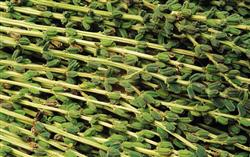
A Complete Analysis of the Key Technical Points for Growing Black Sesame
1. Land preparation and fertilization: Choose sandy loam or loam fields with loose soil, good aeration, and medium to above-medium fertility for planting, and avoid continuous cropping. Prepare the land and fertilize at the end of May and the beginning of June, applying 10-15 kg of urea or 20-25 kg of ammonium bicarbonate per mu, along with 5-10 kg of potassium chloride. 2. Seed treatment: Sun the seeds for 1-2 days before sowing. To prevent...
-
What are the key points of fertilization techniques for summer sesame?
Dense-pod sesame Yizhi No. 1 is one of the higher-yielding types of sesame today, drought-tolerant, lodging-resistant, with very dense pod set, 3 to 7 capsules per leaf, layered thickly one upon another, so dense the stalks cannot be seen, seeds pure white, oil content above 55%, growth period 110 days for spring sowing and 85 to 90 days for summer sowing, yielding 100 kg to 150 kg of sesame per 667 sq m, with high yields...
-
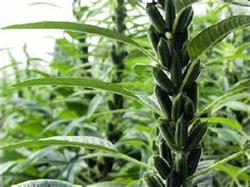
Four key steps to ensure a high yield of black sesame in summer
First, thin and finalize the seedlings in time, and check for and fill gaps: because sesame seeds are small and germinate in large numbers, the seedlings should be thinned when the first pair of true leaves appears after emergence; they should be thinned again when 2 to 3 pairs of true leaves have grown, and finalized at 4 pairs of true leaves, generally leaving about 8000 plants per mu; if poor soil moisture at sowing causes missing plants and broken rows, transplanting from dense areas to sparse ones or sowing after sprouting can be used to ensure...
-
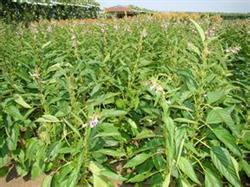
Key Technical Points for Plastic Film Mulching Cultivation of Spring Sesame
1. Select high-yield, disease-resistant varieties. Demonstrations in recent years have shown that choosing an excellent variety is the guarantee of a high yield. The E Zhi No. 2 variety has the characteristics of wide adaptability, good yielding ability, and relatively strong resistance, with a yield generally of 130-150 kg per mu, and it has now been promoted and cultivated over a large area. 2. Finely prepare the soil. Sesame seeds are relatively small...
条件筛选