-

How to reduce pests in edible mushrooms? A detailed guide to practical control methods
How to reduce pests in edible mushrooms
-
How to Reduce Pests in Edible Mushrooms? A Detailed Guide to Practical Control Techniques
Techniques for Reducing Pests in Edible Mushrooms
-
How can edible mushroom pest damage be effectively reduced?
How can edible mushroom pest damage be effectively reduced?
-
How to reduce pests and diseases in edible mushrooms? Practical control methods shared
The main insect pests of edible mushrooms include mushroom gnats, mushroom flies, springtails, mites and nematodes, and the integrated control measures are as follows. Keep the mushroom yard clean. Before cultivation, the mushroom house should be thoroughly cleaned and evenly sprayed with an 800-fold trichlorfon or dichlorvos solution. For outdoor mushroom cultivation, clear the weeds around the cultivation site and spray the soil and the surrounding area with a 250-fold trichlorfon solution. Prevent adults from entering the room. For indoor cultivation of edible mushrooms, nail 60-mesh fine gauze over doors, windows, ventilation holes, etc., to prevent adult mushroom flies, mushroom gnats and other pests from entering the room and causing damage. Trap and kill adults
-
How to reduce pests in edible fungi? Practical pest control techniques shared
1. Keep the mushroom yard clean. Before cultivation, the mushroom house should be thoroughly cleaned and evenly sprayed with an 800-fold trichlorfon or dichlorvos solution. For outdoor mushroom cultivation, clear the weeds around the cultivation site and spray the soil and the surrounding area with a 250-fold trichlorfon solution. 2. Prevent adult insects from entering the room. For indoor mushroom cultivation, nail 60-mesh fine gauze over doors, windows, ventilation holes, etc., to prevent adult insects such as flies and mushroom gnats from entering the room and causing damage. 3. Chemical fumigation. For indoor cultivation of edible fungi, under sealed conditions, use 2-3 tablets of aluminum phosphide per cubic
-
How to reduce contamination in edible mushroom inoculation? Five practical methods to help you solve it
Autumn and winter are the golden seasons for producing edible mushrooms, but every year, inoculation contamination causes economic losses of around 20% for mushroom growers. Using the following 5 methods can reduce the inoculation contamination rate. 1. Bottled fermented material: Fill fermented material 1 to 2 cm deep above the culture medium at 4 cm from the bottle mouth, then sterilize. Its advantages are that contaminating bacteria are less likely to infect the culture medium, and the spawn age is consistent. 2. Wheat grain germination method: Let wheat grains germinate before bottling and sterilizing. That is, let the wheat grains used for spawn germinate all at once, with sprouts 1 to 2 times the length of the wheat grains, then fully sun-dry and store. One day before making the spawn, soak the wheat grains for 12 hours and directly bottle and sterilize. Its advantages are that the process of boiling the wheat grains is omitted, mycelium grows quickly, and there are fewer contaminating bacteria. The contamination rate is 2% to 3%.
-
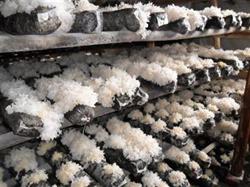
How to reduce contamination in spring cultivation of white fungus
In spring white fungus cultivation, most damage is caused by green mold, with some contamination by Rhizopus and Mucor, while Neurospora is rare. Green mold, Mucor and Rhizopus often occur at the edges of the inoculation holes in the fungus bags, or when the mycelial rings of two holes meet 9-10 days after inoculation, appearing at the front of the mycelium, and also on the bag walls. Green mold also occurs on the fruiting bodies, causing the fungus fronds to rot. Neurospora mostly occurs at the gaps where the bag openings are tied. The main causes of contamination are incomplete sterilization of the substrate bags, lax aseptic technique, holes in the bag film, impure spawn carrying contamination, or contamination of the environment.
条件筛选