How to reduce contamination in spring cultivation of white fungus
In spring white fungus cultivation, most damage is caused by green mold, with some contamination by Rhizopus and Mucor, while Neurospora is rare. Green mold, Mucor and Rhizopus often occur at the edges of the inoculation holes in the fungus bags, or when the mycelial rings of two holes meet 9-10 days after inoculation, appearing at the front of the mycelium, and also on the bag walls. Green mold also occurs on the fruiting bodies, causing the fungus fronds to rot. Neurospora mostly occurs at the gaps where the bag openings are tied. The main causes of contamination are incomplete sterilization of the substrate bags, lax aseptic technique, holes in the bag film, impure spawn carrying contamination, or contamination of the environment.
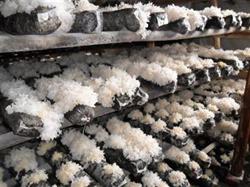 In spring white fungus cultivation, most damage is caused by green mold, with some contamination by Rhizopus and Mucor, while Neurospora is rare. Green mold, Mucor and Rhizopus often occur at the edges of the inoculation holes in the fungus bags, or when the mycelial rings of two holes meet 9-10 days after inoculation, appearing at the front of the mycelium, and also on the bag walls. Green mold also occurs on the fruiting bodies, causing the fungus fronds to rot. Neurospora mostly occurs at the gaps where the bag openings are tied. The main causes of contamination are incomplete sterilization of the substrate bags, lax aseptic technique, holes in the bag film, impure spawn carrying contamination, or contamination of the environment.
To avoid contamination by stray microbes, the key is to do well in the following aspects:
1. Purify the mushroom house environment: frequently clean up environmental sanitation and spread lime powder for disinfection; strictly disinfect and sterilize before cultivation in the house to eliminate sources of contamination.
2. Carefully select raw and auxiliary materials: cottonseed hulls and wheat bran must be free of caking and free of moldy deterioration, and should be placed under strong sunlight to sterilize; test the quality of cultivation bags beforehand.
3. Standardize fungus bag production: keep the moisture content of the culture substrate below 60%, and the time from bagging to loading into the stove must not exceed 6 hours to prevent the substrate from turning sour. For sterilization, keep at 100°C for 24 hours without lowering the temperature midway.
4. Adhere to aseptic technique: thoroughly disinfect and sterilize the inoculation room, select qualified disinfectants; a super-strength cleaning essence can be used, adding 10-20 kg of water per bag, spraying the space, shelf beds and site, then using a disinfection box at no less than 5 grams per cubic meter, with a sterilization time of 1 hour. Inoculation requires passing through the flame of an alcohol lamp.
5. Strictly control the spawn. Carefully select the spawn; for spring white fungus spawn, the Xianghui mycelium is required to be stronger, to avoid the gray receding after inoculation when encountering low temperatures and affecting the growth of the fungus. When scooping spawn, pay attention to disinfecting the inoculation box; when transporting spawn, prevent bottle breakage and stopper loss.
6. Treatment of contaminated bags: contaminated bags harmed by stray microbes should be treated differently: for light contamination, use bagging and tying the opening to control spread, then sterilize and inoculate again; for severe cases, break the bag and take out the substrate, add 1-2% lime and mix well, let it sit for 24 hours, then spread it out to dry, for reuse in the next cultivation. If the fruiting body is contaminated by green mold, harvest it early, and wipe the fungus base with clear liquid of pH 8 lime supernatant to control spread.
II. Eliminate insect pests
1. Fungus gnats: mainly small fungus gnats. Control measures: frequently clean up environmental sanitation, spread lime powder for disinfection; install screen mesh on doors and windows, and regularly spray pyrethrum liquid or 2000-fold Yitaibao solution on the mesh; install black light lamps in the house for trapping and killing. During the peak outbreak period, pesticides are limited to low-toxicity, low-residue varieties, such as 3000-fold fipronil solution sprayed to kill, and mosquito coils can also be lit, or sanitary pills crushed for fumigation to kill.
2. Mites, also called fungus lice, have many varieties, with two common ones being Pyemotes and Tyrophagus. Control methods: the raw material warehouse should be far from the mushroom house, and materials should be sun-dried before use; the surrounding environment should be cleaned thoroughly; disinfect before opening the fungus bags, spraying 3000-fold 73% propargite solution 1 day in advance, then adjust the room temperature to 20°C, close doors and windows for thorough empty-room disinfection, then after the residual medicinal odor is removed, open the adhesive tape; if mites occur in the early stage of fruiting body growth, fresh tobacco leaves can be spread flat beside the fungus bags to attract mites to gather on the leaves, then take them out and burn them to death; tea seed cake can also be ground into powder, stir-fried over low heat until oily and fragrant, then taken out and sprinkled at the mite-infested area, and after attracting them, take them out and scald them to death with boiling water. If unavoidable, 1000-1500-fold 20% amitraz emulsifiable concentrate can be sprayed to kill.
3. Nematodes. Control methods: the culture medium must be thoroughly sterilized, the water source should be tested, the mushroom house should be strictly disinfected in advance, watering should not be too wet, and attention should be paid to ventilation. If nematodes appear in the mushroom house, 0.5% lime water or 1% salt water can be sprayed 2-3 times on cool days, and lime powder should be spread on the floor of the mushroom house for disinfection. During the fungus growth stage, 1% glacial acetic acid or 25% rice vinegar solution can be sprinkled on the diseased spots.
III. Prevention and control of diseases
White fungus diseases are divided into infectious diseases and non-infectious diseases. Infectious diseases are caused by pathogenic fungi; non-infectious diseases are sometimes caused by physiological pathological changes, and sometimes caused by loss of control in production management.
1. Powdery mildew, also called white rot, with the pathogen being Acrocephalosporium. Control methods: strengthen ventilation and dehumidification in the mushroom house; when it occurs in young fungus, spray lime-sulfur mixture, and harvest early, scrape it off with a sharp knife including the roots, apply 4% carbolic acid solution to the fungus base, and fumigate with 50% mildew preservative powder in the evening.
2. Stunting and shrinking disease, with the pathogen Fusarium solani. Control methods: sun-dry raw materials, the water content of the mix should not be too high, 60%; before uncovering the cloth at the hole openings, spray 1000-fold 50% dichlorvos emulsifiable concentrate for sterilization; after cutting the film and expanding the holes, the space humidity should not exceed 80%; if it occurs at the young fungus stage, spray pH 8 lime supernatant; at the mature fungus stage, harvest early, soak and clean with 5% lime water, then process and dry.
3. Black base. Control methods: keep the mycelium culture preferably not above 28°C, open the holes and cut the film to expand the holes in good time to increase oxygen, promote normal metabolism of the mycelium; at the young fungus stage, watering should be less and more frequent, not excessive, to prevent water accumulation beside the fungus base; at the same time pay attention to ventilation and air exchange.
4. Rotten fungus. Control methods: prevent the culture medium from turning sour, pay attention to heat dissipation after sterilization of the material bags, and prevent excessive temperature during mycelium culture. At the fungus growth stage, control 23-25°C, ventilate in time, water appropriately, and keep the relative humidity of the space between 85-95%. If rotten fungus is found in young fungus, remove it in time, dig out the base, wipe with lime water, then spray 1000-fold 100% thiophanate solution to control; if mature fungus rots, harvest early, and smear with 1500-fold 25% thiram solution to control the spread of pathogenic fungi.