-

What medicine is effective for controlling cotton red leaf disease?
Control the top and promote the bottom to enhance the stress resistance of cotton plants. First, for cotton with vigorous growth, apply the plant growth retardant succinic acid or mepiquat chloride to control excessive growth; use 2-3 grams of mepiquat chloride or 8-12 milliliters of mepiquat chloride per mu, mixed with 50 kg of water for spraying. Second, for cotton fields with compacted soil, cultivate and aerate in time to enhance permeability. Third, for cotton fields in low-lying areas, pay attention to clearing ditches and beds at any time to promote cotton roots to grow downward. Fourth, for cotton fields using plastic film mulching cultivation, remove the plastic film immediately so that cotton roots develop deeper. Apply more potassium fertilizer to improve fertilization efficiency. For soil
-
Red-leaf winter peach is a rare premium variety among late-maturing peaches.
In the northern Henan region of Henan, red-leaf winter peach shows pink buds on March 25, begins flowering on April 1, with pink flowers, 5 petals, a flower diameter of 3.5-4 cm, and a flowering period of 7-10 days. Flowers and leaves grow simultaneously; the pink peach blossoms and purplish-red peach leaves form the only red scenic line worth viewing in spring. As the seasons and temperatures change, the purplish-red peach leaves gradually turn copper-green from the base upward, but the new shoots and new leaves at the top remain purplish-red, forming on the same branch lower leaves that are copper-green
-
Red-leaf privet is a common landscaping nursery stock variety
Red-leaf privet is a horticultural cultivar of the genus Ligustrum in the family Oleaceae. It is an evergreen small tree with opposite simple leaves; the branchlets are slightly covered with fine hairs, and the leaves are ovate, ovate-round to ovate-elliptic, thin leathery, extremely similar in leaf shape to Chinese privet (Ligustrum sinense), with stronger sprouting ability, faster growth and vigorous growth. Its new shoots and young leaves are purplish red, and against the backdrop of the old leaves they appear all the more vivid and dazzling. After being pruned several times, the new branches become dense and the whole crown turns purplish red, making it even more gorgeous and striking among green plant clusters. After winter sets in, the whole plant turns purplish black again, standing out even more among all things. Red-leaf privet
-
What are the control methods for cotton red leaf disease?
Cotton red leaf disease is a physiological disorder that has a relatively large impact on cotton yield and quality. This disease usually begins to occur at the early flowering stage. If control is not timely, by the full flowering stage to the boll-setting stage the affected area expands and the condition worsens. When the disease first appears, the leaves take on a dark green color, then gradually thicken and wrinkle, becoming brittle, with yellow spots appearing between the veins while the veins remain green. As the disease worsens, the leaf edges begin to curl downward and turn from yellow to purplish red, withering and dropping off, until the cotton plant is left as bare stalks and dies. The main causes of cotton red leaf disease
-
Golden-leaf dawn redwood is a new and superior colored-leaf tree species
Dawn redwood (Metasequoia glyptostroboides) is the only surviving species of the genus Metasequoia in the family Cupressaceae. This species was once thought to be extinct, until it was discovered in 1941 in the Lichuan area of Hubei, China, and afterwards this plant was also found successively in the Wanxian area of Sichuan. In 1947, dawn redwood seeds were introduced to the Arnold Arboretum in the United States, and from there spread to botanical gardens around the world. In 1948, "dawn redwood" and its scientific name were formally named, and since then it has enjoyed great fame in China and even the whole
-
Cotton red leaf blight is prone to outbreak after heavy rain, growers need to be vigilant
Recently, cotton regions have generally experienced heavy to torrential rain, and for cotton that has endured a long drought, red leaf blight is extremely prone to outbreak. Cotton red leaf blight is a physiological disease. It starts from the main stem growing point or the top of the fruiting branch, and generally develops from top to bottom and from outside to inside. The main stem withers and dies, but the dissected vascular bundles show no discoloration. The root system is thick and short, with few fibrous roots and poor development. The causes of cotton red leaf blight outbreaks are: first, extensive farming in cotton fields, resulting in poor cotton root development; second, cotton fields with poor drainage; third, excessive application of nitrogen fertilizer, vigorous cotton growth,
-
New red-leaf peach series cultivars, good for both ornamental viewing and eating
Ma Yuxi, a senior engineer at the Zhonghua Winter-Ripening Fruit Tree Research Center in Xun County, Henan Province (telephone: 0392-5811384), after 10 years of arduous exploration, finally bred 12 new red-leaf peach series cultivars with different colors and flower types, which both delight the eye and let people enjoy delicious fruit. After spring returns to the earth, this peach can first be enjoyed for its peach blossoms, then for its red peach leaves, third for the red fruit hanging all over the branches, and finally people can also eat sweet, large fresh peaches. For the red-leaf peach series cultivars, the flower buds begin to swell and the leaf buds begin to sprout in early March, and flowering begins in early April
-
Introduction to the Red-Leaf Winter Peach Variety and Its Main Characteristics
In the northern Henan region of Henan, the Red-Leaf Winter Peach shows pink buds on March 25, begins blooming on April 1, with pink flowers, 5 petals, a flower diameter of 3.5-4 cm, and a blooming period of 7-10 days. The flowers and leaves grow simultaneously; the pink peach blossoms and purplish-red peach leaves become the only red landscape worth viewing in spring. As the seasons and temperatures change, the purplish-red peach leaves gradually turn copper-green from the base upward, but the new shoots and new leaves at the top remain purplish-red, forming on the same branch lower leaves that are copper-green and upper leaves that are still red.
-
Golden Locust is an excellent colored-leaf tree species
Robinia pseudoacacia 'Frisia', of the Fabaceae family, genus Robinia, is a broadleaf deciduous tree. The twigs are thorny, with pinnate compound leaves; the foliage is golden yellow in spring, turning yellow-green in summer and orange-yellow in autumn, with rich and extremely beautiful color changes. It blooms in early summer, with white flowers. Native to northern America, it loves sunlight, tolerates slight shade when young, and can adapt to acidic, calcareous and alkaline soils; it has a shallow root system, is not tolerant of waterlogging, and grows rapidly. It is suitable for growing in the Three-North region. It is suitable as a specimen landscape tree and
-
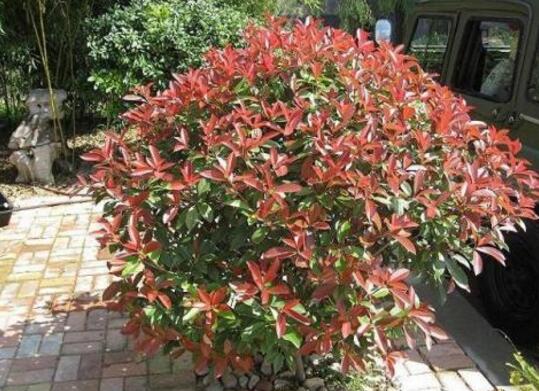
Is red-leaf photinia toxic? Key points of bonsai production techniques, soil is crucial
Red-leaf photinia is a common landscaping plant because of its high ornamental value, but for those who want to grow it indoors, the question they care about most is its toxicity. So is red-leaf photinia toxic? Is red-leaf photinia suitable for indoor potting? Let's find the answers to these questions together.
条件筛选