Is red-leaf photinia toxic? Key points of bonsai production techniques, soil is crucial
Red-leaf photinia is a common landscaping plant because of its high ornamental value, but for those who want to grow it indoors, the question they care about most is its toxicity. So is red-leaf photinia toxic? Is red-leaf photinia suitable for indoor potting? Let's find the answers to these questions together.
Is red-leaf photinia toxic?
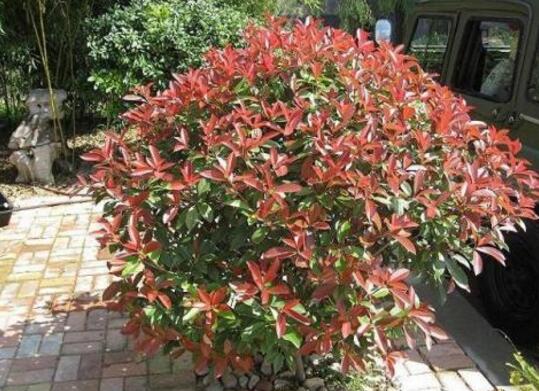
In nature, many plants with bright colors are somewhat toxic, so some flower lovers assume that red-leaf photinia, with its bright red leaves, is no exception. So is red-leaf photinia toxic? The answer is no, it is not toxic. The branches and leaves of red-leaf photinia are non-toxic, and moreover it is an excellent industrial raw material.
Is red-leaf photinia suitable for indoor potting?
Since red-leaf photinia is non-toxic, is it suitable for indoor potting? The answer is yes. Growing it indoors not only provides ornamental value but also purifies indoor air and beautifies the environment. Especially in spring and autumn, seeing the bright red leaves is even more refreshing. However, the following points should be noted when potting.
Key points of red-leaf photinia bonsai production techniques
1. Variety and container
If growing red-leaf photinia in a pot, it is best to use cuttings or tissue-cultured seedlings. These types can be pruned into low shrubs, and the plant height can be controlled above 1.5 m, making them more suitable for indoor growing.
2. Soil selection
We know that red-leaf photinia does not have high soil requirements, but if potted, acidic soil with a pH of 5.5-6.5 is best. In addition, sandy soil is preferable because it has better air permeability and drainage, creating a soil environment more conducive to growth.
3. Potting techniques
When potting, do not plant the roots too deep. Generally, it is enough to ensure that two-thirds of the roots are in the soil. In addition, the root system should be spread out as much as possible, and the plant should be upright rather than tilted, which can prevent it from growing crooked during growth and affecting its appearance.
4. Applying base fertilizer at the bottom of the pot
Among the key points of red-leaf photinia bonsai production techniques, the biggest difference from garden planting is the application of base fertilizer. In the cultivation method of potted red-leaf photinia, base fertilizer should be applied at the bottom of the pot when planting, or organic fertilizer should be mixed into the soil, so that red-leaf photinia can obtain sufficient nutrients from the beginning of its growth period.
Japanese maple bonsai pictures and growing techniques
Among potted plants, the Japanese maple is deeply loved and favored by people from all walks of life for its graceful posture and elegant leaf shape. In horticulture, its varieties have variable leaf shapes and colors, making them very ornamental. If planted on lawns, by streams, beside ponds, at wall corners, near pavilions, or among rocks, they all have a natural and elegant charm.After autumn, the bright red Japanese maple bonsai pictures show colors as brilliant as flowers, as splendid as rosy clouds. As an excellent foliage tree species, it is believed that no matter where it is planted, it has a natural and elegant beauty. This article will combine Japanese maple pictures to tell everyone about Japanese maple seedling prices and Japanese maple growing techniques.
[Editor's picks] How to grow Guzmania How to grow spider plant What plants absorb formaldehyde Propagation methods of azalea Price of Dendrobium officinale
——————————————————————————————————————————————[Plant profile]
——————————————————————————————————————————————
Chinese name: Japanese maple
Scientific name: Japanese Maple
Aliases: Chicken-claw maple, maple tree
Family: Aceraceae
Genus: Acer
Distribution: Shandong, southern Henan, Jiangsu, Zhejiang, Anhui, Jiangxi, Hubei, Hunan, Guizhou and other provinces; also distributed in Korea, Japan and other countries.
Morphological characteristics: Deciduous small tree or tree, crown umbrella-shaped, posture elegant. Bark smooth. Branchlets reddish-brown. Leaves opposite, palmately 7-9 lobed, base truncate to heart-shaped. Lobes caudate at the apex, margins with irregular sharp teeth or double sharp teeth. Young leaves densely pubescent, old leaves smooth and hairless. In autumn, the red leaves are like brocade, very pleasing to the eye. Flowers polygamous, forming corymbs composed of small purplish-red flowers, opening in April. Samaras spread at an obtuse angle, curved upward, mature in October, brownish-yellow.Japanese maple growing techniques
——————————————————————————————————————————————Ecological characteristics of Japanese maple
————————————————————————————————————
Prefers a warm, humid and semi-shaded environment. Cold-resistant, not tolerant of waterlogging, relatively drought-tolerant, afraid of strong direct sunlight. Optimum growth temperature 15-25°C, can withstand low temperatures of -8°C in winter. The soil should be deep, fertile and well-drained sandy loam; it also tolerates acidic and calcareous soils.
Propagation methods of Japanese maple
————————————————————————————————————
VI Sowing: Collect seeds in October, dry slightly and remove wings, sow in autumn or stratify in moist sand, sow in February in spring. Cover with 1 cm of soil. Germination occurs 30-40 days after sowing. Seedlings need shading and moisture retention. The height of current-year seedlings can reach 30-40 cm.
VII Grafting: Mainly used for cultivated varieties. Rootstock is 2-3 year old Japanese maple. In March in spring, perform branch grafting; when the leaf buds of the rootstock swell, perform cut grafting or side grafting. In August in summer, perform bud grafting, mainly single-bud side grafting, with a high survival rate. Can become a seedling in the same year.
VIII Layering: Conducted in October, using the air layering method. Perform ring barking 20-25 cm from the branch tip, wrap with leaf mold and plastic film. Can become a seedling in the following spring.Key points for growing Japanese maple
————————————————————————————————————
Japanese maple should be transplanted after leaf fall in autumn and winter or before bud break in spring. Large seedlings should be with soil balls, and planted in fertile, semi-shaded, moist sites. Potted plants should be done after removing leaves in late August, placed in a semi-shaded, moist place, and fertilized 1-2 times to promote lush branches and leaves. After frost, the leaves turn yellow and red; keep indoors for maintenance, leaf fall is delayed, which can prolong the leaf-viewing period.
Pest and disease control
————————————————————————————————————
During the cultivation of Japanese maple, there are often hazards from anthracnose, leaf spot and black spot. Usually, Bordeaux mixture or 70% mancozeb wettable powder 600 times solution can be sprayed. Pests include slug moths, giant bagworms, aphids and star longhorn beetles, which can be killed by spraying 1500 times solution of fenitrothion.Japanese maple seedling prices
——————————————————————————————————————————————
Japanese maple seedling prices also vary with different varieties and specifications. Here the editor has collected some Japanese maple seedling price lists for everyone's reference.
Japanese maple seedling prices
Reference price of one-year-old seedlings (H: height cm unit/yuan) Note: The following seedlings all have large specifications 2-15 cm
Variety
Specification
Unit price
Variety Specification Unit price
Hackberry
H30
0.8
Schima superba
H300.2
Zelkova serrata
H30
1
Sweetgum
H600.25
Crape myrtle
H70
0.6
Tung tree
H100
1
Trident maple
H60
0.5
Huangshan goldenrain tree
H60
0.3
Sassafras
H50
0.65
Dawn redwood H600.12
Slash pine
H20
0.15
Slash pine
H20
0.15
Chinese tulip tree
H50
0.35
Camphor tree
H40
0.25
Elaeocarpus
H80
0.5
Red-leaf photinia
H30
1
Chinese bishopwood
H60
0.3
Osmanthus
H30
0.6[More plant encyclopedia]
What is daylily Symbolic meaning of lily Efficacy and effects of globe amaranth Uses of mulberry tree How to grow peonies Flower-growing knowledge
Types of cactus Is gardenia toxic What is the flower language of lavender Gardenia leaves turning yellow Potted vegetables Uses of asparagus fern
Uses of pothos Hyacinth flower language Cactus flower How to grow lilies Flower cultivation methods Flower cultivation Potted plants Radiation-proof plants
Indoor plants Hydroponic plants Flower language Complete flower language Complete flower language with pictures Complete flower pictures Flower pictures and namesJapanese maple has beautiful leaf shapes and is a foliage plant. It is generally planted along roadsides and other places. Now there are also potted varieties placed in homes. Cultivation methods of Japanese maple:
Basic information of Japanese maple:
Japanese maple (Acer palmatum Thunb), also known as chicken-claw maple, belongs to the Aceraceae family, Acer genus, deciduous small tree or tree, crown umbrella-shaped, posture elegant. Bark smooth. Branchlets reddish-brown. Leaves opposite, palmately 7-9 lobed, base truncate to heart-shaped. Lobes caudate at the apex, margins with irregular sharp teeth or double sharp teeth. Young leaves densely pubescent, old leaves smooth and hairless. In autumn, the red leaves are like brocade, very pleasing to the eye. Flowers polygamous, forming corymbs composed of small purplish-red flowers, opening in April. Samaras spread at an obtuse angle, curved upward, mature in October, brownish-yellow.
Cultivation methods of Japanese maple:
1. Soil: Japanese maple has strong vitality. For open-field cultivation, choose a place with high, dry, sunny terrain, loose and fertile soil, and deep soil layers. Avoid planting in low-lying, waterlogged, or clay-heavy soil, otherwise it will grow poorly.
2. Watering: For potted Japanese maple, watering should be sufficient during the growing season, but not excessive, just enough to keep the potting soil moist.
3. Sunlight: Japanese maple is a weak-positive tree species, tolerant of semi-shade. When planted alone in direct sunlight, it is prone to sunscald in summer. In spring and autumn, it can be placed on a balcony or in a courtyard for cultivation. In summer, move it to a semi-shaded place, paying attention to appropriate shading to prevent scorching sun exposure that causes leaf edges to burn. If it needs to be placed indoors for viewing, it should be placed in a well-lit place and attention should be paid to air circulation. After a period of time, move it back outdoors to a sunny place for cultivation.
4. Temperature: Japanese maple prefers a warm climate. In the north, before winter begins, it should be moved to a cold room in time for the winter, placed in a room at 0-5°C.
5. Fertilization: For potted Japanese maple, generally from the beginning of spring budding, apply a thin cake fertilizer water once a month. From September, switch to potassium fertilizer. If 0.5%-1% potassium sulfate solution or plant ash extract is applied, the leaf color will be bright.
6. Pests: Common pests of Japanese maple include white grubs, mole crickets, scarabs, slug moths, aphids, longhorn beetles, and heart-boring worms. Prevention should be the main approach. Spray hymexazol or dimethomorph or Aimiao emulsifiable concentrate + ningnanmycin + abamectin + lambda-cyhalothrin or chlorpyrifos or acetamiprid + organosilicon 3000 times solution. When there is no disease, apply once every 15-20 days; when the disease is severe, apply once every 5-7 days. Note to alternate medications.
Japanese maple has a unique and beautiful leaf shape and changes color after autumn, with good ornamental value. Potted cultivation for indoor environment beautification is also a good choice. The cultivation methods of Japanese maple are introduced here, hoping to be helpful to everyone.
Japanese maple pictures, Japanese maple seedling prices, Japanese maple bonsai pictures and growing techniques
After autumn, the bright red Japanese maple bonsai pictures show colors as brilliant as flowers, as splendid as rosy clouds. As an excellent foliage tree species, it is believed that no matter where it is planted, it has a natural and elegant beauty. This article will combine Japanese maple pictures to tell everyone about Japanese maple seedling prices and Japanese maple growing techniques.
【Editor's picks] How to grow Guzmania, how to grow spider plant, what plants absorb formaldehyde, propagation methods of azalea, price of Dendrobium officinale
[Japanese maple] Japanese maple seedling prices, Japanese maple growing techniques, Japanese maple bonsai pictures
——————————————————————————————————————————————
[Plant profile]
——————————————————————————————————————————————
Chinese name:Japanese maple
Scientific name:Japanese Maple
Aliases:Chicken-claw maple, maple tree
Family:Aceraceae
Genus:Acer
Distribution:Shandong, southern Henan, Jiangsu, Zhejiang, Anhui, Jiangxi, Hubei, Hunan, Guizhou and other provinces; also distributed in Korea, Japan and other countries.
Morphological characteristics:Deciduous small tree or tree, crown umbrella-shaped, posture elegant. Bark smooth. Branchlets reddish-brown. Leaves opposite, palmately 7-9 lobed, base truncate to heart-shaped. Lobes caudate at the apex, margins with irregular sharp teeth or double sharp teeth. Young leaves densely pubescent, old leaves smooth and hairless. In autumn, the red leaves are like brocade, very pleasing to the eye. Flowers polygamous, forming corymbs composed of small purplish-red flowers, opening in April. Samaras spread at an obtuse angle, curved upward, mature in October, brownish-yellow.
Japanese maple growing techniques
——————————————————————————————————————————————
Ecological characteristics of Japanese maple
————————————————————————————————————
Prefers a warm, humid and semi-shaded environment. Cold-resistant, not tolerant of waterlogging, relatively drought-tolerant, afraid of strong direct sunlight. Optimum growth temperature 15-25°C, can withstand low temperatures of -8°C in winter. The soil should be deep, fertile and well-drained sandy loam; it also tolerates acidic and calcareous soils.
Japanese maple'spropagation methods
————————————————————————————————————
ⅥSowing: Collect seeds in October, dry slightly and remove wings, sow in autumn or stratify in moist sand, sow in February in spring. Cover with 1 cm of soil. Germination occurs 30-40 days after sowing. Seedlings need shading and moisture retention. The height of current-year seedlings can reach 30-40 cm.
ⅦGrafting: Mainly used for cultivated varieties. Rootstock is 2-3 year old Japanese maple. In March in spring, perform branch grafting; when the leaf buds of the rootstock swell, perform cut grafting or side grafting. In August in summer, perform bud grafting, mainly single-bud side grafting, with a high survival rate. Can become a seedling in the same year.
ⅧLayering: Conducted in October, using the air layering method. Perform ring barking 20-25 cm from the branch tip, wrap with leaf mold and plastic film. Can become a seedling in the following spring.
Key points for growing Japanese maple
————————————————————————————————————
Japanese maple should be transplanted after leaf fall in autumn and winter or before bud break in spring. Large seedlings should be with soil balls, and planted in fertile, semi-shaded, moist sites. Potted plants should be done after removing leaves in late August, placed in a semi-shaded, moist place, and fertilized 1-2 times to promote lush branches and leaves. After frost, the leaves turn yellow and red; keep indoors for maintenance, leaf fall is delayed, which can prolong the leaf-viewing period.
Pest and disease control
————————————————————————————————————
During the cultivation of Japanese maple, there are often hazards from anthracnose, leaf spot and black spot. Usually, Bordeaux mixture or 70% mancozeb wettable powder 600 times solution can be sprayed. Pests include slug moths, giant bagworms, aphids and star longhorn beetles, which can be killed by spraying 1500 times solution of fenitrothion.
Japanese maple seedling prices
——————————————————————————————————————————————
Japanese maple seedling prices also vary with different varieties and specifications. Here the editor has collected some Japanese maple seedling price lists for everyone's reference.
| Japanese maple seedling prices | |||||
Reference price of one-year-old seedlings (H: height cm unit/yuan) Note: The following seedlings all have large specifications 2-15 cm | |||||
| Variety | Specification | Unit price | Variety | Specifications | Unit price |
| Chinese hackberry | H30 | 0.8 | Chinese Gugertree | H30 | 0.2 |
| Red beech | H30 | 1 | Sweetgum | H60 | 0.25 |
| Crape myrtle | H70 | 0.6 | Tung tree | H100 | 1 |
| Trident maple | H60 | 0.5 | Huangshan goldenrain tree | H60 | 0.3 |
| Sassafras | H50 | 0.65 | Dawn redwood | H60 | 0.12 |
| Slash pine | H20 | 0.15 | Slash pine | H20 | 0.15 |
| Chinese tulip tree | H50 | 0.35 | Camphor tree | H40 | 0.25 |
| Elaeocarpus | H80 | 0.5 | Red photinia | H30 | 1 |
| Bischofia | H60 | 0.3 | Osmanthus | H30 | 0.6 |
【More plant encyclopedia】
What is daylily The symbolic meaning of lilies The benefits and effects of globe amaranth The uses of mulberry How to grow peony flowers Flower-growing knowledge
Types of ball cactus Is gardenia poisonous What is the flower language of lavender Gardenia leaves turning yellow Potted vegetables The uses of asparagus fern
The uses of pothos The flower language of hyacinth Cactus flowers How to grow lilies Flower cultivation methods Flower cultivation Potted plants Anti-radiation plants
Indoor plants Hydroponic plants Flower language Complete guide to flower language Complete guide to flower language with pictures Complete flower pictures Flower pictures and names