-
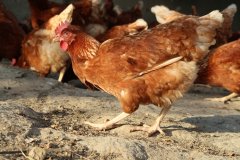
Revised guidelines for humane egg production: increased space in poultry houses, no forced molting for egg production
The Agriculture Committee of Taiwan, China recently revised and circulated the "Definition and Guidelines for Humane Egg Production Systems." The biggest differences before and after the revision are lowering the stocking density for free-range and floor-rearing, prohibiting forced molting, stipulating that low-yielding hens after culling must not enter non-humane production system farms for continued rearing, and raising the conditions for enriched cages to EU standards.
-

What Does "Golden Cicada Sheds Its Shell" Mean? An Analysis of When and Why Cicadas Molt
The cicada, commonly known as "zhiliao," is abundant in the Central Plains region and is rich in nutrients, being both edible and medicinal. After the cicada nymph emerges from the ground, it must shed a layer of skin when transforming into an adult cicada. This layer of skin is called "chantui" or "cicada skin." So what does "golden cicada sheds its shell" mean? How long does it take for a cicada to molt?
-
The four growth stages of silkworm babies: how many days for eggs to hatch, how many times they molt, and how they become silkworm moths
The silkworm, also known as the mulberry silkworm or Bombyx mori, is an economically important insect commonly found in southwestern China, the Jiangsu-Zhejiang region, Anhui and other places. Because it can spin silk and be made into various silk fabrics, it is widely raised. So how does a silkworm become a silkworm moth? How many days does it take for eggs to hatch? How many times does it molt in its lifetime?
-
When do crayfish usually molt? Key management points during the molting period
The growth of crayfish depends on molting, and the molting rate is related to the growth stage of the crayfish and water quality environmental factors. Before each molt, the crayfish needs to accumulate considerable energy. Even so, after molting it is the period when the crayfish's body is weakest and most vulnerable to invasion by pathogens, so every molt
-
How to Care for a Newly Molted Katydid? Detailed Rearing Methods and Precautions
For a newly molted katydid, take care to control the temperature well, keeping it at around 28°C, and not too high. In the early stage after molting, feed it skin worms or oil cricket; after two or three days, feed it half a soybean or edamame (soaked in water or boiled) each day until it starts singing loudly. When feeding, it is best to take it out for a walk.
-
What are the fastest methods for racing pigeons to molt
Feather replacement in racing pigeons is commonly known as molting. It refers to the periodic annual replacement of feathers in adult pigeons, as well as the replacement and growth of feathers during the development of young pigeons, mostly in late summer and early autumn, commonly known as "seven scattered, eight falling, nine complete, ten beautiful." So, do you know the fastest methods for racing pigeons to molt? 1. Racing pigeon molting
-
How Often Do Ducks Molt? Understanding Molting Patterns in One Article
Ducks are a common type of poultry with fairly high economic and nutritional value, so many farmers choose to raise ducks. But duck farming is also a skilled job that requires mastering a lot of duck-raising knowledge, such as how often ducks molt. Friends who do not know might as well join us
-
What are the tips for molting in scorpion farming?
Many farmers report that young scorpions have difficulty molting, which has long been a tough problem troubling farmers and easily leads to the common issue of physiological sudden death. Therefore, in farming practice, paying attention to the following points will improve the survival rate of young scorpions. Let's learn about it together below.
-
Detailed Explanation of Key Techniques for Handling the Molt and Waking Stages of the Silkworm
I still remember that when I was little, the editor also loved raising silkworms very much. The first thing I did every day after coming home from school was open my box to see whether the little silkworms inside had grown a bit. But for the editor, that was purely a child raising them for fun. People who truly raise silkworms need to
-
Key Points of Feeding and Management During the Molting Period in Hwamei Breeding
Feeding and management of the hwamei during the molting period: Like birds in nature, the hwamei molts once a year (those that molt poorly may molt twice), mostly during the 8th to 10th lunar month of the year (a few molt earlier or later), and the whole process ends after about 100 days.
条件筛选