-
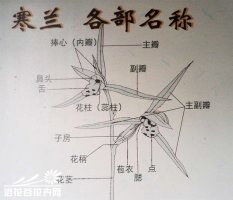
Illustrated Guide to Identifying Kanran Orchid Leaf Variegation, Leaf Types, and Flower Types
Kanran orchid, Kanran orchid, of the genus Cymbidium in the family Orchidaceae. Scientific name: Cymbidium Kanran Mak. The plant is slender and well-proportioned, the leaves elegant and graceful, the flower colors brilliant and varied, and the fragrance pure and long-lasting....
-
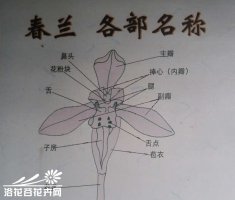
Complete Identification Guide to Cymbidium goeringii Flower Colors, Petals, and Leaf Colors
Cymbidium goeringii is a common original species of terrestrial orchid, mostly produced in temperate zones, mainly distributed in China, and is a specialty of China. Those produced in Jiangsu and Zhejiang are considered the most valuable, while Fujian, Guangdong, Sichuan, Yunnan, Anhui, Jiangxi, Gansu, Taiwan, China and other places also produce it....
-
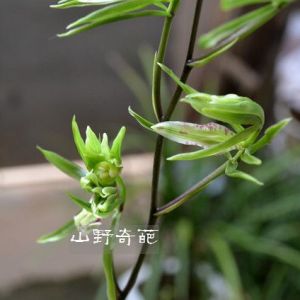
What kind of orchid is the Green Peacock thin-leaf cold orchid? Let us introduce you to this variety
The thin-leaf cold orchid wonder flower Green Peacock was collected by orchid enthusiast Xiao Xue of Anyuan County during the summer vacation of 2010. The collection site and another wonder flower of the county, Shanye Ju, are each located on the east and west ridges of the same village. After collection, it was planted under a navel orange tree in his own yard. Because he was never home to care for it, the orchids under the tree had poor ventilation and were often stepped on by chickens, so many seedlings rotted. 20...
-
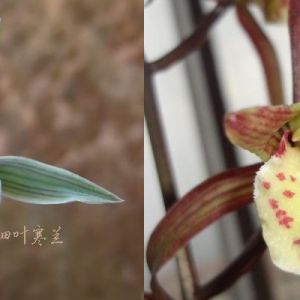
A Detailed Guide to Distinguishing Large-Leaf Cold Orchid from Fine-Leaf Cold Orchid
Yifeng Orchid Garden Large-leaf cold orchid and fine-leaf cold orchid are not distinguished by the length and width of the leaves (that is to say, among large-leaf types there are also those with small, fine leaves, and among fine-leaf types tall plants can also appear), but rather by whether the petals (especially the side petals) have a contrasting border, whether the base color of the lip is white, and whether the orchid roots are thick and sturdy...
-
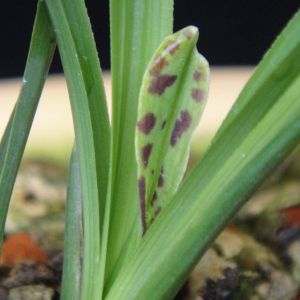
Leaf Butterfly, Butterfly Grass, Butterfly Leaf, Leaf Butterfly
Butterfly grass, also called butterfly leaf or leaf butterfly, is a variation on orchid leaves. It mostly occurs on the central leaf of the orchid plant, followed by the third and fourth leaves near the center, and whole-plant butterfly transformation is very rare. An orchid whose leaves show butterfly-like expression is called butterfly grass. This butterfly transformation is most often seen on one side edge of the leaf, followed by...
-
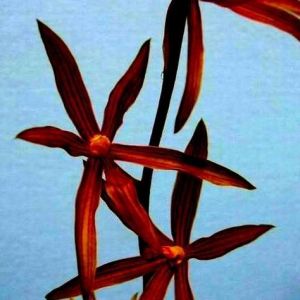
What does the ink orchid leaf sword orchid look like, and what are its characteristics?
The predecessor of "Black Diamond" was a mutation of the ink orchid divine chrysanthemum variety; in mainland China it is called "Leaf Sword", and in Taiwan, China it has now been renamed "Black Diamond". The characteristics of this orchid are that the leaf tips have a crystal water sweep, the leaf backs have a 'dark green transparent glass pattern', the pattern is stable, the flower form is chrysanthemum-petal type, and the flowers are fragrant.
-
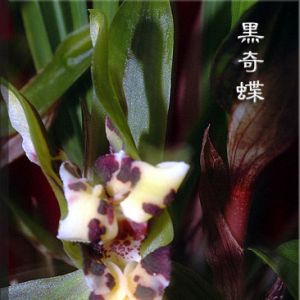
What is going on when water in the leaf core causes stem rot and soft rot?
Won the Special Gold Award at the 14th (Yuxi) Orchid Expo of China and the Gold Award at the 4th (Kunming) Orchid Expo of Yunnan. Grower: Zhao Jiaxing
-
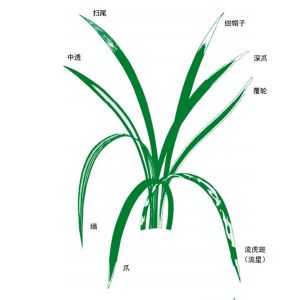
A Guide to Appreciating Orchid Leaf Variegation and Leaf Shapes
The white or yellow patches and patterns that appear on the leaves of Chinese orchids (Cymbidium) are called "yi" (variegation), and orchids cultivated for the changing patterns on their leaves are called "yi orchids" (variegated orchids). According to the standards of Japan and Taiwan, China, there are as many as 35 types of variegation patterns. Each type of pattern is called 1 yi; those with multiple patterns and spots are called "comprehensive yi," but on the same leaf...
-
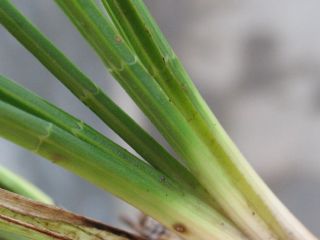
What is the orchid petiole ring? A leaf structure shaped like a finger ring
The orchid's finger ring: both Cymbidium goeringii (spring orchid) and Cymbidium ensifolium (Chinese cymbidium) have a petiole ring, located roughly within 1-4 cm of the orchid pseudobulb, appearing as a ring-shaped protrusion, the dividing line between the petiole and the leaf blade; when the leaf withers it breaks off at the finger ring. The appearance of the petiole ring also indicates that this seedling is about to reach maturity. Orchid leaves often drop at a certain point at the base, and this point is usually formed by transverse...
-
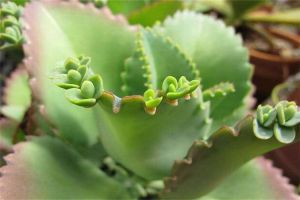
Is Kalanchoe pinnata (large-leaf air plant) actually toxic?
This is a very common phrase, but many people may not know it is also a plant. Although few people know about it, surely someone has grown this plant. It is a succulent plant; as long as its roots are buried in the soil, it can grow a new one, which is also the origin of its name. Now some people are paying attention to it, so they also discuss whether this plant is toxic. Let's solve this mystery.
条件筛选