A Detailed Guide to Distinguishing Large-Leaf Cold Orchid from Fine-Leaf Cold Orchid
Yifeng Orchid Garden Large-leaf cold orchid and fine-leaf cold orchid are not distinguished by the length and width of the leaves (that is to say, among large-leaf types there are also those with small, fine leaves, and among fine-leaf types tall plants can also appear), but rather by whether the petals (especially the side petals) have a contrasting border, whether the base color of the lip is white, and whether the orchid roots are thick and sturdy...
Author: Yifeng Orchid Garden
The easiest way to distinguish them is to look at the lip: the fine-leaf lip color is clear, the large-leaf one is muddy.
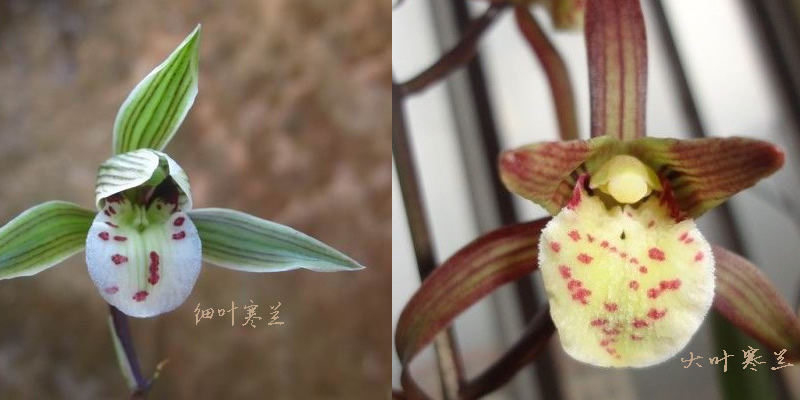
Large-leaf cold orchid and fine-leaf cold orchid are not distinguished by the length and width of the leaves (that is to say, among large-leaf types there are also those with small, fine leaves, and among fine-leaf types tall plants can also appear), but rather by whether the petals (especially the side petals) have a contrasting border, whether the base color of the lip is white, and whether the orchid roots are thick and sturdy. Among cold orchids there is also no such thing as a medium-leaf type (medium-leaf cold orchid). When we describe the leaf information of a cold orchid variety, it is best to describe it more clearly, for example using large-leaf fine-leaf-type cold orchid, large-leaf medium-leaf-type cold orchid, or large-leaf large-leaf-type cold orchid, so that even orchid enthusiasts who do not fully understand cold orchids will know that what is being described is a large-leaf cold orchid. Similarly, when describing fine-leaf cold orchids, one can also use fine-leaf fine-leaf-type cold orchid, fine-leaf medium-leaf-type cold orchid, and fine-leaf large-leaf-type cold orchid to distinguish leaf size.
What we usually mean by cold orchid refers to the winter cold orchid that blooms in winter, with its flowering period mostly concentrated from mid-to-late October to December, though of course there are earlier and later ones, and these are already very few. Within the winter cold orchid, according to differences in various characteristics, they are further divided into large-leaf cold orchid and fine-leaf cold orchid. Below we discuss some basic characteristics and common knowledge of large-leaf and fine-leaf cold orchids:
The large-leaf cold orchid, as the name suggests, has leaves (plant form) that are relatively tall and large, but among large-leaf cold orchids there is also a considerable portion whose leaf type is relatively short and small. The large-leaf cold orchid has lighter leaf color, glossy leaf surface, and relatively fine roots; the fine-leaf cold orchid has leaves (plant form) that are relatively short and small, and likewise a portion are relatively tall. The fine-leaf cold orchid has darker leaf color, with less gloss than the large-leaf type, mostly has thick roots, and a very small portion has fine roots.
The petals of the fine-leaf cold orchid (especially the side petals) in the vast majority of cases have a contrasting border, and most of these have a white border, with a very small portion having a red (or purplish-red) border and a yellow border. But there are also very few fine-leaf ones that have no contrasting border at all, and these mainly appear among natural hybrid varieties; the base color of the fine-leaf lip is almost always white, and a considerable portion is white with green veins inlaid, while pure white base also exists, though not many; of course some lips also have mixed-color bases, very few. Relatively speaking, the petals of the large-leaf cold orchid very rarely have a contrasting border, though it is not that they never do; likewise, large-leaf cold orchids very rarely have a white base color on the lip, though it does occur, and large-leaf lips mostly have mixed-color bases (among large-leaf cold orchids there are also solid-color lips, such as green and yellow plain lips). The lips of large-leaf cold orchids all have lip coating (fuzz), while fine-leaf ones almost have none.
The large-leaf cold orchid is relatively rich in both flower color and lip base color, while relatively speaking the fine-leaf one appears more uniform. Among fine-leaf cold orchids, blue-green flowers are more common, while red flowers, purplish-red flowers, white flowers, yellow flowers and so on are relatively fewer. Among fine-leaf cold orchids there is a type of color-changing flower, which usually only begins to change color when the buds are about to open, and some varieties change color very gorgeously.
Relatively speaking, the large-leaf cold orchid produces more flowers, with some having more than a dozen, the flower stem is thick and sturdy, and the majority of flower scapes rise above the leaves; the petals of the large-leaf cold orchid are relatively slender and long compared with the fine-leaf one, so large-leaf flower shapes vary, whether regular, graceful, or twisted, in countless forms. The fine-leaf cold orchid produces fewer flowers, usually three to five, with the more numerous ones only reaching seven or eight, the flower stem is relatively thin, that is, what we call a lamp-wick stem, and few fine-leaf cold orchid flower scapes can rise above the leaves; the fine-leaf petals are shorter, the outer petals are relatively firm and strong, and the flowers open more regularly than the large-leaf ones. From this it seems, in my opinion: large-leaf types are suitable for clump planting (that is, cultivating multiple shoots together, not dividing them too thinly, except for those pursuing variety propagation), so that large-leaf plants not only look majestic and imposing in form, but during the flowering period, the flower stems rising high above the leaves show their dignified true character even more. On the contrary, fine-leaf types are suitable for single planting (cultivation with a smaller number of shoots), which both solves the problem of fine-leaf types being difficult to propagate and highlights the delicate beauty of the fine-leaf leaf form, and during the flowering period the flowers and petals will not be crowded by the numerous leaves, so that even for fine-leaf types whose flower scapes do not rise above the leaves, flower viewing will be clear at a glance, simple and distinct.
The flowering period of the large-leaf cold orchid is mostly concentrated from late October to November each year, while the fine-leaf one is generally from November to December, with some earlier or later depending on climate differences in each place, but not by much. Of course, the flowering period span of cold orchids is very wide, but that is very few. The large-leaf cold orchid has a strong fragrance, the fine-leaf one a delicate fragrance, and very few fine-leaf ones are also strongly fragrant; whether large-leaf or fine-leaf, there are also unscented ones, but those too are very few. Due to temperature reasons, the fragrance of cold orchids may also fail to be released. According to my experience, for large-leaf cold orchids above the high twenties in degrees, and for fine-leaf cold orchids above ten degrees, it is generally very difficult to smell the fragrance, though of course there are individual ones that also release fragrance at high temperatures. Fine-leaf cold orchids even need to be close to zero degrees for the fragrance to be smelled, so many orchid growers in the north who grow orchids indoors cannot smell the fragrance of fine-leaf ones (when fine-leaf ones bloom in the north, indoor heating is basically already on), but as long as the conditions for fragrance release are suitable, whether large-leaf or fine-leaf, both can release fragrance. Fine-leaf cold orchids bloom readily, with most flowering from just one or two shoots, while large-leaf cold orchids are much more lazy about flowering.
1. Large-leaf flowers are numerous and dense, giving a feeling of being chaotic and lifeless, lacking that certain charm no matter how you look at it; fine-leaf flowers are relatively sparse, unique, delicate, and full of spirit.
2. Large-leaf flowers have heavy lip coating, giving a greasy feeling, and the outer petals and side petals are too slender and long, easily turning over, mostly twisted, with no aesthetic appeal; the fine-leaf flower lip surface is fresh and clear, and the spots and colored patches on the lip are often very eye-catching, easily playing the role of the finishing touch, and the petals are inlaid with a ring of white contrasting border, very beautiful, and the firmness of the flower is also clearly superior to the large-leaf type.
3. Large-leaf types are easy to grow, and their propagation is superior to small-leaf ones; small-leaf ones are more delicate and have a low propagation rate.
4. Large-leaf flowers release fragrance easily, but some varieties have a fragrance that is not pure, too strong and slightly muddy, like the smell of cheap perfume; fine-leaf ones are also fragrant, only the conditions for fragrance release are more demanding than for large-leaf ones, and the temperature difference between day and night is very important. Once fragrance is released, that fragrance is intermittent, coming and going, but absolutely refreshing to the heart!