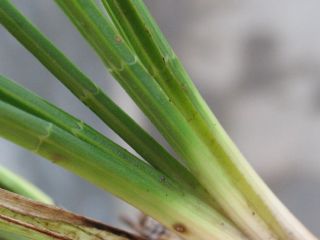
What is the orchid petiole ring? A leaf structure shaped like a finger ring
The orchid's finger ring: both Cymbidium goeringii (spring orchid) and Cymbidium ensifolium (Chinese cymbidium) have a petiole ring, located roughly within 1-4 cm of the orchid pseudobulb, appearing as a ring-shaped protrusion, the dividing line between the petiole and the leaf blade; when the leaf withers it breaks off at the finger ring. The appearance of the petiole ring also indicates that this seedling is about to reach maturity. Orchid leaves often drop at a certain point at the base, and this point is usually formed by transverse...
Orchid leaves often drop at a certain point at the base, and this point is usually composed of several layers of thin-walled cells separated transversely between the leaf blade and the leaf base (petiole), called the "joint" (petiole ring); among the various native epiphytic orchids, the joint on the leaf is especially obvious. Some also call it the "petiole ring" before the leaf drops, and the "petiole scar" after the leaf has dropped; in orchid circles it is commonly known as the "false finger ring".