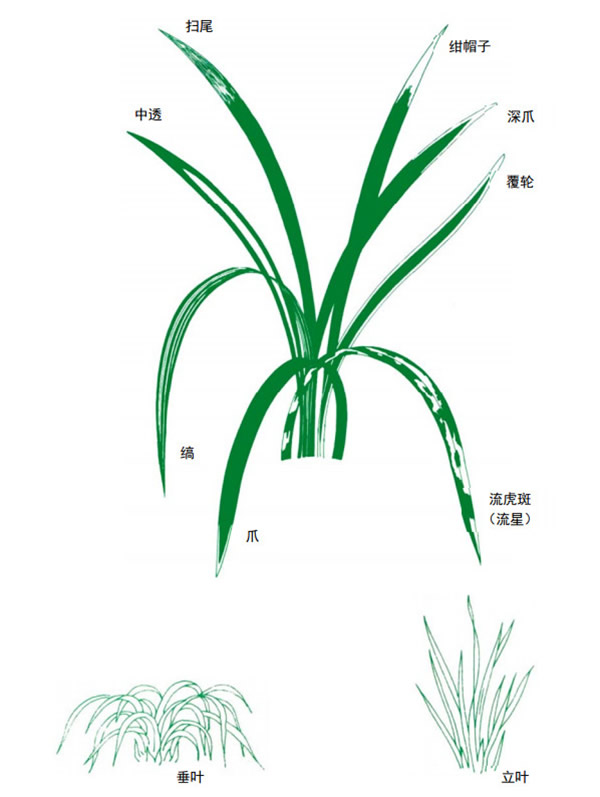
A Guide to Appreciating Orchid Leaf Variegation and Leaf Shapes
The white or yellow patches and patterns that appear on the leaves of Chinese orchids (Cymbidium) are called "yi" (variegation), and orchids cultivated for the changing patterns on their leaves are called "yi orchids" (variegated orchids). According to the standards of Japan and Taiwan, China, there are as many as 35 types of variegation patterns. Each type of pattern is called 1 yi; those with multiple patterns and spots are called "comprehensive yi," but on the same leaf...
The white or yellow patches and patterns that appear on the leaves of Chinese orchids (Cymbidium) are called "yi" (variegation), and orchids cultivated for the changing patterns on their leaves are called "yi orchids" (variegated orchids). According to the standards of Japan and Taiwan, China, there are as many as 35 types of variegation patterns. Each type of pattern is called 1 yi; those with multiple patterns and spots are called "comprehensive yi," but the phenomenon of multiple patterns appearing on the same leaf is extremely rare.
Looking across the mainland orchid community, in recent years growers have gradually shaken off the traditional aesthetic mindset and sensibility that valued only flower artistry while paying little attention to leaf variegation. The pursuit and affection for leaf-variegated fixed orchid lines has become a new trend, with a tendency to heat up. Most orchid enthusiasts deeply hope that the orchids in their hands will one day evolve elegant leaf variegation. In this way, it can add both ornamental value and economic value. Leaf-variegated orchids have truly become one of the mainstream directions in Chinese orchid cultivation today.
(1) Green-leaf yi: refers to those that, through observation during cultivation, have shown no variegation response.
(2) Yunjing (cloud well): refers to promising varieties originally having cultivation value that are expected to produce variegation.
(3) Tiaoyin (striped silver): during cultivation, white silver threads have already appeared in the leaf width, indicating variegation.
(4) Anyin (hidden silver): the variegation of fine silver-thread groups hidden on the leaf surface and leaf underside.
(5) Fuyin (floating silver): the variegation in which greyish-white silver-thread groups can be seen with the naked eye and are widely distributed across a leaf surface filled with green pigment.
(6) Huidi (grey base): the variegation in which the silver-thread groups have developed to the extreme, and the original green pigment from the leaf surface to the leaf underside has become pale white or pale grey-green. The variegation of a surface about to produce yi.
(7) Silver-color unification: the variegation in which the silver-thread groups have evolved to the extreme and the introduced pigment appears unified as one, allowing the direction of variegation to be judged.
(8) Zhongban yi (central patch yi): the variegation in which the central vein is bright and the secondary veins produce line variegation.
(9) Zhongban gao yi (central patch stripe yi): the variegation in which the central vein is bright and line variegation extends from the leaf base toward the leaf tip at the secondary veins and other areas.
(10) Baojin zhao gao (precious brocade claw stripe): having claw-stripe variegation, with both the front and back of the leaf bearing a fu (decayed/grey) base, fine stripes, and vivid pigment.
(11) Zhongtou yi (central transparency yi): the variegation in which the central vein is transparent and the leaf tip section remains unchanged green. This green is called the ganmao (dark blue-green cap).
(12) Zhongtou gao yi (central transparency stripe yi): the variegation in which the central vein is transparent, the secondary veins produce stripe variegation, and it bears a ganmao cap; this is called zhongtou gao yi.
(13) Zhongtou fine stripe yi (central transparency fine stripe yi): the variegation in which the central vein is transparent, the secondary veins produce line variegation, and it presents overall fine-line stripe variegation.
(14) Highest variegation: presenting both central patch and central transparency variegation, that is, variegation has extended over the whole leaf and no green pigment remains.
(15) Super-high variegation: presenting central patch, central transparency, and claw stripe variegation all three, that is, the original green pigment is forced out beyond the leaf body, and the entire leaf presents white, yellow, grey and other colors. Also called Youli.
(16) Yin-yang variegation: presenting central patch, central transparency, and claw variegation all three, that is, the variegation appears on one side of the leaf while the other side is green-purple.
(17) Small sweep-tail: refers to those inherently containing variegation at the leaf tip.
(18) Large sweep-tail: refers to those inherently containing variegation at the leaf tip, with the variegation extending over more than half a leaf surface (section).
(19) Golden-body sweep: the variegation in which the entire leaf presents fu (decayed/grey), either inherent or evolved through cultivation.
(20) Fu (decay): also called grey. The variegation of those inherently rich in fu, or those that have evolved to present fu through cultivation. Both belong to the variegation of the most promising color-flower varieties.
(21) Claw yi: also called bird's beak. The variegation in which the leaf tip produces variegation while the other parts remain green leaves.
(22) Inserted yi: the stripe variegation further evolved from the bird's beak. The variegation in which lines are inserted from the leaf tip section.
(23) Wide-mouth claw yi: a claw variegation deeper and thicker than the ordinary bird's beak.
(24) Small rim: the line variegation evolved from the bird's beak to both sides of the leaf base.
(25) Large rim: the line variegation evolved from the wide mouth (also called crown yi) to both sides of the leaf base.
(26) Claw stripe yi: having a bird's beak and further evolving onto the leaf surface to present line variegation; this is called claw stripe.
(27) Wide claw stripe yi: the variegation in which a promising variety originally having crown yi evolves line variegation. Those with thick lines are called thick
stripe yi, and those with fine lines are called fine stripe yi.
(28) Crown yi: after cultivation, a deep claw evolves, and when the claw base is wide and thick it is called a crown. It is the highest-grade variegation of claw yi.
(29) Crown stripe yi: the evolved form of crown yi, in which the leaf width contains stripe variegation.
(30) Highest crown yi: among crown fine stripe yi, those containing considerable pigment constitute the highest-grade variegation.
(31) Crane yi: the highest-grade expression of claw yi, crown yi, and the like.
(32) Crane stripe yi: the variegation in which crane yi further evolves patch-stripe variegation, each enhancing the other's brilliance.
(33) First bright then receding: the variegation in which the variegation is vivid when the shoot is small, then recedes back to green leaves as it matures.
(34) First dark then bright: the variegation in which the variegation is dark and pale when the shoot is small, then gradually becomes vivid and bright as it matures.
(35) Black bird's beak: originally green, after cultivation it presents black claw variegation; striped variegation is then called black bird's beak or black stripe yi.