-

Grim Situation of Major Pests and Diseases at the Wheat Ear Stage
At present, wheat in the Jianghuai, Huanghuai and other regions has successively entered the booting and heading stages, which is an important period for yield formation and also a critical period for the occurrence and control of pests and diseases. Affected by last year's warm winter, the base number of wheat pests and diseases in some areas is relatively high; recently, continuous rainy weather has appeared in Jianghuai and other areas,
-
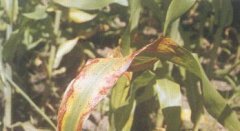
Causes, Symptoms and Control Methods of Sorghum Sheath Blight
What causes sorghum sheath blight? What are its symptoms? How should it be controlled? Let's take a look together. Symptoms: It mainly damages the leaves and the base of the stem. On the leaf sheaths near the ground level, small white-green water-soaked lesions first appear, then expand into oval shapes, with brown margins and lighter centers. Lesions on the leaves appear grayish-green or grayish-white and cloud-like, and most of the lesions merge into a tiger-stripe pattern, causing the entire leaf to wither and die.
-
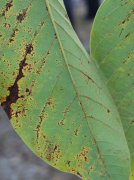
Symptoms and Control Methods of Rust Disease in Atemoya Orchards
Because orchards in mountainous areas and river valleys have high humidity, they are prone to triggering the spread and expansion of "annona rust." The Taitung District Agricultural Research and Extension Station of the Council of Agriculture (hereinafter referred to as the Taitung Station) recently monitored Beinan, Luye, and Donghe, among other areas, and found that some atemoya orchards
-
Symptom Identification and Control Methods for Truffle Disease in Oyster Mushrooms
Oyster mushroom (scientific name: Pleurotus ostreatus; also known as oyster cap, rough-skinned oyster mushroom, oyster mushroom, black peony mushroom, and called Xiuzhen mushroom in Taiwan, China) is a species in the family Pleurotaceae, order Agaricales, phylum Basidiomycota, and is a quite common gray edible mushroom. The germ tubes of the oyster mushroom continuously branch and elongate, forming
-
Occurrence and Control Methods of Pests and Diseases in Hami Melon Cultivation
I. Bacterial Leaf Spot Symptoms: In the early stage, water-soaked lesions appear near the veins on the underside of leaves. The lesions expand rapidly and merge together, with a yellow halo at the edges. Control method: In the early stage of the disease, spray the leaves with 77% Duoning at 500 times dilution or 3% Zhongshengjunsu at 800 times dilution 2-3 times, once every 4-5 days.
-
Causes and Control Methods of Citrus Sunburn
Citrus sunburn is a common physiological disease in hot seasons, mainly affecting leaves, fruit and bark. The occurrence of this disease is mainly caused by exposure to high temperatures and scorching sun. At noon and in the afternoon during hot weather, the local temperature of orange trees exposed to direct sunlight rises sharply
-
How to prevent and control spring soybean virus disease? Detailed explanation of occurrence patterns and control methods
Viral disease is a major disease of spring soybean, causing about 15% yield loss in normal outbreak years and over 50% yield loss in severe outbreak years. 1 Symptoms After spring soybean is infected, the upper leaves first show light yellow-green mottling, and the mesophyll bulges in a blister-like manner along the veins; then the mottling and wrinkling become increasingly severe, the leaves become deformed, the mesophyll protrudes, the leaf margins curl downward, plant growth is clearly stunted, the number of pods decreases, the pods are small and slender, and the pods show deformed symptoms such as flattening and bending. After infected spring soybean matures, the seeds are clearly smaller, and light brown streaks can appear on the seeds.
-
Occurrence patterns and control methods of soybean sclerotinia stem rot
Soybean sclerotinia stem rot occurs commonly in Heilongjiang Province. In 2001, the disease was relatively severe in Raohe County. In continuous soybean cropping fields, the disease incidence rate was 3%-30%, and in individual fields following American sunflower, the incidence rate reached 50%. In severely affected fields, the crop was even completely lost. 1 Causes of the disease 1.1 Climatic conditions In mid-to-late July, continuous low temperature and scant sunshine
-
Control Methods and Technical Key Points for Rice Bakanae Disease
Symptoms: After rice is infected with bakanae disease, the internodes of the affected plants elongate, growing thin and tall, the plant color is paler, the leaves are narrower than those of normal plants, there are varying numbers of adventitious roots inside or outside the leaf sheaths at the nodes, and white mold grows inside the rice stalks, later turning light red, sometimes
-
Occurrence and Control Methods of Rice Pests and Diseases at the Mid-Season
According to field surveys of pests and diseases by each forecasting station, the field moth population of the third generation of the rice leaf roller is currently large, and the egg mass is high. All towns are urged to actively carry out control work. I. Occurrence situation: (1) Third generation of the rice leaf roller: 1. Field moth population: According to observations at each forecasting station, the field moth population
条件筛选