Symptoms and Control Methods of Rust Disease in Atemoya Orchards
Because orchards in mountainous areas and river valleys have high humidity, they are prone to triggering the spread and expansion of "annona rust." The Taitung District Agricultural Research and Extension Station of the Council of Agriculture (hereinafter referred to as the Taitung Station) recently monitored Beinan, Luye, and Donghe, among other areas, and found that some atemoya orchards
Because orchards in mountainous areas and river valleys have high humidity, they are prone to triggering the spread and expansion of "annona rust." The Taitung District Agricultural Research and Extension Station of the Council of Agriculture (hereinafter referred to as the Taitung Station) recently monitored Beinan, Luye, and Donghe, among other areas, and found that some atemoya orchards have been infected with rust disease. It calls on farmers to strengthen orchard inspections; in the early stages of the disease, control measures can be adopted to reduce losses.
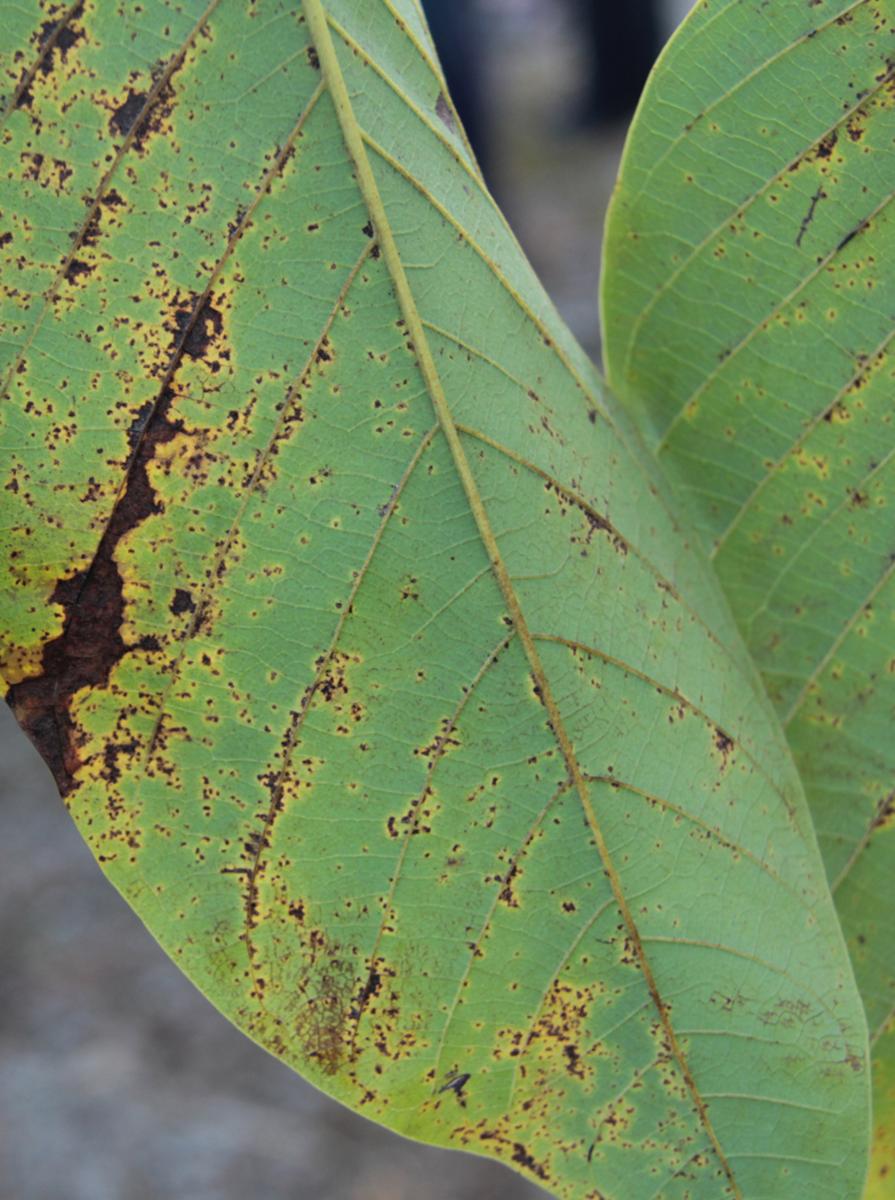
The early symptoms of annona rust are similar to those of spider mites, causing some farmers to use the wrong pesticide when attempting control. In the early stages, rust disease usually occurs only on a few mature leaves at the base of the branches. On the underside of the leaves, needle-head-shaped yellow powdery spore masses can be seen, which then expand; in severe cases, they cover the entire leaf, causing the leaves to yellow and drop. According to statistics, from September of last year (2017), farmers began reporting rust disease one after another, and after December many orchards were severely affected, causing large numbers of leaves to drop and affecting the harvest.
In the early stages, rust disease lesions are similar to those of spider mites, and needle-head-shaped yellow powdery spore masses can be seen on the underside of the leaves.
To prevent rust disease damage, the Taitung Station recommends the use of emergency control pesticides, including: 10% azoxystrobin aqueous suspension, 23% azoxystrobin aqueous suspension, 250g/L (25% w/v) azoxystrobin aqueous suspension, 50% azoxystrobin water-dispersible granules, 50% trifloxystrobin water-dispersible granules, 43.7% trifloxystrobin aqueous suspension, 500g/L (50% w/v) trifloxystrobin aqueous suspension, 23.6% pyraclostrobin emulsion, 25.9% difenoconazole water-based emulsion, and 250g/L (25% w/v) difenoconazole water-based emulsion.
The Taitung Station further pointed out that in order to avoid the development of pesticide resistance, farmers are advised to alternate pesticides with different modes of action. For example, the mode-of-action code for azoxystrobin, pyraclostrobin, and trifloxystrobin is C3, while that for difenoconazole is G1; alternate the use of C3 and G1 pesticides. In addition, if it is not possible to correctly determine whether the lesions are rust disease, farmers may also consult the Taitung Station's Plant Protection Laboratory or the pest and disease diagnosis service stations in each district.