-

How should lotus root cultivation be managed?
How should lotus root cultivation be managed? Please give a detailed introduction. Lotus root cultivation can be managed by referring to the following methods: For topdressing lotus root, apply fertilizer 2-3 times. The first time is when 1-2 standing leaves have grown, the second time can be before the rows close, and the third time is when the rear ridge leaves appear. Per 667 sq m (mu), for the first application use 200...
-
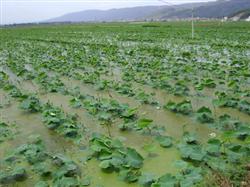
What is the difference between deep-water lotus root and shallow-water lotus root? Explained in one article
What is the difference between deep-water lotus root and shallow-water lotus root? Please give an introduction. Deep-water lotus root and shallow-water lotus root are different. According to the adaptability of lotus root to water level, it can be divided into two ecological types: shallow-water lotus root and deep-water lotus root. Shallow-water lotus root is suitable for a water level of 10-20 cm, with a maximum water depth tolerance of 30-50 cm. Deep-water lotus root is suitable for a water level of 30-50 cm, with a maximum water depth tolerance...
-

What are the control methods for lotus root rot?
How do you control rot when growing lotus root? Please give an introduction. Lotus root rot, commonly called stalk rot, mainly damages the underground stem, and the leaves and stalks can also be affected. Affected leaves form green wilt-colored patches along the leaf margins and curl downward, then the whole leaf turns brown, and the leaf stalk shrivels and dies from top to bottom. When it occurs severely, the whole field turns a withered yellow, caus...
-

How to Grow Lotus Root for High Yield? Key Growing Techniques Explained
How can lotus root be grown for high yield? We hope experienced readers will share their advice. Zhongdi Web has summarized the key points for achieving high yield in lotus root cultivation, listed below for readers' reference. Point 1: Choose high-quality lotus root planting stock: you can use a mid-season variety such as the large purple-red lotus root, whose main rhizome has 4-5 nodes. Point 2: Disinfect the...
-

Detailed Explanation of Key Techniques for Growing Early-Maturing Lotus Root
What are the techniques for growing early-maturing lotus root? What methods can make lotus root mature early? We also ask experienced netizens to help introduce them. Zhongdiwang has compiled several key techniques for making lotus root mature early, listed below for netizens' reference. Method 1: Select excellent lotus root seed stock: choose ones that are undamaged and disease-free, with good varietal characteristics, large size...
-

Complete Guide to Lotus Root Varieties and Introduction to Common Varieties
What lotus root varieties are there? Where can I find a complete guide to lotus root varieties? We ask knowledgeable readers to help introduce them. Lotus root is slightly sweet and crisp, and can be eaten raw or cooked; it is one of the common table vegetables. But exactly which lotus root varieties exist is something some readers still do not know well, so Zhongdi Net has compiled the commonly cultivated lotus root varieties, detailed below...
-

Why does lotus root only grow leaves and not rhizomes?
Why does lotus root only grow leaves and not rhizomes? How should lotus root be fertilized? Experienced gardeners are asked to help explain. The main reason lotus root does not form rhizomes is that balanced fertilization was not achieved: too much nitrogen fertilizer was applied and too little potassium fertilizer. To achieve high quality and high yield in lotus root, you need to "reduce nitrogen, control phosphorus, and increase potassium." Therefore Zhongdiwang has compiled the lotus root...
-

What are the methods for weed control in lotus root cultivation?
How do you control weeds when growing lotus root? Which herbicide works better? We'd also like experienced growers to share their advice. During the growth of lotus root, especially in the early stage of shallow-water lotus root growth, the paddy field contains many weeds such as pondweed, needle spikerush, dwarf arrowhead, triangular bulrush, four-leaf clover fern, and black algae, which grow quickly and affect lotus root growth, because...
-

Lotus root cultivation techniques video and image collection
Lotus root belongs to the water lily family. Lotus root is slightly sweet and crisp, and can be eaten raw or cooked; it is one of the common table vegetables. Lotus root is also a plant with considerable medicinal value; its roots, leaves, flowers, stamens and fruits are all treasures, and all can be used as nourishing medicine. Made into powder, lotus root can aid digestion and stop diarrhea, stimulate the appetite and clear heat, nourish and calm the constitution, and prevent internal bleeding; it is a...
-

Methods and Key Technical Points for Growing Lotus Root in Dryland
How do you grow lotus root in dryland? If you have never tried growing lotus root in dryland, how should you grow it? Dryland lotus root cultivation is an emerging high-efficiency growing technique that frees lotus root cultivation from dependence on water, enabling aquatic lotus to be grown on dryland, and the suitable growing areas are constantly expanding. Because dryland lotus root growing can be done on either a large or small area, with simple management, low input, ...
条件筛选