-
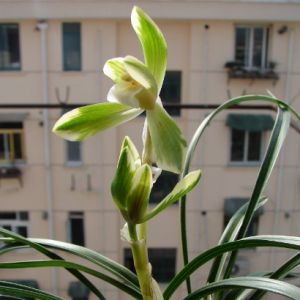
An Introduction to the Characteristics and Care Essentials of the Snow Mountain Spring Orchid Variety
Snow Mountain Tiancao: the leaf margins are edged with a white marginal variegation, and the flowers also carry a marginal edging; it is an affordable variety that excels in both foliage and flowers. This variety is easy to cultivate, has a high propagation rate, and also has a high flowering rate.
-
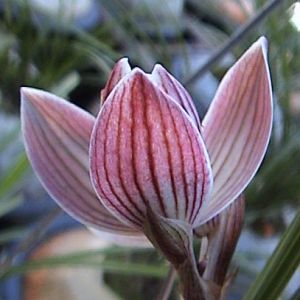
Introduction to the Characteristics of the Hentiangao Cymbidium Lianbanlan Variety
This orchid is a famous Lianban orchid from Yunlong, Dali. Because its flowers bloom rather low but its spirit aspires high, it can only raise its head and howl at the sky, hence the name Hentiangao (Resenting the Sky's Height).
-
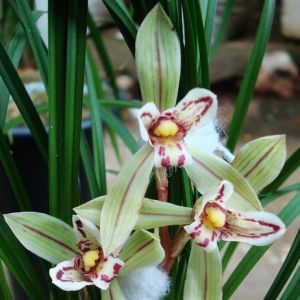
Introduction to and Characteristics of the Cymbidium lianpan 'Xinhai Die' Variety
Xinhai Die: Xinhai Die, also known as Xinghai Die, has slender leaves that droop slightly, usually with 5 leaves, and occasionally produces leaf variegation (ye die). The leaf buds are purplish red, and after opening, the leaf margins are pale red. The leaves are 10-25cm long and 0.3-0.5cm wide, with a fine texture and glossy surface, and shallow leaf grooves. The leaf buds emerge with a reddish tint and gradually turn green. Each scape bears 2-3 flowers, with all the petals (peng ban) transformed into butterfly-like (die) forms, appearing cat-ear-shaped with rounded tips, and the petals curl outward to combine with the lip into a three-star butterfly (sanxing die). The lip has a U-shaped red patch set against a white background, making the colors vivid and very striking. It was cultivated and selected by the Xinhai Orchid Garden in Yongping County, Dali Prefecture, and was named Xinghai Die by Li Yinglong in August 2005. It has been one of the most sought-after varieties in the Yunnan orchid market in recent years. It won the Gold Award at the 14th China (Yuxi) Orchid Expo in 2004 and the 15th China (Leshan) Orchid Expo in 2005, among others.
-
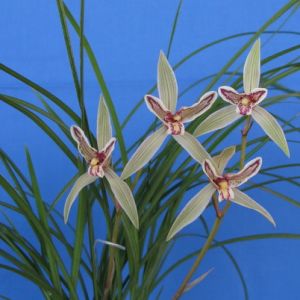
Cymbidium tortisepalum 'Erfeng' (Fengyu Xiaguan) Variety Introduction
In 2006, the sky-high-priced orchid "Datang Fengyu" became a household name, but few realize that "Datang Fengyu" is the name of a series formed by three types of leaf variegation, namely: Da Feng, Er Feng, and San Feng. Da Feng has a short, compact plant form, sometimes with the central leaf completely transformed into a lip, as if a tongue grows out of the leaf, and it blooms a true-form pistil petal orchid, also known as a three-star butterfly. Er Feng, (...
-
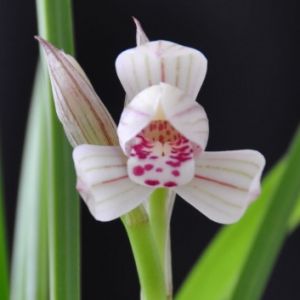
Introduction to the Characteristics and Cultivation Methods of the Runhe Lotus-Petal Orchid Variety
This orchid's leaves are 40CM-60CM long and 0.8CM-1.2CM wide, with leaf tips shaped like a spoon bearing white-tipped crystal, a bold and upright leaf form belonging to the semi-pendulous type, with a pronounced dehydrated look. One stem bears three flowers, each bloom identical, with colors soft and restrained rather than blatantly gaudy, like a shy young maiden. It symbolizes cultivation of character. The flowers bloom above the leaves, the overall form is rigorous, and the proportions are harmonious, with fine...
-
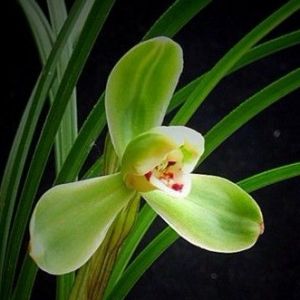
Detailed Introduction to the Characteristics of the Huomei Cymbidium Variety
Huomei was discovered in the early spring of 2003, found by a Mr. Zhou, an orchid enthusiast from the south slope of Nanyue Mountain in Huoshan County, at a hillside called Mozijian about 3-4 km from the county town. The plant height is 25 cm, and the grass color also carries a yellowish tinge even when grown in shade. It is a medium-sized flower, with outer petals tightly edged and round-headed, slender roots, Guanyin-held small Ruyi tongue, and it blooms frequently. In the spring of 2005, I purchased two seedlings from Huoshan, and in the spring of 2008, for...
-
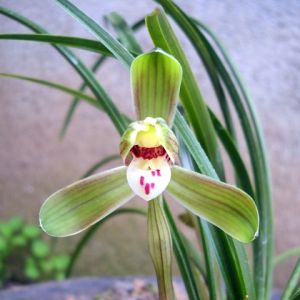
Introduction and Appreciation of the Chunlan 'Caixia Xianzi' Variety
Flower-obsessed Girl: The New Meixian at Xinchang orchid enthusiast Pan Ruiping's home. He is also the owner of 'Ruihe'. It is said that this new Meixian was also discovered in Guoju, Beilun. At that time on the mountain, Brother Pan traded a single plant of 'Ruihe' to the fellow orchid digger who went with him to dig orchids, in exchange for three old pseudobulbs. After seeing the flower this year, I was moved by the thought that this flower was also dug up in Beilun (I'm dizzy, it seems quite a few good things from Beilun have been dug up and taken away). So they asked me, as a member of the home community, to name this new flower. I was quite apprehensive, and after thinking for several days I came up with a few names for Brother Rui to choose from and decide. In the end he decided to name this new flower 'Caixia Xianzi' (Rosy Cloud Fairy). At the time, I chose this name mainly because of the flower's color, like the morning glow in the sky. I felt it was quite rare for Beilun to produce a bicolor meixian-form shuixian.. (I admit I have a very strong hometown sentiment.) This 'Caixia Xianzi', standing gracefully, do you like it? Hehe!
-
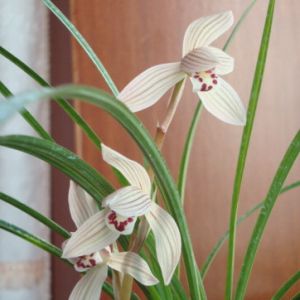
Introduction to the Characteristics of the Cinnabar Thread Jade Concubine Lotus-petal Orchid Variety
Cinnabar Thread Jade Concubine is a broad-leaf lotus-petal orchid (Cymbidium tortisepalum var. longibracteatum). Its flowers are larger than those of Cinnabar Thread Jade Lotus, and stately; its color is pure white with a glutinous elegance, appearing noble and generous. Cinnabar Thread Jade Lotus is a medium-broad-leaf lotus-petal orchid; relatively speaking, its flowers are somewhat smaller, the petals thinner, and the color paler. But on the whole they are very similar. Cinnabar Thread White Lotus has relatively finer, smaller leaves...
-
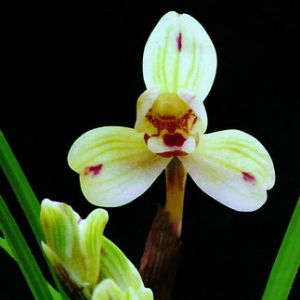
Introduction to the Characteristics of the Yutangchun Cymbidium tortisepalum Variety
Yutangchun is a standard white-flowered plum-petal form of Cymbidium tortisepalum (Lianban orchid), with medium-wide leaves and a semi-upright leaf type; it is currently few in number.
-
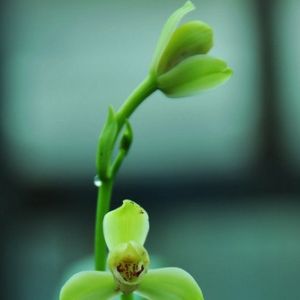
A Brief Introduction to the Characteristics of the Jianlan Cultivar Tianchuan Yumei
This is a Sijilan (four-season orchid) wild-collected cultivar obtained in 1996 by Mr. Chen Jianxin of Muchuan County from a local friend, and developed through ten years of cultivation and selection. It first bloomed in 2002, and its flower posture and form have remained stable to this day. It was named by Chen Jianxin and Zhou Naiqing. It was first divided and planted in September 2005, and those who introduced and cultivated it include Zhou Naiqing, Liu Wenlong, Wang Yuecheng, Zhang Dafu...
条件筛选