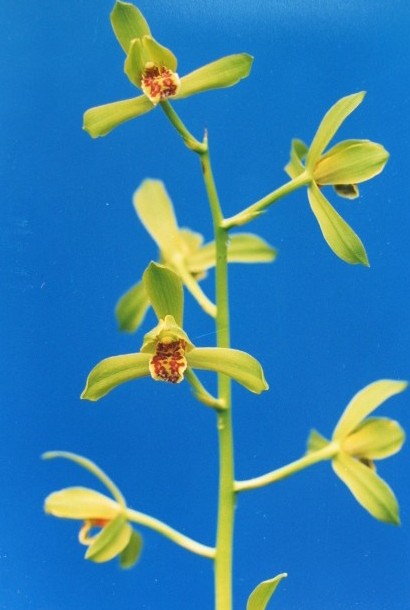
Loumei Huilan Orchid Variety Introduction: A Classic Huilan Meibian Masterpiece
Petal type: Green-shell lotus-form narcissus petal. History: Selected during the Guangxu period of the Qing Dynasty (1892) by the Lou family of Shaoxing, Zhejiang, hence the name "Loumei." Legend has it that after the host had finished entertaining guests and was seeing them to the door, this huilan happened to unfurl its petals and release its fragrance, so the host invited the guests back to admire the flowers, hence it is also called "Liumei." Characteristics: The three outer petals have large heads, fine root contractions, flat shoulders, light...
Petal type: Green-shell lotus-form narcissus petal.
History: Selected during the Guangxu period of the Qing Dynasty (1892) by the Lou family of Shaoxing, Zhejiang, hence the name "Loumei." Legend has it that after the host had finished entertaining guests and was seeing them to the door, this huilan happened to unfurl its petals and release its fragrance, so the host invited the guests back to admire the flowers, hence it is also called "Liumei."
Characteristics: The three outer petals have large heads, fine root contractions, flat shoulders, a shallow cupped hold, and a large round spread tongue. Divided-clump silkworm-moth hold, flower stem fine and long. Flower color emerald green. The drawback is that the side petals' root contractions are somewhat fine and long. Listed as one of the new eight varieties of huilan flowers.
Green huilan "Loumei," from "A Brief History of Orchids and Huilan": "Produced during the middle Guangxu period, by the Lou family of Shaoxing. Three petals with large heads, fine contractions, divided-clump silkworm-moth hold, tongue large and not rolling, color green, shoulders flat, stem fine and long. Elegant and pleasing to behold."
Shen Yuanru and his son's book "Orchids" also records "Loumei": "Green-shell lotus-form narcissus petal. History: Selected during the middle Guangxu period of the Qing Dynasty by the Lou family of Shaoxing, hence the name Loumei. According to another legend, the host was entertaining guests in the orchid hall at the time, and after the banquet, while seeing the guests to the door, a pot of orchid happened to burst its buds and unfurl its petals, so the host brought the guests back inside to admire it, naming it 'Liumei,' later changed to 'Loumei.' Characteristics: Three petals with large heads and fine root contractions, divided-clump silkworm-moth hold, large spread tongue (after fully opening, the front end rolls back), color green, shoulders flat, flower stem fine and long, fully comparable to Dayipin."
"Loumei" has long been highly praised in orchid-growing circles, believed to be the only flower comparable to "Dayipin." The leaves of "Loumei" are a mix of semi-drooping and arching-drooping, with the widest leaf reaching 0.8cm and leaf length reaching about 55cm. "An Illustrated Appreciation Compendium of Famous and Precious Chinese Orchid Varieties" considers this variety to have "medium to slightly short leaves. Arching-drooping." In reality the actual plant's leaves do not appear particularly short. The leaf color is emerald green with a glossy sheen, the leaf surface has U-shaped deep grooves, with the U-shaped grooves of the basal leaves being more pronounced, the leaf margins have fine teeth, the lateral veins are prominent, the leaf tips taper smoothly, the leaf sheaths are fine, tall and round-headed, the basal leaves are hard in texture, curving and drooping with little droop, and although the plant form is fine, it combines rigidity and suppleness. After the leaf buds emerge from the sheath they are pale white-green, with the upper portion being more heavily green, and the bud tips show indistinct faint iridescence. The flower buds are pale white-green, with light purplish-red fine vein lines extending to the top, the vein spacing is wide, and between the veins small light purplish-red spots are visible. The sheath margins have broad, slightly thinner white sandy edges. The flower stem is a "lamp-wick stem," rising well above the foliage, bearing 6-9 flowers, with strong plants reaching 11 flowers. The bud arrangement is sparse and airy, the small bracts are fine and long, and the stem, small bud sheaths, bracts, and flowers are all one color of jade green. The three outer petals are broad and large, with large heads, pointed tips, and fine root contractions, possessing the root-contraction and angle-releasing form. The texture is glutinous and moist with visibly thick flesh, shoulders flat, the main petal slanting upward as a cover, the five petals divided into clumps, a shallow soft cupped silkworm-moth hold, a large round spread tongue, with striking red spots on the tongue surface, the tongue tip rolling back after being open for a long time. The flower color is emerald green and handsome, the petal surface like waxed coating, spirited and dignified, not losing its form after being open for a long time. The greatest characteristic of "Loumei" is that it does not develop faded patches, and although the stamenization on the hold is slight, it holds up well, which is also very rare. In appreciating "Loumei" I believe there are two other outstanding points of appreciation: first, its flower color, which among green huilan belongs to the type that is very pure and clean green; second, the red spots on the tongue are very brilliantly colored, making the overall flower's contrast exceptionally strong. "Loumei" is a rare lotus-form narcissus among huilan flowers. Its shortcoming is that the main petal is slightly thin, and the side sepals' root contractions are slightly fine and long.