-

How to identify Schisandra chinensis? Learn these few tricks to tell it apart easily
Schisandra chinensis is also known as northern schisandra. It is a perennial deciduous woody vine of the genus Schisandra in the family Magnoliaceae, and its fruit is used as medicine. Schisandra chinensis mainly contains volatile oil, whose main components include citric acid, a-ylangene, sugars, benzoic acid, citral, and others. The seeds contain schisandrin and others. The fruit is sour in taste and warm in nature. It has functions such as astringing, relieving cough, nourishing the kidney, securing essence, and promoting fluid production. It mainly treats cough and asthma, lung deficiency, spontaneous sweating, insomnia, chronic diarrhea, fluid depletion, and other conditions. Schisandra chinensis is mainly produced in the three provinces of Heilongjiang, Jilin, and Liaoning. In addition, Hebei, Inner Mongolia, Shandong,
-
How to Identify Real vs. Fake Gastrodia elata? A Few Practical Methods for You
"Parrot beak, concave navel, ringed dots and dried ginger skin outside, remember the rosin-like cross-section." This is the mnemonic for identifying real vs. fake Gastrodia elata. In this mnemonic, the rosin-like cross-section is an important basis for judging the authenticity of Gastrodia elata: it is long-oval, slightly flattened, wrinkled, sometimes curved. One end has a residual stem base or a reddish-brown withered bud (called the parrot beak), and the other end has a round navel-shaped scar (commonly called the concave navel). The outer skin is pale yellow or earth yellow, slightly transparent or opaque, with horizontal ring lines formed by dot-like protrusions. The texture is hard, not easy to break, and the cross-section is slightly flat and horny. The taste is slightly pungent and sweet, and when chewed it is crisp
-
What are the methods for identifying the macroscopic characteristics of Gastrodia elata and fake Gastrodia elata?
In recent years, similar plant tubers have often appeared on the market, passing off fake products as genuine and passing off fake products as genuine Gastrodia elata. In order to reduce mistakes and clean up the market, the macroscopic characteristics of several easily confused fake Gastrodia elata are introduced here: Gastrodia elata: "Parrot beak, concave navel, outside has ring spots and dried ginger skin, rosin-like cross-section must be remembered." This is the mnemonic for identifying true and false Gastrodia elata. In this mnemonic, the rosin-like cross-section is an important basis for judging the authenticity of Gastrodia elata. The dried tuber of authentic Gastrodia elata is long elliptical, often flattened, shrunken and curved, 6-13 cm long, 2-6 cm in diameter. One end has a residual stem base or a red-brown withered
-
How to Identify True and False Gastrodia? A Detailed Guide to Practical Identification Methods
Gastrodia is a precious Chinese medicinal herb. With the gradual shortage of wild Gastrodia resources, Gastrodia has been listed as a nationally protected third-class endangered plant. In recent years, although artificial cultivation of Gastrodia has progressed rapidly, due to large demand, market shortages, and firm prices, some lawbreakers have taken the opportunity to pass off fakes as genuine. For this reason, the methods for identifying true and false Gastrodia are introduced as follows: 1. True Gastrodia. It has eight major characteristics: (1) The underground tuber is ovate or elliptical; after processing, steaming, and drying, it usually appears as a long ellipse, slightly flat, sometimes curved,
-
How to Identify Authentic vs. Fake Gastrodia elata? A Quick Guide to Telling Real from Fake
In recent years, due to excessive harvesting for medicinal use, wild Gastrodia elata has been steadily declining, and the medicinal material is in very short supply. Gastrodia elata is an important medicinal material for treating vertigo. Its nature and flavor are sweet and neutral, and it enters the liver meridian. Its main function is to calm the liver and extinguish wind. For dizziness and blurred vision, flushed face, and light-headedness with heavy feet caused by liver yang rising, or for high fever with convulsions, epileptic spasms, and opisthotonus caused by internal stirring of liver wind, taking Gastrodia elata in combination with other drugs often produces good results. In view of this, some unscrupulous merchants pass off similar rhizomes as Gastrodia elata to deceive consumers. On the market
-

What Is the Price of Saffron? A Detailed Guide to Identifying Genuine vs. Fake
Saffron Prices and How to Tell Real from Fake
-
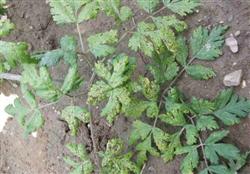
How to identify and control brown spot disease of Angelica sinensis?
What is brown spot disease of Angelica sinensis? How to control it? Please provide guidance. The pathogen of brown spot disease of Angelica sinensis is a fungus of the genus Septoria in the subphylum Deuteromycotina. The pycnidia are round, and the conidia are filiform to needle-shaped, colorless and transparent, straight or slightly curved, mostly with slightly pointed tips, with 1-3 septa. 1. Damage symptoms: it damages the leaves. At...
条件筛选