-

Soybean Good Seed Propagation Methods and Key Technical Points
Soybean is a self-pollinating crop. Due to mechanical mixing, adverse climatic and cultivation conditions, and natural cross-pollination, the varietal characteristics often deteriorate. Therefore, self-pollinated seeds cannot be used long-term, and seeds should be replaced every three years. Thus, it is necessary to persist in purification and rejuvenation and carry out good propagation work to maintain the varietal characteristics of good varieties. 1. Purification and rejuvenation methods for soybean varieties (1) Line selection The commonly used method for soybean purification and rejuvenation consists of three steps: individual plant selection, line identification, and mixed high-ratio propagation. Three plots are established: an individual plant selection nursery,
-
Growing button mushrooms (Agaricus bisporus) in winter-fallow rice fields delivers good returns
In 2004, our county carried out cultivation demonstrations of growing button mushrooms (Agaricus bisporus) in winter-fallow rice fields across 16 townships. After the late rice harvest, rice straw and other materials were used as the main raw materials and composted and fermented into growing substrate, making use of the winter temperature and light resources and the idle winter season of the rice fields; open-field cultivation of button mushrooms achieved notable returns. Chen Yeru, a farmer at the Lixian Institute of Agricultural Sciences, is a button mushroom cultivation demonstration household, with a family of 4 people and 2 laborers, and had never previously cultivated edible fungi. After technical training at the Lixian Edible Fungi Research Institute, he set up on his own contracted field
-
How to do a good job of disease prevention in pigeons during different production periods
(1) For squabs during the brooding period, pay attention to preventing trichomoniasis. Trichomoniasis is mainly transmitted directly to squabs by parent pigeons carrying the parasite, so check whether the parent pigeons are carrying it, and if so, treat them promptly. Pay attention to preventing pigeon pox, which is generally prevalent from March to June, so do a good job of vaccination and mosquito control. Once it occurs, timely surgical treatment should be given. A small amount of low-toxicity mosquito-killing water can also be sprayed on the squabs to prevent mosquito bites, but be sure not to use too much. In addition, pay attention to preventing diseases such as coccidiosis, mycoplasmosis and salmonellosis. (2) Young pigeons kept for breeding
-
How good is the Gangyou 22 rice variety? Characteristics and yield introduction
Breeding institutions: Crop Research Institute of Sichuan Academy of Agricultural Sciences and Rice Research Institute of Sichuan Agricultural University. Approval status: approved in 1996 by the Sichuan Provincial Crop Variety Approval Committee and the Guizhou Provincial Crop Variety Approval Committee, and in 1998 by the National Crop Variety Approval Committee. Variety approval number: Guoshendao 980009. Variety source: Gang 46A x CDR22. Characteristics: medium indica late-maturing hybrid rice. Plant height about 110 cm, moderate plant type, thick stems
-
How to make watermelon rind taste good? The method for making licorice watermelon rind strips
Watermelon rind is rich in carbohydrates, minerals and vitamins, and has effects such as clearing heat and detoxifying, and promoting urination. The following introduces the technique for making licorice watermelon rind strips: Cut into strips. Thoroughly wash fresh watermelon rind with clean water, drain off the water, remove the green outer skin and the red flesh, then use a stainless steel knife to cut the watermelon rind into strips 0.2 cm wide and 6 cm long. Salting. First mix sodium benzoate and table salt, in amounts of 0.1% and 10% of the weight of the watermelon rind strips respectively. Then, in a container, salt in the order of one layer of watermelon rind and one layer of mixed salt, with a somewhat larger amount of mixed salt on the topmost layer. The salting time is generally 24 to 48 hours. Rinsing. Put the salted watermelon rind strips into a container holding clean water, changing the water once every 1 hour, until the salt content in the watermelon rind strips drops to 1% (the salt content is tested with a handheld salinity refractometer). Sugar processing. Put the rinsed watermelon rind strips into a bamboo basket and drain off the water. Then, in a container, process with sugar in the order of one layer of watermelon rind strips and one layer of sucrose. The amount of sucrose used is 20% of the fresh watermelon rind strips, and the sugar processing time is 24 to 48 hours. Baking. Take out the sugar-processed watermelon rind, drain off the sugar liquid thoroughly, arrange it evenly on a baking tray, send it into the drying room, and bake at 65 to 70 degrees C until the moisture content of the watermelon rind is 25%. Auxiliary ingredient formula. Calculated per 100 kg of fresh watermelon rind strips, prepare the auxiliary ingredients: sodium saccharin 0.05 kg, monosodium glutamate 0.2 kg, citric acid 0.05 kg, table salt 0.5 kg, potassium sorbate 0.01 kg. Soaking the auxiliary ingredients. Place the dried watermelon rind strips in a container. Dissolve the auxiliary ingredients according to the formula in licorice water, pour into the container, and mix the watermelon rind strips thoroughly from top to bottom. On the second day, mix from top to bottom another 1 to 2 times, leave for 2 days, take out the watermelon rind strips and bake them. The licorice aqueous solution is made by boiling 4 kg of licorice and 25 kg of water per 100 kg of fresh watermelon rind strips, and filtering it. Baking. Evenly arrange the watermelon rind strips that have been soaked with auxiliary ingredients on a baking tray, and send them into the drying room for baking. It is suitable to control the drying room temperature at 60 to 65 degrees C. During baking, turn them several times, and when the moisture content of the product drops to about 25%, the baking is finished. Mixing in licorice powder. Cool the watermelon rind strips at room temperature. Mix licorice powder (used in an amount of 0.1% of the fresh watermelon rind strips) into the watermelon strips, and mix evenly to obtain the finished product.
-
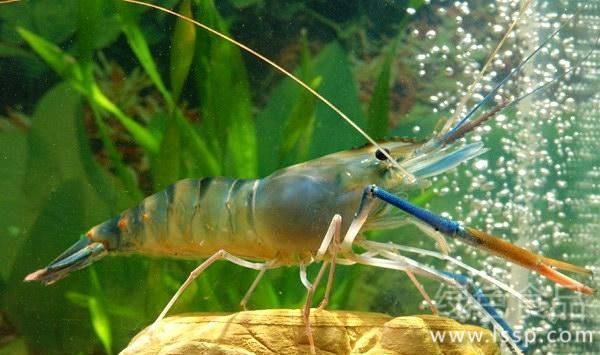
To achieve high yield and good profits from freshwater shrimp and river crabs, grasping six key points is very important
For high yield and good profits from freshwater shrimp and river crabs, grasping the "six key points" is very important
-
What herbicide is good for weed control at the soybean cotyledon stage
Fomesafen (Flex, Douchuoyou) can be used for control. Generally, when soybean has 1 to 3 compound leaves, use 68 to 132 milliliters of 25% fomesafen aqueous solution per mu, add 20 to 30 kilograms of water, and spray evenly. Fomesafen is a selective contact herbicide, mainly absorbed through weed stems and leaves, and can also be absorbed through roots. It should be applied after the volunteer rapeseed in the field has basically emerged.
-
Why oyster mushroom transplanting gives such good yield increases
Practice has shown that thinning and transplanting densely clustered mushroom buds gives good yield increases. The transplanting method is as follows. 1. Transplant at the right time: transplant when the mushroom buds have just appeared. 2. Planting material: there are no strict requirements; they can be planted on either spawn material that has not yet fruited or material that has already been harvested. Spawn material that has not yet fruited helps the mycelium wounds from transplanting heal and the fruiting bodies develop well. 3. Transplanting method and management: transplanting should be done by digging holes in the spawn brick or spawn bed. Place the small clump of mushroom buds that has been picked into the hole that has been dug, and press firmly around it so that the mushroom buds and the spawn material on the surface of the spawn brick or bed
-
How can you ensure a good mushroom harvest in the later stages of oyster mushroom cultivation?
There are many varieties of oyster mushrooms, and according to their fruiting temperature they are divided into four major categories, namely high-temperature type, wide-temperature type, medium-temperature type and low-temperature type. Oyster mushrooms cultivated in spring are generally of the wide-temperature type and high-temperature type; the fruiting temperature of wide-temperature varieties is 2-30°C, and that of high-temperature varieties is 10-32°C. In production, although the temperature meets the fruiting requirements, oyster mushrooms generally produce few mushrooms in the later stages, and the quality is also poor. In fact, if the later-stage management of spring-cultivated oyster mushrooms is strengthened, they can still produce as many good mushrooms as in the early stage. 1. Soaking. For spring-cultivated oyster mushroom bags, after 2-3 flushes of fruiting, the
-
Keeping mountain bees brings high returns and is a good path to increasing income and becoming better off
The mountain bee is a wild economic insect. The honey it makes from the nectar of the many flowers in nature is a fine grade of honey, and its market price can reach 30-40 yuan per kg. Generally, one bucket of mountain bees can yield about 25 kg of honey per year. If the colony is strong, the nectar source is good and the climate is suitable, each colony can produce 40-50 kg of honey. Right now is the peak period for mountain bee colony division, and bringing mountain bees home to raise them is a good project with low investment and quick results. Making and placing the bee bucket. The bee bucket is made up of a bottom bucket, an extension bucket, a bucket bottom and a bucket cap (lid)
条件筛选