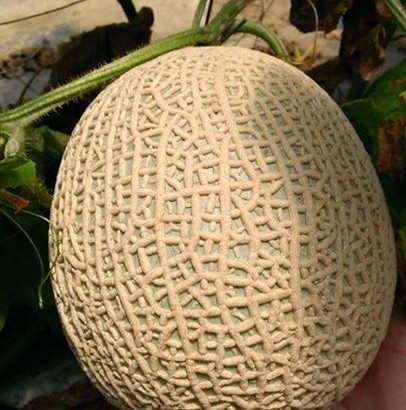
The Hami melon originated in the Turpan-Hami Basin of Xinjiang, a land that nurtures sweet, fine melons
The Hami melon is a well-known cultivar group of the melon (Cucumis melo), named because the Hami region of Xinjiang presented it as tribute to the imperial court during the Qing Dynasty. Its place of origin is generally believed to be the Turpan-Hami Basin in eastern Xinjiang, including present-day Hami, Shanshan and Turpan. It can be said that this land is both the homeland of the Hami melon and the source of its name.
The Turpan-Hami Basin lies deep inland, with an arid climate and little rain, long hours of sunshine, and a large temperature difference between day and night. Snowmelt from the Tianshan Mountains nourishes the melon fields through karez and other waterworks, while the gobi soil is well aerated. All these conditions help the fruit accumulate sugar. Long adaptation to the arid environment has also given the Hami melon its thick, transport- and storage-friendly rind and rich flavor.
In terms of varieties, Hami melons can be broadly divided into netted and smooth-skinned types; the flesh may be crisp or soft, and the color ranges from greenish white and pale yellow to orange-red. In the past, people often named them after their place of origin and melon shape. Today, through continuous breeding, the varieties have become more diverse, but melons grown in Xinjiang are still regarded as the most representative of the authentic flavor.
Now, besides Xinjiang, Gansu, Inner Mongolia, Hainan and other places also grow them on a large scale. With protected cultivation and improved transport and storage, Hami melons can be enjoyed easily in many places. When choosing one, look at whether the netting is clear and whether the fruity aroma is rich; a well-ripened melon usually has a noticeable fragrance. Understanding the terroir of its place of origin makes it easier to see where the Hami melon's distinctive sweet aroma comes from.
Related Reading