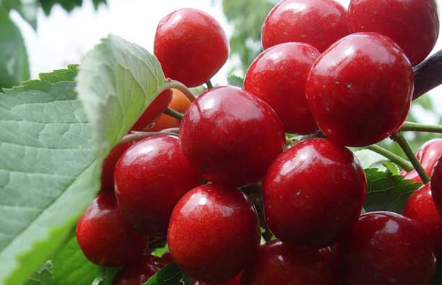
Red Lantern cherry variety characteristics and cultivation techniques: can little-leaf disease be cured?
Do you like eating cherries? This fruit has quite a lot of varieties, so how many cherry varieties do you know? If you want to grow cherries, you can do it, and the cultivation methods for cherries are relatively simple. Let's take a look at the characteristics of the Red Lantern variety!
Characteristics and cultivation techniques of the Red Lantern variety
The Red Lantern cherry ripens early, needing only 45 days from flowering to maturity. Its fruit is large, with a single fruit weight of 9.6 grams under open-field cultivation, and under protected cultivation the largest the author has seen reached 18 grams. It is outstanding among early-maturing varieties, and until the beginning of this century it had always been the most important cultivated variety in China's main large cherry production areas.
The Red Lantern cherry can be trained into a spindle-shaped tree. During winter pruning in the first and second years, the new branches formed that year should be heavily shortened back to the base. Because the axillary buds at the base of Red Lantern are relatively shriveled, when shortening back, leave them appropriately longer than for other varieties. For other varieties such as Pioneer, Hongmi, and Shameidou, leaving 3~4 buds at the base, about 4~5 cm, is enough for shortening back, but Red Lantern should be left longer, until there is a sufficient number of relatively plump buds to meet the need, generally cutting back to leave 15~20 cm, and in individual cases it can be even longer.
Few flowers, few fruit set
In plants affected by little-leaf disease, the leaves are deformed, twisted, lusterless, and uneven in leaf flesh. Although the plant can still normally build its tree shape and flower, it sets few fruit and the fruit is deformed, losing its commercial value. Other varieties such as Meizao and Hongmi also suffer from little-leaf disease, but it is most common in Red Lantern.
Prone to little-leaf disease (viral disease)
The cause of Red Lantern little-leaf disease and effective control measures are still not clear to this day. According to observation, plants affected by little-leaf virus in the base generally occur as one plant or several adjacent plants, and it is estimated that this is caused by taking scions from diseased plants when grafting. Therefore, purchasing high-quality nursery stock is the key to avoiding the occurrence of little-leaf disease.In 2017, Hongmi was top-grafted onto Red Lantern trees with little-leaf disease, and little-leaf diseased leaves were found to appear on the new Hongmi branches, indicating that the disease-causing factor was expressed in the new Hongmi graft.
Now you know the characteristics of this cherry variety. If you want to grow it, pay attention to the issue of improvement!