How to Propagate a Kumquat Tree? A Detailed Guide to Its Lifespan and Flowering Times
Kumquat, you must have eaten this fruit before, but did you know it has another name you might not know, "golden jujube"? Is the kumquat grown the same way as oranges? Let's take a look!
"Golden jujube" is the affectionate nickname people in Yilan use for the kumquat (Kumqat). The kumquat is oval in shape, like a golden jujube, both beautiful and auspicious, which is why the people of Yilan call it "golden jujube."
The kumquat (Kumqat) is a perennial evergreen small tree of the Rutaceae family. It originated in Zhejiang, China, and was introduced to Taiwan in 1906 by the Japanese "Tashiro." It is mostly distributed in northern Taiwan, of which Yilan County has about 280 hectares under cultivation, accounting for more than 92% of the national total, making it the main kumquat-growing region.
The Lanyang Plain is surrounded by mountains on three sides and faces the Pacific Ocean to the east, with frequent mountain winds that brew thick dew in the nearby mountain areas. The climate is wet, rainy and cool, forming an excellent growing environment for kumquat trees.
Propagation of the Kumquat Tree
Kumquat trees are generally propagated by grafting, and their lifespan can reach up to 40 years.
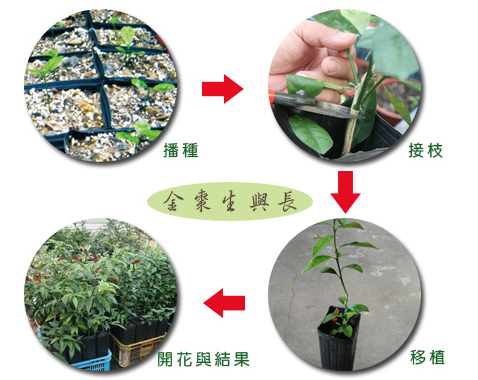
The process is as follows:
1. Sowing: Take seeds of the sour mandarin and sow them in a field or in a container filled with soil.
2. Grafting: Wait until the trunk of the sour mandarin grows to about 1 cm thick, then cut it back, leaving only 3-5 cun of the trunk. After that, cut a new shoot from a kumquat tree and graft it onto the cut trunk of the sour mandarin.
3. Transplanting: About one year after grafting, the kumquat is transplanted. About 600 kumquat plants are grown per chia of land, and it takes careful and proper management, including pruning, weeding, fertilizing and spraying, to maintain the growth quality and yield of the kumquat.
4. Flowering and fruiting of the kumquat:
A. A kumquat tree can bloom three to five times a year. The first bloom is roughly after Qingming Festival until around Dragon Boat Festival, with about 45 days between each bloom, and the last bloom is around September to October.
B. The kumquat harvest season runs from November to March of the following year, lasting up to five months.
C. The first and fifth blooms of the kumquat produce fewer fruits, and the quality is also poorer.
D. During the non-harvest period, kumquat trees require orchard management work such as fertilizing, watering, pest removal, weeding and pruning to improve yield and quality.