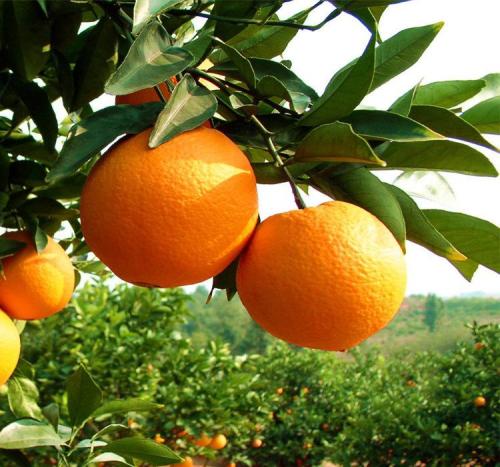
What is the difference between red-fleshed oranges and yellow-fleshed oranges, and which one tastes better?
There are red-fleshed oranges as well as traditional yellow-fleshed oranges, so what kind of differences are there between these two oranges? Would you like to find out!
Whether yellow-fleshed or red-fleshed liu ding (oranges), both are among the "sweet orange" varieties of the Rutaceae family, Citrus genus. Sweet oranges have many varieties; based on fruit type, they are divided into four major categories: common sweet oranges (Valencia, liu cheng, jin cheng, etc.), blood oranges (red-fleshed liu ding counts as a small branch within them), navel oranges, and acidless oranges.
Valencia is the kind we often see in supermarkets imported from the United States as "Sunkist." Actually, "Sunkist" is not a variety but the name of a brand and company. However, because nearly all of California's Valencia oranges are collectively sold through this company, its brand name is far more famous than the variety name. Taiwan also grows a little Valencia, mainly in Taitung, with a relatively late harvest season, around March.
The yellow-fleshed liu ding we used to eat belongs to the common sweet orange category. It was introduced to Taiwan from Guangdong around 1930. After the 1980s, after paddy fields across the island were converted to dryland farming on a large scale, the cultivated area increased greatly, making it the fruit tree with the most abundant output in Taiwan after autumn and winter. Fully yellow-ripened liu ding has a sugar content of about 12-13 degrees Brix and a juice yield of about 45%. Its acidity is lower than that of Valencia. For foreigners, it is a relatively mild-flavored fruit, but it suits Taiwanese people's preference for less sour tastes, so it is planted in large quantities.
Red-fleshed liu ding should be considered a type of blood orange, but abroad, blood oranges are cultivated in higher-latitude regions. The colder it is, the more blood-red the color becomes (because the flesh contains anthocyanins, which make it red), hence the name. In colder regions, it is a very flavorful fruit. But after being introduced to Taiwan, because we are a subtropical country, the red-fleshed liu ding grown here is very juicy and has quite a bit of sugar, but almost no acidity. Compared with yellow-fleshed liu ding, red-fleshed liu ding can be said to have virtually no acidity at all. So some people also call it "grandma orange," meaning that even elderly people who fear sourness dare to eat it.
Therefore, here is the key point: for Xidiyiao's yellow-fleshed liu ding, the sugar-to-acid ratio is usually higher than that of ordinary liu ding. Those who like it find the flavor richer, while those who fear sourness find it rather sour. So friends who like eating Xidiyiao yellow-fleshed liu ding, after accidentally buying red-fleshed liu ding, will feel the difference is huge, because their expectations for the fruit are different.
Next year, we will ask our friends at the Homemakers United Foundation Cooperative to clearly label red-fleshed liu ding in particular, so that everyone will not accidentally buy the wrong one. Friends who do not like sourness can consider buying red-fleshed liu ding, and friends who like a stronger flavor, please consider supporting yellow-fleshed liu ding. Please!