-
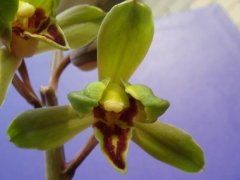
Cymbidium faberi 'Yushan Mei', also known as 'Xiao Cheng Mei' — how much does one seedling cost?
Yushan Mei, also known as Changshu Mei, belongs to the Cymbidium faberi varieties and is an old variety among them, much loved by many flower enthusiasts. Its petal type is also the Mei type, a fine specimen of the Mei class, and it has long been known as "Xiao Cheng Mei." As for the price, one seedling costs around 200 yuan per seedling. So
-
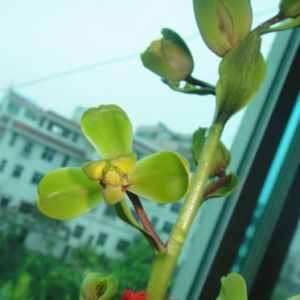
Appreciation and Care Essentials of the Three-Diamond Round Plum Cypripedium (San Zuan Yuan Mei) Variety
The leaves take shape as natural fish-belly leaves, with many bright veins, a very glutinous leaf texture, heavy crystal content, and graceful leaf posture. The flower scape rises 40-plus cm above the foliage. The floral bracts are distinctive, especially thick and glutinous with multiple veins, and the buds are bizarre, like dragon horns. After the flowers open, the flower scape turns from red to green, becoming clean and tender green, but the flower stalks still...
-
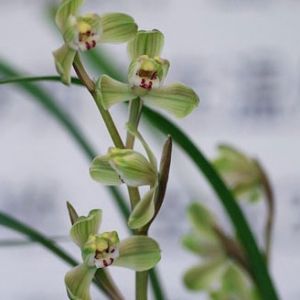
Detailed Introduction to the Cymbidium tortisepalum 'Yufu Mei' Variety
The plant has an elegant and graceful form, with tall flower scapes and flowers that hold well. The three outer petals are round-headed with tightly rolled edges and slender bases; the five petals are set in separate segments, with Guanyin. It has a Liuha. The three sepals curve inward, full of inner richness. The flower color is jade-like, lustrous and elegantly refined.
-
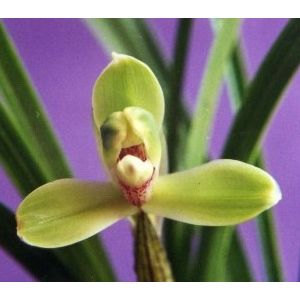
Cymbidium goeringii 'Yuyao Diyi Mei' Variety Introduction
The three outer petals are short and round, thick in texture, and the five petals are separated at the base; the lip is of the ruyi type, the flower droops slightly at the shoulders, the flower scape is slender but not very long, and the flower color is not pure green. The old leaves are slightly sickle-shaped, the bracts are pointed and pale red, and the leaf blades are somewhat thick. It was selected by Xu Linghu of Yuyao during the Daoguang period of the Qing Dynasty, and is also known as Diyi Mei.
-
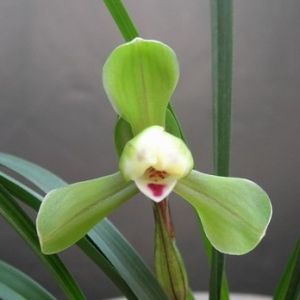
The Cymbidium goeringii cultivar Yongfeng Mei, also known as Yuan Mei or Guanchun Mei
The leaves arch outward and slope down, semi-pendulous. The leaf texture is thick and hard, the leaf tips pointed and long, the leaf color dark green. The bud sheaths are water-green with purple stripes. The three outer petals of the flower have large round heads, contracted bases, tightly rolled edges, and the petal bases curl slightly backward. The semi-hard cupped holds (pollinia) have white tips at the front, with purple-red stripes inside the holds. One-character shoulder (level shoulders). Ruyi tongue (ruyi-shaped lip), with bright red spots. "Yongfeng Mei" leaf length 25...
-
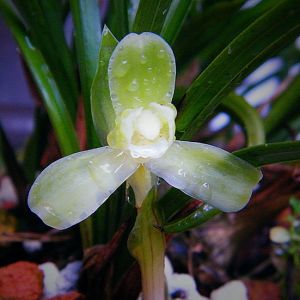
Characteristics of the Chunlan (Cymbidium goeringii) variety Yu Mei Su
Selected in Shaoxing during the Kangxi period of the Qing Dynasty. The leaves are slanted and upright, thick and hard in texture, narrow and slender. The leaf color is dark green with a slight luster. The bud sheaths are red with green markings. The three outer tepals have long feet and round tips, tapering at the base with flat edges, the tepal tips slightly flutter, slightly drooping shoulders. The petals are shallow-cupped, with a pure white ruyi-shaped lip, and a slight red on the cheeks, also known as "red-sheath peach-cheek plum-suberect."
-
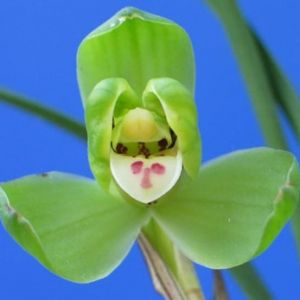
Guiyuan Mei Cymbidium goeringii Variety Introduction and Care Tips
Also known as Saijinxuan, selected by Zhu Xiangbao of Shaoxing in the early years of the Republic of China. It gets its name from its shape, which is round and upright like a longan. The leaves are deep green; the basal leaves are broad with shallow longitudinal veins, the middle leaves are narrow with V-shaped leaf grooves, the leaf margins have medium serrations, and the leaf texture is thick, hard and elastic. The leaf tips taper sharply, forming a dew-catching shape, the leaf base narrows inconspicuously, the leaf posture is a mix of semi-pendent and semi-upright, and the basal leaves have a fish-belly shape...
-
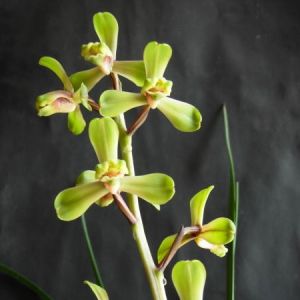
Cymbidium faberi cultivar Yuanding Mei, also known as Xinyuan Mei and Xiaojiang Xinmei
Cymbidium faberi Yuanding Mei, also known as [Xinyuan Mei]: cultivated and named by Liang Benhong of Xiaojiang, Xinchang. In 2005 it was collected from the wild in Suichang, Zhejiang, by stripping the bud sheath, with 5 plants at the time of collection. In 2008 it produced flower buds for the first time, but because the plants were not strong, it did not bloom normally. In spring 2009 it bloomed again stably, and the owner Liang Benhong brought this flower to the Second China Orchid Culture Expo and won a silver award...
-
Detailed Introduction to Qingyuan Mei, a Meiban Variety of Cymbidium goeringii
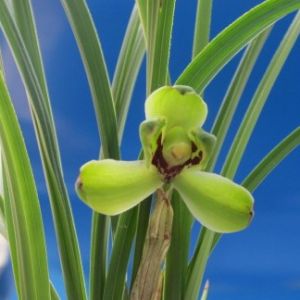
History: In 1983, Huang Xiaojin of Hangzhou selected it from orchid plants dug up by a farmer in Tonglu; "Jiangnan Xue" was selected at the same time. Both plants were dug by the same orchid farmer from Qingyuan Mountain at the border between Tonglu and Fuyang. Characteristics: After Qingyuan blooms, not only are the three outer petals round and neat, but the tight edges are also extremely good; when the three outer petals are picked off, they can scoop water like a small spoon...
-
Introduction to the variety characteristics of Yuchunmei Chunlan
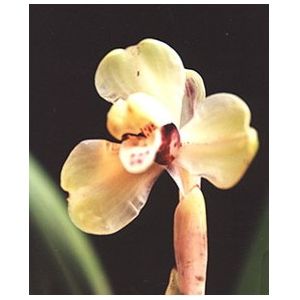
Purchased from a fellow orchid enthusiast in early 2000. In the spring of 2001, it bloomed again as shown in the photo. The fragrance is deep and far-reaching, and the flowering period lasts nearly two months. The main and secondary petals are round and large, uniform in size, with a tender yellow and light green color, accompanied by bright red patches. The lip petals are fleshy, and the five petals are separated into distinct segments. The Ruyi tongue has two rows of red spots arranged regularly on its surface, 6-8 in total, dazzlingly bright red. The petals are crystal-clear like jade, hence the name Yu...
条件筛选