The Cymbidium goeringii cultivar Yongfeng Mei, also known as Yuan Mei or Guanchun Mei
The leaves arch outward and slope down, semi-pendulous. The leaf texture is thick and hard, the leaf tips pointed and long, the leaf color dark green. The bud sheaths are water-green with purple stripes. The three outer petals of the flower have large round heads, contracted bases, tightly rolled edges, and the petal bases curl slightly backward. The semi-hard cupped holds (pollinia) have white tips at the front, with purple-red stripes inside the holds. One-character shoulder (level shoulders). Ruyi tongue (ruyi-shaped lip), with bright red spots. "Yongfeng Mei" leaf length 25...
Selected in 1920 by a Shaoxing flower farmer in Fenghua. The three outer petals have tightly rolled edges, long stalks with contracted bases, semi-hard cupped holds, a pointed ruyi tongue, and a tall flower scape; the flower color is not pure green. The old leaves slope and droop, with blunt leaf tips.
The leaves arch outward and slope down, semi-pendulous. The leaf texture is thick and hard, the leaf tips pointed and long, the leaf color dark green. The bud sheaths are water-green with purple stripes. The three outer petals of the flower have large round heads, contracted bases, tightly rolled edges, and the petal bases curl slightly backward. The semi-hard cupped holds (pollinia) have white tips at the front, with purple-red stripes inside the holds. One-character shoulder (level shoulders). Ruyi tongue (ruyi-shaped lip), with bright red spots.
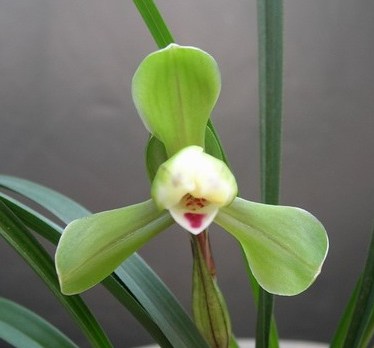
"Yongfeng Mei" leaves are 25--30cm long, 1cm wide, with an obliquely upright leaf posture, the marginal leaves semi-pendulous, a leaf groove near the leaf base, a relatively flat leaf surface at the leaf tip, thick leaf texture, fine and dense serrations along the leaf margin, and a smoothly tapered leaf tip. The leaf armor is tall, and the armor tip easily forms an inward-curling shape; the new shoots are purple-green, the flower buds green with a purple blush, the lower part of the bracts purple, the upper part turning green, and the ovary bract clothing dark green with purple vein lines. The flower scape is level-set and dark purple-red; when the flower bud first opens, the outer petals clearly show a white edge, with the petal tips even more prominent; the three outer petals have large round heads, finely contracted bases, a purple blush near the outer petal bases, and both edges are recurved; level shoulders, the main petal held high with the tip in an upward-covering shape. The hold tips have thick, heavy white heads with light purple blush spots, the semi-hard holds clasp tightly without separating, the tongue is ruyi-shaped, and after fully opening the tongue tip droops downward, with a vivid large red spot near the tongue tip. When the flower is opening, attention should be paid not to let the temperature rise too suddenly, to avoid too short a flower stem and the formation of a pot-surface flower; at the appropriate time, combine with withholding water in the pot, so as to avoid the outer petals becoming wavy and wrinkled, or the base stretching too long and the tongue tip curling backward, which would lower the flower's quality. A well-opened "Yongfeng Mei" has a tall, upright flower stem, outer petals with large round heads, finely contracted bases, level shoulders, smooth and clean holds embracing and protecting the column, a ruyi tongue that does not droop, a central cavity facing upward, a well-proportioned flower shape, and brilliant color and luster; it is a very fine plum-petal flower. The greatest distinguishing feature of this flower is that the flower shape is large, the flower is not pure green but adorned with red veins, and the red spots on the tongue surface form a "heart" shape! Its flowering period is 10 days to half a month later than that of ordinary Cymbidium goeringii.
Yongfeng Mei: Cymbidium goeringii, plum petal, a traditional famous cultivar.
History: Yongfeng Mei emerged in Fenghua in the 9th year of the Republic of China, dug up by the mountain collector Xu Aji. It was selected and bred by Mr. Yang Zuren of Siming.
Shen Yuanru and his son's "Orchids" records "Yongfeng Mei": "Selected by a flower peddler before the War of Resistance." "Three Hundred Questions on Chinese Orchid Art" says, "The Cymbidium goeringii 'Yongfeng Mei,' also known in Japan as 'Yuan Mei.' Selected in Fenghua in 1920." "Cymbidium goeringii Register" says, "Selected in 1920 by a Shaoxing flower farmer in Fenghua." "Nai'an Ju Orchid Cultivation Talks" says it emerged in Fenghua in 1920. "Jiangsu and Zhejiang Orchids" says, "Yongfeng Mei is said to have been selected by a flower peddler in the 1930s. Another account: selected in Fenghua, Zhejiang in 1920." Wu Yingxiang's "Chinese Orchids" also calls it "Guanchun Mei," saying, "It is said to have been selected by an orchid peddler in the 1930s." And so on. Among the records of the selection year, the correct one should be 1920. The "Continued Orchid Register of the Same Heart" written by Feng Zicai of Shangyu in 1930 gives a relatively detailed account.
Characteristics: The greatest distinguishing feature of this flower is that the flower shape is large, the flower is not pure green but adorned with red veins, and the red spots on the tongue surface form a "heart" shape! Its flowering period is 10 days to half a month later than that of ordinary Cymbidium goeringii.
"Yongfeng Mei" leaves are 25--30cm long, 1cm wide, with an obliquely upright leaf posture, the marginal leaves semi-pendulous, a leaf groove near the leaf base, a relatively flat leaf surface at the leaf tip, thick leaf texture, fine and dense serrations along the leaf margin, and a smoothly tapered leaf tip. The leaf armor is tall, and the armor tip easily forms an inward-curling shape; the new shoots are purple-green, the flower buds green with a purple blush, the lower part of the bracts purple, the upper part turning green, and the ovary bract clothing dark green with purple vein lines. The flower scape is level-set and dark purple-red; when the flower bud first opens, the outer petals clearly show a white edge, with the petal tips even more prominent; the three outer petals have large round heads, finely contracted bases, a purple blush near the outer petal bases, and both edges are recurved; level shoulders, the main petal held high with the tip in an upward-covering shape. The hold tips have thick, heavy white heads with light purple blush spots, the semi-hard holds clasp tightly without separating, the tongue is ruyi-shaped, and after fully opening the tongue tip droops downward, with a vivid large red spot near the tongue tip. When the flower is opening, attention should be paid not to let the temperature rise too suddenly, to avoid too short a flower stem and the formation of a pot-surface flower; at the appropriate time, combine with withholding water in the pot, so as to avoid the outer petals becoming wavy and wrinkled, or the base stretching too long and the tongue tip curling backward, which would lower the flower's quality. A well-opened "Yongfeng Mei" has a tall, upright flower stem, outer petals with large round heads, finely contracted bases, level shoulders, smooth and clean holds embracing and protecting the column, a ruyi tongue that does not droop, a central cavity facing upward, a well-proportioned flower shape, and brilliant color and luster; it is a very fine plum-petal flower.
Characteristics: The greatest distinguishing feature of this flower is that the flower shape is relatively large, the flower is not pure green but adorned with red veins, and the red spots on the tongue surface form a "heart" shape! Its flowering period is 10 days to 15 days later than that of ordinary Cymbidium goeringii. A well-opened "Yongfeng Mei" has a tall, upright flower stem, outer petals with large round heads, finely contracted bases, level shoulders, smooth and clean holds embracing and protecting the column, a ruyi tongue that does not droop, a central cavity facing upward, a well-proportioned flower shape, and brilliant color and luster; it is a very fine plum-petal flower.