-

Method for Processing Shiitake Mushroom Stems into Shiitake Floss
1. Raw material formula: 100 kg shiitake mushroom stems, 4-6 kg high-quality soy sauce, 3-4 kg white sugar, 2-3 kg peanut oil, 5 kg scallions, 0.2 kg monosodium glutamate, 4 kg yellow rice wine, 0.6 kg refined salt, appropriate amounts of ginger, fennel, food coloring, and five-spice powder. 2. Raw material preparation: Select shiitake mushroom stems free of sawdust, insect damage, and mold, cut into 1 cm pieces, wash clean with water, and soak for 1-2 days to allow full water absorption and softening. 3. Pre-boiling: Place the soaked mushroom stems into a pot and heat to a boil, then simmer over low heat
-
What are the control methods for stem rot in Japanese euonymus?
Rot is a major disease that Japanese euonymus is prone to, and in severe cases it can cause the entire plant to die. Affected by the special climate of winter and spring, Japanese euonymus does not green up well, and some dead branches appear, weakening the growth vigor of the euonymus and thereby reducing the plant's disease resistance. Some Japanese euonymus is prone to stem rot. One- and two-year-old branches are especially the most severely affected: in the early stage the stem turns brown, the leaves lose their green color, the tender shoots droop, and the leaves do not fall off; in the later stage the affected part of the stem turns black, the cortex shrinks, the inner bark tissue rots, and many tiny black
-
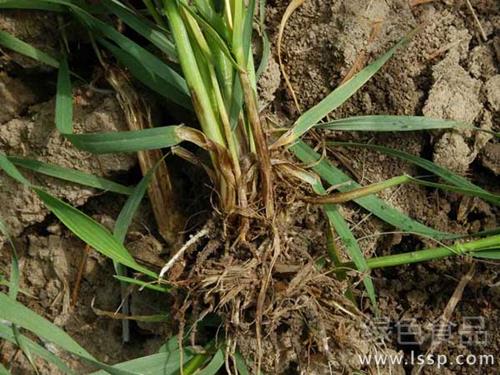
How to prevent and control wheat root rot? Identification of symptoms of root rot, stem blight and yellow leaves, and medication
How to prevent and control wheat root rot when roots rot, stems wither and leaves turn yellow
-
Identification and Control Methods of Cotton Stem Blight
Symptoms The disease occurs more severely in the Northeast cotton region, the Yellow River basin and the Yangtze River basin, and the cotton regions along the rivers and coast. Cotton can be affected throughout the entire growth period, with the seedling stage and bud stage suffering the most severe damage. When cotyledons and true leaves are infected, small round spots initially appear with purplish-red edges and grayish-white centers, after which the lesions expand or merge into irregular-shaped lesions. Some lesions develop concentric rings in the center, scattered with small black granules, which are the pathogen's pycnidia. The diseased parts often break apart and fall off. Under high humidity, water-soaked lesions appear on young tender leaves, then spread rapidly as if scalded by boiling water,
-
Detailed Explanation of Key Cultivation Techniques for Single-Stem Wheat After Cotton Stubble
With the adjustment of the planting industry structure, the area of wheat-cotton double cropping has developed rapidly across various regions, achieving both expansion and increase in grain and cotton production. However, some problems have also been exposed, namely that the suitable sowing period for wheat coincides with the cotton harvesting period. Using conventional sowing methods has brought many adverse effects on wheat growth and development, such as small seedlings, weak seedlings, susceptibility to freezing, poor root development, fewer productive ears, and low and unstable yields. If timely stubble clearing is adopted and the single-stem wheat cultivation method is applied around Frost's Descent, this contradiction can be well resolved. The main cultivation techniques are as follows: 1. Timely pulling of cotton stalks and timely stubble clearing
-
Identification and Control Methods of the Wheat Stem Borer
Scientific name: Lepidoptera, Noctuidae. Also known as wheat moth, stem borer, stem-boring worm, etc. Distributed in winter wheat regions such as Shandong, Hebei, Jiangsu, and Gansu. Hosts include wheat, barley, etc. Damage characteristics: young larvae cause damage inside the leaf sheaths; after wheat and barley jointing, the larvae damage the young leaves, causing leaf curling, stunting, dead hearts, or forming damaged plants, with each larva damaging 2-3 plants. The larvae bore into the base of the first stem node, causing white heads. It is an important pest of wheat and barley in China. Morphological characteristics: adult body length 5.9-7.
-
Stem Cell Research Opens a Second Front for the Cloning Sheep Technology Route
The Leap from Sheep to Monkey Without the two papers published on November 20, Shoukhrat Mitalipov would have been the most watched stem cell research scientist during this period. On November 14, this scientist at the Oregon National Primate Research Center in the United States published a paper in Nature, announcing that he had successfully obtained cloned rhesus monkey embryos. This was the first time scientists had cloned viable
-
Occurrence Patterns and Control Methods of Cotton Red Leaf and Stem Blight
Disease symptoms and occurrence patterns: Cotton red leaf and stem blight is an explosive disease that frequently occurs in the middle and late stages of cotton growth. It can cause leaves to turn red from bottom to top until they drop off. The leaf veins remain green, the leaf mesophyll turns red, and the leaves become thicker, brittle, and wilted before finally dropping. When the stem is cut open, it does not change color, which distinguishes it from cotton Fusarium and Verticillium wilt. Generally, in old cotton-growing areas, the disease is more severe in cotton fields with continuous cropping year after year, sandy soil, too shallow a plow layer, or insufficient fertilizer lacking potassium fertilizer. Drought in the middle and late stages, along with severe potassium and zinc deficiency in the soil, can also easily accelerate the occurrence of this disease.
-
What are the three main causes of cotton red leaf stem blight?
Cotton red leaf stem blight is a physiological disease caused by potassium deficiency. It occurs in the middle and late stages of cotton growth, and in dry years the occurrence and severity of damage are more serious. In the field, cotton generally begins to show symptoms at the bud stage, and the disease is most severe during the boll-setting and boll-opening stages. Symptoms mainly appear on the leaves. Diseased leaves develop from top to bottom and from the outside inward. Diseased leaves begin to lose green color from the edges, first turning yellow, then producing red spots, and finally the whole leaf turns red, the mesophyll thickens, wrinkles and becomes brittle, while the veins remain green. In severe cases, the leaves of the whole plant lose green color, then turn red and brown, the leaves scorch and fall off, leaving bare stems, and the plant
-
How to prevent cotton red leaf stem blight? These integrated measures must be mastered
Cotton red leaf stem blight is a physiological disease. In recent years, it has occurred in large amounts in the cotton region of the Yangtze River Basin in our area. It begins at the early flowering stage, and is more severe and widespread from the full flowering stage to the boll-setting stage. In our area specifically, it occurs sporadically in July and August. It reaches its peak from mid-to-late September to October. Lightly affected plants are yellow and thin, with few and small bolls, short fiber, and poor boll opening; severely affected plants die prematurely, and the bolls cannot mature, greatly affecting yield. 1. Disease symptoms. At the early stage of the disease, red and purple spots appear on the leaves, gradually spreading until the whole leaf turns red
条件筛选