-

Dongliu Line e-Service System Officially Launched, Balancing Epidemic Prevention and Worry-Free Travel
e-Service System Officially Launched, ID Digitization [TB News Network] The Maritime and Port Bureau announced today (the 12th) that the Dongliu Line e-Service System has officially launched. Through just a few simple steps, information on ID documents can be converted into digital data, effectively ensuring that...
-

Real-name system for pesticide purchases takes effect on July 1, ensuring peace of mind for agricultural products and safeguarding farmers' benefits
To ensure the food safety of agricultural products, the Council of Agriculture is promoting a real-name system policy for pesticide purchases. On July 1, 2021 (ROC year 110), it announced amended regulations requiring retail pesticide sellers to include the purchaser's ID card number or residence permit number when reporting sales data...
-
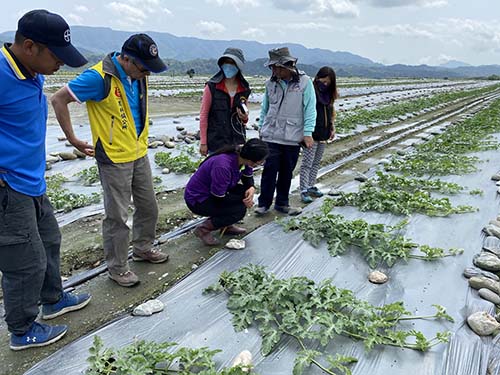
Gummy Stem Blight Found in Watermelon Fields in Fenglin Township; Hualien County Government Urges Growers to Take Preventive Measures
After gummy stem blight damage was reported in some watermelon fields in Fenglin Township, Hualien County, the Hualien County Department of Agriculture, together with the Animal and Plant Disease Control Center, the Hualien District Agricultural Research and Extension Station of the Council of Agriculture, Executive Yuan, and the Fenglin Township Office, went on the 17th to 4 watermelon fields where gummy stem blight had occurred...
-

Pingtung Tropical Agriculture Expo enters its final 8 days, register with real-name system to enter and draw a limited-edition lucky bag
The Pingtung Tropical Agriculture Expo, organized by Pingtung County, runs from its opening on 2/6 until 3/1, and is a great choice for a southern spring outing. Due to the pandemic, the entire park requires real-name registration for entry. To thank the public for cooperating with the real...
-

Quality fruits and vegetables depend on good water and a healthy ecosystem
Only good water and a healthy ecosystem can produce quality fruits and vegetables
-
The Forest-Friendly Circular and Self-Care System of Dawu Tribe
06 The Friendly Cycle in the Forest - The Self-Care System of Dawu Tribe
-
The controversy over paraquat as a defoliant for adzuki beans should not stigmatize the pesticide review system
Tsai Shang-yen / Whether or not paraquat should be used as a defoliant on adzuki beans, please do not stigmatize the pesticide review system
-
A Detailed Explanation of the Formation Process of Young Cactus Stems
Cacti bear little resemblance to ordinary terrestrial plants. They have no leaves, and their spindle-shaped or warty bodies are vastly different from the branches of ordinary plants. However, a few cacti, besides having typical cactus flowers, also produce common young stems and leaves, such as Pereskia. This genus consists of many-branched shrub-type or small tree-type plants. The young stems are round and slightly fleshy. Generally speaking, the lateral buds of flowering plants are borne in the leaf axils, and most of them merely become small buds without further growth. But in many plants, at least some of the lateral buds grow into short, slender shoots, such as those of <span style="color:#FF8000;">apple</span> trees and pear trees. On these young shoots, the new leaves are almost all borne at a single point . This point is remarkably similar to the areole of a cactus, because the spines of a cactus are in fact its modified leaves. </p> <p align="center"> </p> <p align="center"> Pictured: young cactus stem </p> <p>   In fact, some plants do have leaves modified into prickles, such as Berberis, in which transitional forms ranging from leaf-like spines to prickles have been found. Botanists call these modified leaves and buds prickles rather than spines (only bud-derived structures are called spines, such as those of Rubus). The spines of cacti are also formed by the modification of leaves, so the botanically correct term is also prickles. However, this book still refers to them as spines according to customary usage. When new shoots or flower buds emerge from an areole, it clearly demonstrates that the areole does indeed contain buds. Theoretically, every areole is capable of producing new shoots. If the new shoot above any areole is removed, a new shoot will emerge from that areole to replace the removed one. </p> <p>   The leaves of some Pereskia species have become very small and narrow. The genus Opuntia also has leaves, which are round but soon fall off. The leaf-like basal segments of many Opuntia plants are easily mistaken for flat new leaves. In fact, when young, these cacti still produce small and feeble leaves; new stem segments emerge from the areoles on the leaf-like stem segments, while true new leaves are no longer produced. </p> <p>   The round young stems of Pereskia often give rise to variants with hump-like, angular, or ridged stems. At this point, as the plant grows, the spirally arranged areoles become increasingly obviously arranged in longitudinal rows. The areoles of cacti with angular stems are also arranged spirally during their seedling stage. </p> <p>   The amount of water stored within the body of a cactus varies greatly with the seasonal alternation between rainy and dry seasons, and the ridged structure is particularly suited to this growth pattern. </p> <p>   When water is scarce in the dry season, the ribs become thinner; when water is abundant in the rainy season, the ribs thicken, yet the overall form of the plant does not change much. In other words, without any change in the plant's surface area, the internal water storage capacity differs greatly, like the bellows of an accordion. In contrast, the stem segments of pad-shaped cacti shrink irregularly when water is scarce. Moreover, the surface area of ribbed cacti is larger relative to the plant's total volume than that of other types (all green plants need a certain surface area to receive sunlight). </p> <p>   The number of ribs can increase to a great many. For example, many Trichocereus cacti bear a very large number of ribs, but the genus with the greatest number of ribs is Stenocactus, which can produce as many as 120 thin, cardboard-like ribs. The young stems of many climbing and epiphytic cacti are slender and long, slightly cylindrical, or bear only irregular hump-like protrusions. The thicker young stems bear ribs, and as the plant grows, these ribs eventually become thin and wing-like, which helps the plant grow healthily in a semi-shaded environment. Later, the three-winged stems eventually give rise to two-ribbed, leaf-like flat stems. </p> <p>   On many ribbed cacti, the protrusions on the ribs are more or less distributed in a hump-like pattern. If sunlight shines directly from above, the various protrusions will to some extent shade one another from the sun. Therefore, when the shape of the ribs is clearly distinguishable, one can see that the ribs are mostly arranged in a spiral. If the ribs are composed of isolated, unconnected warty protrusions, as in Rebutia or Mammillaria, then the spiral direction of the ribs is difficult to discern, and only chains of warty protrusions arranged in intersecting diagonal rows can be seen on the plant surface. As with the arrangement of leaves, the number of warty protrusions in each row is often 5, 8, 13, 21, 34... that is, each number is the sum of the previous two. This arrangement allows the warty protrusions to be distributed densely and evenly, and maximally ensures that they do not shade one another from the sun. </p> <p>   Cacti that bear large warty protrusions differ most in form from ordinary cacti. These warty protrusions superficially resemble leaves, as in Ariocarpus or Obregonia, but the warty protrusions bear an areole, and flowers can emerge from within the areole. Therefore, the warty protrusions are not leaves but part of the stem. On some small spherical or leaf-like cacti, such as Blossfeldia or Lophophora, the spindle ridges can only be identified by the arrangement of the areoles. </p> <p>   Recommended articles: </p> <p>   The External Structure and Morphology of Cacti </p> <p>   An Evolutionary Overview of the "Living Fossil" Cacti </p> <p>   Cacti Shed Their High-Priced "Outer Garment" and Are Replaced by Low-Priced Ones </p> <p>   In Summer, Small Potted Plants Are Sought After, and Cacti Rank at the Top </p>
-
Comprehensive Analysis of the Morphological Characteristics of Walnut Trees
I. Root System The portion of the walnut below the root crown is collectively called the root system, which is divided into the primary root, lateral roots and fibrous roots. The primary root is well developed, the lateral roots extend far horizontally, the fibrous roots are numerous and the root system is vigorous. Generally speaking, the root system of precocious walnuts is more developed than that of late-bearing walnuts, and this is especially evident in young trees.
-
A Detailed Guide to Seed Selection Techniques and Seedling Raising Methods for Stem Lettuce
Stem lettuce is a very common vegetable in our daily lives. It is simple to stir-fry and has a delicious taste, and it is loved by many people. In a while, farmer friends will begin planting crops, and I believe most farmers know how to grow stem lettuce. So how do you select seeds for stem lettuce
条件筛选