-
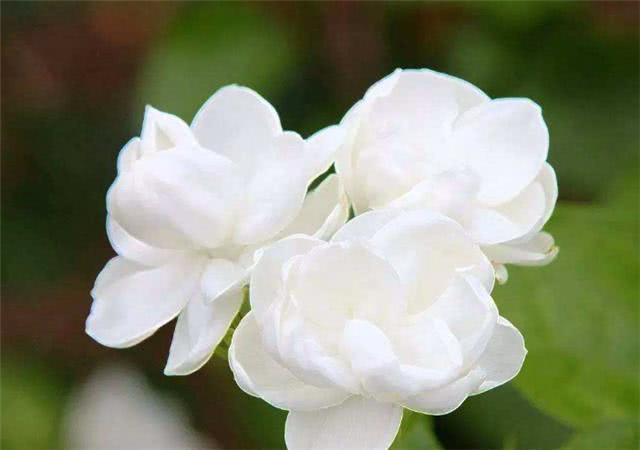
These 2 kinds of flowers should not be fertilized too much in autumn; leaf spindling affects their winter survival
After the Beginning of Autumn, there was a spell of rain, and then most places have already started to cool down. The weather is turning cooler, and autumn is also the harvest season. Many potted flowers can grow vigorously in autumn. And the climate for growing flowers in autumn is also quite suitable, no matter what...
-

Key Points of Autumn Spinach Planting Techniques and a Detailed Explanation of Management Methods
Autumn Spinach Planting Techniques
-

What to Do When the Washing Machine Shakes Violently During Spin Cycle: Add a Base for More Safety and Less Noise
Our lives are now filled with all kinds of smart appliances: a microwave for heating food, a range hood for removing cooking fumes, and a washing machine for doing the laundry. They really do make daily life much more convenient. Huahua thinks the most practical one is...
-

Pennywort growing spindly and sparse? Just one little trick to make your pennywort thrive and grow strong
Pennywort has round, adorable leaves that look like ancient Chinese coins, symbolizing reunion and good fortune. It is also fairly easy to grow - a cup or a plastic bottle at home is enough to produce a beautiful display. It is perfect for growing a pot on a windowsill, and...
-
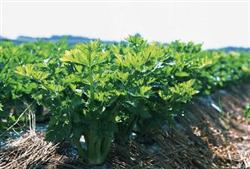
How to overwinter and protect spinach seedlings in the north? Key technical points explained in detail
Celery, also known as Western celery, foreign celery, or American celery, is planted in autumn in the Shuyang area. The average yield per mu is 3000-4000 kg, and high-yielding fields can reach 5000 kg per mu. Its high-yield autumn cultivation techniques are briefly described as follows: 1. Select good varieties for sowing. Choose varieties that bolt late, have strong stress resistance, are not prone to softening, and have thick, solid stalks...
-
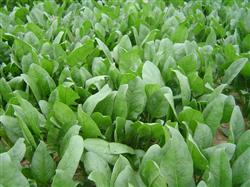
What are the technical measures for spinach sowing management?
After sowing spinach, fasten the greenhouse cover properly. Generally, two waterings are needed for full emergence; 10 days after emergence, water again. Once the two true leaves of spinach unfold, the leaf number, leaf weight, and leaf area increase rapidly. Before 3 to 4 leaves, keep the soil moist, apply 25 kg of ammonium bicarbonate per mu, shallow hoe once, thin out overly dense seedlings, and control water appropriately. In November around "Minor Snow"...
-
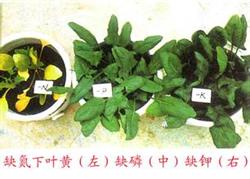
What to Do About Nitrogen Deficiency in Spinach? Detailed Control Measures
Nitrogen deficiency in spinach: leaves are pale green, the basal leaves (older leaves) turn yellow and this gradually spreads upward, and they turn brown when dry. Plants are stunted, with few branches (tillers), and show premature aging. Control method: apply sufficient base fertilizer, with 2000-3000 kg of decomposed manure, 30-35 kg of phosphate fertilizer, and 10-15 kg of potassium fertilizer per mu. 2-...
-
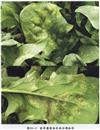
How to prevent and control downy mildew in spinach? Detailed explanation of prevention and integrated treatment methods
The disease is caused by a fungus called spinach downy mildew. It mainly affects the upper surface of the leaves; the lesions are pale yellow, irregular in shape and varied in size, with a diameter of 3-17 mm and indistinct edges. After the lesions expand, they join together into patches, and in the later stage they turn brown and the leaves die; on the underside of the leaves, a grayish-purple mold layer forms on the lesions. The disease spreads from the outer leaves...
-
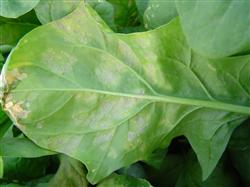
A Detailed Guide to the Prevention and Integrated Treatment of Spinach Downy Mildew
The disease is caused by a fungus called spinach downy mildew (Peronospora farinosa f. sp. spinaciae). It mainly affects the upper surface of the leaves; the lesions are pale yellow, irregular in shape, vary in size, measure 3-17 mm in diameter, and have indistinct edges. After the lesions expand, they join together into patches, and in the later stage turn brown and die, while a grayish-purple mold layer forms on the lesions on the underside of the leaves. The disease spreads from the outer leaves...
-
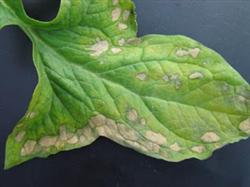
Detailed Guide to Identifying and Controlling Downy Mildew in Spinach
Downy mildew is a common disease of spinach, with severity varying from year to year. The spinach downy mildew pathogen is an obligate parasite that only infects spinach. I. Symptoms Spinach downy mildew can locally infect leaves and can also cause systemic infection. When leaves are locally infected, the affected areas first appear as pale green, water-soaked round spots, which then expand...
条件筛选