-

Symptoms and control methods of downy mildew in codonopsis (Codonopsis pilosula)
Irregular brown lesions appear on the leaf surface, and a gray mold-like growth (conidiophores and conidia) appears on the underside of the leaves, which can cause the plant to die. Control method: remove diseased plants and fallen leaves and burn them in a centralized manner; during the disease period, spray 300-fold dilution of 40% Shuangyiling or 1000-fold dilution of 70% chlorothalonil, once every 7 to 10 days, for 2 to 3 consecutive times.
-
Control Methods and Technical Key Points for Powdery Mildew of Black Locust
Methods for controlling powdery mildew of black locust: 1. Promptly clear away diseased dead branches and fallen leaves, and burn them in a centralized manner. 2. In the early stage of the disease, spray a 2000-fold dilution of 10% Score granules, or a 1500-fold dilution of 25% Triadimefon wettable powder, or a 3500-fold dilution of 30% Triflumizole wettable powder, which can achieve good control results.
-
How to prevent and control powdery mildew on Japanese euonymus? These methods you need to know
Symptoms: The disease affects leaves and twigs. The lesions are mostly distributed on the upper surface of the leaves. In the early stage of the disease, many small white round spots are scattered on the infected leaves. As the lesions gradually expand and merge with each other, they become irregular large spots. When the disease occurs severely, the infection rate of new shoots can reach 10%. White powder appears on the entire surface of the leaves and new shoots. The diseased leaves gradually lose green, turn yellow, and finally turn brown-black. The diseased parts become deformed, the diseased leaves shrink, and the diseased shoots twist and wither. Pathogen: The pathogen is Oidium euonymi (Are.) Sa
-
What are the symptoms of powdery mildew on Japanese euonymus?
Symptoms of powdery mildew on Japanese euonymus: the white powder is mostly distributed on the upper surface of the leaves of Japanese euonymus, and also grows on the underside of the leaves. Individual lesions are round and white, and after the lesions expand and merge with each other they become irregular. When the white powdery mycelium and spore layer on the surface are wiped off, the original diseased site appears as a yellow round spot. In severe cases, up to 100% of new shoots can be infected. Sometimes diseased leaves become shrunken, and diseased shoots become twisted, deformed and stunted.
-
How to treat powdery mildew on Euonymus japonicus? Detailed control techniques
Powdery mildew occurs commonly, affecting its ornamental value and restricting its use in landscaping. Symptoms: Powdery mildew mainly harms the leaves of Euonymus japonicus, with lesions mostly distributed on the leaf surface, producing white powdery mold spots. When the disease is severe, the leaf underside and new shoots can also be affected, causing leaf shrinkage and deformation, new shoot distortion, atrophy and stunted growth, and causing leaf drop and shoot dieback. In the early stage of the disease, many small white round spots are scattered on the leaves; as the lesions gradually expand, they form irregular large spots, even covering the entire leaf surface. If the white powdery layer on the surface of the lesion
-
Occurrence and Control of Powdery Mildew on Japanese Euonymus
Symptoms: The disease affects leaves and twigs. The lesions are mostly distributed on the upper surface of the leaves. In the early stage of the disease, many small white round spots are scattered on the infected leaves. As the lesions gradually expand and merge with each other, they become irregular large spots. When the disease occurs severely, the infection rate of new shoots can reach 10%. White powder appears on the entire surface of the leaves and new shoots. The diseased leaves gradually lose green color, turn yellow, and finally turn brown-black. The diseased parts are deformed, the diseased leaves shrink, and the diseased shoots are twisted and stunted. Pathogen: The pathogen is Oidium euonymi
-
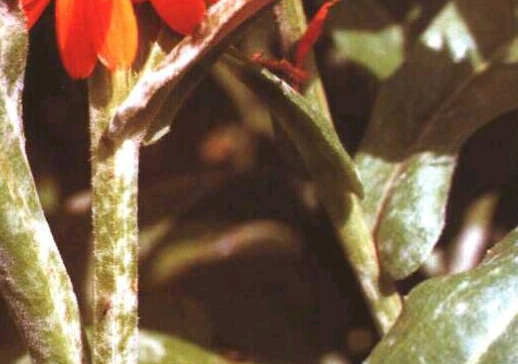
How to prevent and control powdery mildew in pot marigold
Affected plant: pot marigold (Calendula officinalis L.). Distribution and damage: The disease occurs commonly in Hebei, Liaoning, Yunnan and other places, and causes relatively serious damage. Symptoms: After the leaves and stems are infected, powdery round spots 0.5-1.2 mm appear on the leaves
-

What are the symptoms of downy mildew in stock (Matthiola incana)?
Downy mildew is a major disease of stock. This disease affects the host's leaves, tender shoots and flowers. In the early stage, pale green spots appear on the leaf surface, which later turn into yellow spots. On the corresponding underside of the leaves, a white downy mildew layer grows. After the tender shoots and flowers are infected, they often become stunted or deformed. When the damage is severe, the leaves wilt and droop, and the whole plant dies.
-

How to prevent and control pepper powdery mildew? These measures need to be mastered
Prevention and control measures for pepper powdery mildew
-

How to control powdery mildew, leaf spot, aphids and scarab beetles on cypress vine?
Although cypress vine is very tenacious and has strong adaptability to the environment, during cultivation it can sometimes become infected with pests and diseases due to neglect of management, sudden environmental changes and other reasons. Once this happens, the consequences can be unimaginable. Here, the editor will tell you a few common pest and disease control methods for cypress vine.
条件筛选