-

Key Points for Integrated Control of Powdery Mildew on Schisandra chinensis
1. Field symptoms Powdery mildew mainly damages the leaves of Schisandra chinensis, and in severe cases the fruit, petioles and stems are also affected. In the early stage of leaf infection, small white powdery mildew spots appear, gradually expanding and merging into patches, and the mildew layer thickens, like a layer of flour scattered on the leaf surface. On the underside of the mildew spots, small chlorotic spots initially form, expanding into irregular patches as the disease develops. In the late stage of the disease, black particles are produced in the mildew layer, causing moldy staining and fruit drop, reducing yield while also lowering quality. 2. Disease occurrence The powdery mildew pathogen of Schisandra chinensis belongs to the genus Erysiphe in the Ascomycota, and the conidia are mostly cylindrical, with a few being cylindrical-columnar, elliptical or long-oval. In the Fengcheng area, the pathogen overwinters as cleistothecia on diseased plant residues, and in May to June of the second year produces ascospores and conidia for infection, with July to August being the peak period of disease occurrence. The disease can occur at temperatures of 20-28°C, with 25-26°C being the most suitable. The disease is severe in mountainous areas above 1000 m in altitude; it is severe where management is poor, nitrogen fertilizer is applied excessively, and planting is too dense; 1-2 year old Schisandra chinensis plants are lightly affected, while those over 3 years old are severely affected.
-
How to control powdery mildew on the medicinal plant honeysuckle (Japanese honeysuckle)?
Honeysuckle, scientific name Lonicera japonica Thunb., also known as mountain honeysuckle. It belongs to the Caprifoliaceae family and is a perennial vine-like shrub. The buds or nearly opened flowers are used as medicine. The leaves and branches can also be used as medicine. It has the effect of clearing heat and detoxifying. Starting in the 1960s, it was converted from wild to cultivated, and now from south to north, many cities and counties grow it, and at one time the area was quite large. The symptoms mainly damage the leaves, and sometimes also damage the stems and flowers. The lesions on the leaves are initially small white spots, then expand into white powdery patches, and in the later stage the entire leaf is covered with a powdery layer, and in severe cases
-
Occurrence and Control Methods of Brown Spot Disease and Powdery Mildew in Honeysuckle
Honeysuckle, also known as Erhua or Japanese honeysuckle flower, is a perennial climbing shrub. The dried flower buds of honeysuckle are a widely used antibacterial medicinal material, possessing the effects of clearing heat and detoxifying, promoting meridians and activating collaterals, and reducing inflammation and swelling. With the development and utilization of the medicinal value of honeysuckle, its cultivation has become increasingly widespread. However, the damage caused by brown spot disease and powdery mildew in honeysuckle has also shown an upward trend year by year. The occurrence and control of these 2 diseases are described as follows: Honeysuckle brown spot disease is a leaf disease caused by fungi of the genus Cercospora in the subphylum Deuteromycotina, occurring commonly and causing serious damage
-
Identification of Symptoms and Control Methods for Powdery Mildew on Licorice
It mainly damages leaves, and can also damage pods. The surface of affected leaves and pods is covered with a layer of white powder, and later many small black spots appear on the lesions, which can cause early defoliation or wilting of the whole plant. Control methods: spray 0.1-0.3 degrees Baume lime sulfur mixture, 50% thiophanate-methyl wettable powder 800 times dilution, 50% amobam 600 times dilution.
-
Occurrence and Control Methods of Powdery Mildew in Licorice
The pathogen is a type of imperfect fungus among the fungi, with the scientific name Erisiphepolygoni. It damages the leaves, and diseased leaves develop white powdery growth on both the upper and lower surfaces. For control, spray 0.2-0.3 degrees Baume lime sulfur mixture.
-
What are the control methods for powdery mildew on Schisandra chinensis?
1. Disease symptoms: Powdery mildew damages the leaves, fruits and new shoots of Schisandra chinensis, with young leaves and young fruits suffering the most severe damage. It often causes leaves to dry up, new shoots to die back and fruits to drop. In the early stage of leaf infection, needle-like spots appear on the underside of the leaves, gradually covered with a layer of white powdery substance, and in severe cases it spreads to the entire leaf. Diseased leaves turn from green to yellow, curl upward, wither and drop. Young fruit infection starts near the rachis, and in severe cases gradually spreads outward to the entire fruit cluster; diseased fruits become wilted and drop, and dark brown spots appear on the fruit stalk and new shoots. In the late stage of the disease,
-
Detailed Explanation of the Harm and Control Methods of Angelica Powdery Mildew
The pathogen of Angelica powdery mildew (Erysiphe sp.) is a fungus of the genus Erysiphe in the subphylum Ascomycotina. The cleistothecia are clustered, embedded in the mycelium, spherical or flattened spherical, black or dark brown. The cleistothecia contain 3-6 asci. The asci are nearly spherical, oval, colorless, with short stalks, thick-walled, and contain 3-6 ascospores. The ascospores are elliptical, colorless and transparent, single-celled. 1. Harmful symptoms: It damages the leaves. In the early stage of the disease, grayish-white powdery lesions appear on the leaf surface, which then expand and merge into large spots,
-
What are the control methods for powdery mildew in goji berry (Lycium barbarum)?
[Symptom characteristics] It mainly damages the leaves. The leaf surface is covered with white mildew spots (early stage) and powdery patches (slightly later). These white mildew spots and powdery patches are both the symptoms of this disease and the signs of this disease (the pathogen's conidiophores and conidia). In severe cases, the goji berry plant appears entirely white on the outside, which is quite striking. Photosynthesis of the diseased plant is hindered, ultimately causing the leaves to gradually turn yellow and fall off easily. [Pathogen and disease occurrence characteristics] The pathogen is Oidium sp. of the Moniliaceae in the Deuteromycotina. In cold regions, the pathogen overwinters in the soil with diseased debris as the sexual-stage fruiting body, the cleistothecium.
-
Symptoms and control methods of downy mildew in codonopsis (Codonopsis pilosula)
Irregular brown lesions appear on the leaf surface, and a gray mold-like growth (conidiophores and conidia) appears on the underside of the leaves, which can cause the plant to die. Control method: remove diseased plants and fallen leaves and burn them in a centralized manner; during the disease period, spray 300-fold dilution of 40% Shuangyiling or 1000-fold dilution of 70% chlorothalonil, once every 7 to 10 days, for 2 to 3 consecutive times.
-
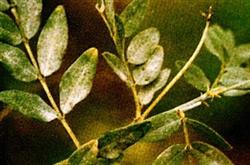
What Is Astragalus Powdery Mildew? Detailed Guide to Symptom Identification and Control Methods
What is Astragalus powdery mildew? How to control it? Astragalus powdery mildew 1. Disease symptoms: Powdery mildew mainly damages Astragalus leaves. In the early stage, white powdery spots appear on both sides of the leaves, and in severe cases the entire leaf is covered with a layer of white powder, with white powder also present on petioles and stems. Affected plants often drop their leaves early, and yield is damaged. Onset...
条件筛选