-

How to Raise Seven-Spotted Ladybirds? Breeding Methods and Precautions
The seven-spotted ladybird, also known as golden tortoise, new daughter-in-law, flower big sister, etc., is a predatory insect of the genus Coccinella in the family Coccinellidae. It is widely distributed throughout China, found in Northeast China, North China, Central China, Northwest China, East China and Southwest China. Its life cycle goes through four different developmental stages: egg, larva, pupa and adult
-
What are the characteristics and eating habits of the seven-spot ladybird?
The seven-spot ladybird is also called the golden tortoise, the new bride, and the flower big sister. It is a beneficial insect, and because it has seven black round spots on its wings, people gave it this name. The seven-spot ladybird is distributed in many places in our country and is a very common insect. So what
-
-
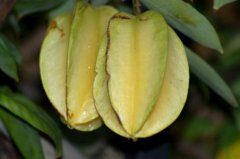
What are the control methods for the flower ladybird leaf roller moth on carambola?
The flower ladybird leaf roller moth belongs to the order Lepidoptera and is a pest that harms carambola. So how do we control the damage caused by the flower ladybird leaf roller moth pest? What are the ecological habits of this member of the order Lepidoptera, and what do the symptoms of damage look like? Ecological habits: The flower ladybird leaf roller moth belongs to the order Lepidoptera, commonly
-
What is the difference between the potato ladybird beetle and the 28-spotted ladybird beetle?
The potato ladybird beetle and the eggplant 28-spotted ladybird beetle are very similar in morphology. As soon as the potato sprouts, adults and larvae gather on vigorous plants to feed on the leaves and cause damage, overwintering as adults. Around April, the overwintered adults lay eggs in the field, and they emerge in July. In spring-planted areas, there is 1 generation per year. The larvae and adults of the 28-spotted ladybird beetle damage the leaves of vegetables such as eggplant, potato, tomato and cucumber, causing wilting. The larvae live on the underside of leaves. In warm regions, the adults have 2 to 3 generations per year, overwinter as adults, and generations overlap. After overwintering, the adults gather
-
Identification and Control Methods for the Potato Ladybird Beetle
The potato ladybird beetle (Henosepilachna vigintioctomaculata Motschulsky) belongs to the order Coleoptera, family Coccinellidae. It is widely distributed in northern China. It mainly damages potatoes, eggplants, Chinese cabbage, rapeseed, as well as beans, cucurbits and so on. [Field identification] Both adults and larvae feed on leaves, gnawing the epidermis and mesophyll on one side, creating many net-like pits. The adult is about 8 mm long and hemispherical. The body dorsum and elytra are yellowish-brown; the center of the pronotum
-
A Detailed Guide to Identifying and Controlling the 28-Spotted Ladybird Beetle on Eggplant
The 28-spotted ladybird beetle on eggplant belongs to the order Coleoptera, family Coccinellidae, also known as the groundcherry ladybird beetle, commonly called "flowered big sister." Its host crops include solanaceous vegetables such as eggplant, tomato, green pepper and potato, as well as cucurbitaceous vegetables such as cucumber. In addition, it can also damage crops such as beans, groundcherry and Chinese cabbage, among which eggplant suffers the most serious damage. It is distributed throughout the country, but occurs in larger numbers and causes serious damage in areas south of the Yangtze River basin. 1 Field identification 1.1 Damage characteristics It damages crops as adults and larvae. Newly hatched larvae
-
What are the control methods for the 28-spotted ladybird beetle (Henosepilachna vigintioctopunctata)?
1. Morphological characteristics: The adult is yellowish-brown and hemispherical. The pronotum usually bears 6 black spots, and each wing cover has 14 nearly round black spots of two sizes, with the black spots not connected at the suture between the two wing covers. The egg is bullet-shaped, yellowish-white when first laid and later brown, with the eggs in an egg mass arranged rather densely. The newly hatched larva is pale yellow, later turning white, spindle-shaped, with many white branched spines on the body segments, and the bases of the branched spines have dark brown rings. The pupa is oval, yellowish-white, with black markings on the back, and the posterior end is wrapped in the cast skin of the last-instar larva. 2. Life habits and
-
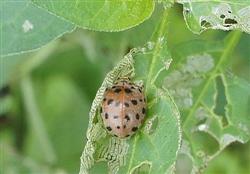
Control Methods for the Twenty-Eight-Spotted Ladybird Beetle on Leaf Goji
What harm does the twenty-eight-spotted ladybird beetle do to leaf goji? How do you control the twenty-eight-spotted ladybird beetle on leaf goji? Netizens are asked to help introduce methods. Zhongdiwang has compiled the harm caused by the twenty-eight-spotted ladybird beetle to leaf goji and its control methods, listed below for netizens' reference. Harm caused by the twenty-eight-spotted ladybird beetle: twenty...
-
条件筛选