What food does the 18-spot ladybird mainly eat?
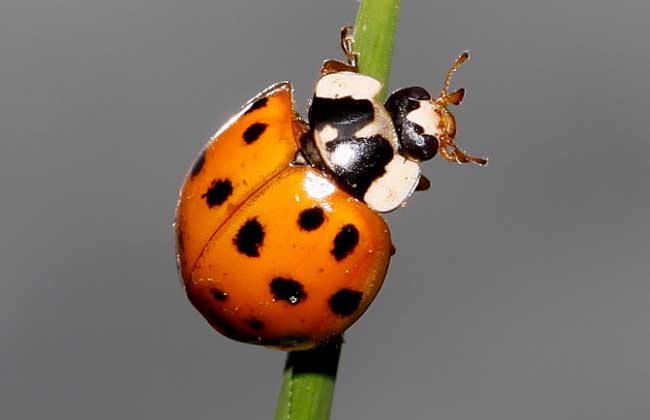
The 18-spot ladybird is a type of 28-spot ladybird, an insect of the order Coleoptera, family Coccinellidae. The adult is slightly small, the pronotum usually has 6 black spots, the black patches at the seam where the two elytra meet are not connected, and the 4 black spots in the second row at the base of the elytra are basically in a straight line. The larval body segments have white branched bristles. Let us take a look below at what food the 18-spot ladybird eats!
What food does the 18-spot ladybird eat?
The 18-spot ladybird is a phytophagous insect. Adults and larvae scrape and feed on the leaf mesophyll on the underside of leaves, leaving only the epidermis and forming many irregular, semi-transparent fine grooves, resembling the bottom of a sieve. They can also eat leaves into holes or leave only the veins. In severe cases, the damaged leaves dry up and turn brown, and the whole plant dies. Eggplants and melons, where gnawed, often split, and the tissue becomes stiff, rough and bitter, unfit for eating.
Are ladybirds beneficial insects or pests?
Ladybirds include both pests and beneficial insects. There are very many species of ladybirds, and by feeding habit they can be divided into carnivorous ladybirds and phytophagous ladybirds. Adult carnivorous ladybirds prey on any soft, tender-bodied insect, and their favorite food is aphids, such as the seven-spot ladybird. Most species of phytophagous ladybirds feed on plants of the Solanaceae, Cucurbitaceae and Asteraceae, such as the potato ladybird and the 28-spot ladybird, which collectively eat the leaves of eggplants and potatoes and are therefore regarded as pests.
Control methods for the 18-spot ladybird
1. Clean the garden and fields in time and dispose of leftover plant debris to reduce the overwintering insect source base.
2. During the peak egg-laying period, remove egg masses from the underside of leaves. Taking advantage of the adults' death-feigning habit, tap the plants and use a basin to catch the falling insects and kill them in a centralized way.
3. When the field egg hatch rate reaches 15-20%, use pesticides for control. You may choose 80% dichlorvos emulsifiable concentrate, or 90% crystallized trichlorfon, or 50% malathion emulsifiable concentrate at 1000 times dilution, 50% phoxim emulsifiable concentrate at 1500-2000 times dilution, 2.5% deltamethrin emulsifiable concentrate, or 20% fenvalerate, or 40% pyrethroid compound emulsifiable concentrate, or 40% fenvalerate-malathion emulsifiable concentrate at 3000 times dilution, or 21% miexhabing emulsifiable concentrate at 6000 times dilution for spraying.