What are the control methods for the flower ladybird leaf roller moth on carambola?
The flower ladybird leaf roller mothbelongs to the order Lepidoptera and is a pest that harms carambola. So how do we controlthe flower ladybird leaf roller mothpest damage? What are the ecological habits of this member of the order Lepidoptera, and what do the symptoms of damage look like?
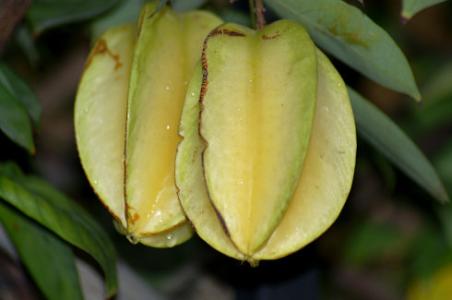
Ecological habits: The flower ladybird leaf roller mothbelongs to the order Lepidoptera and is commonly known as the carambola fruit borer. Besides harming carambola, it is also occasionally found on longan, lychee, peach, guava and sugar apple. It occurs year-round in Taiwan, China, and can complete about 8 generations a year. Adult lifespan is about 8 to 19 days, and the pre-oviposition period is about 3 to 13 days. Adults mate in the early morning, and females lay eggs in the evening. Eggs are laid on the fruit surface, with one to more than ten eggs per fruit, and each female moth can lay an average of 120 eggs. Newly laid eggs are white and turn red after 1 to 2 days, with an egg stage of about 3 to 10 days. Larvae are red to dark red, with a larval stage of about 10 to 26 days. After the larvae mature, most of them bore out of the fruit and spin cocoons to pupate in bark crevices, in the sandy soil under the tree, on dead branches, fallen leaves or dried fruit, with a pupal stage of about 9 to 24 days.
Damage symptoms: After hatching, the larvae immediately bore into the fruit through the stem end, fruit ribs or tail end, feeding on the flesh inside. Outside the bore hole, granular brown frass excreted by the larvae can be seen, and this feature can clearly be distinguished from the damage holes of the Oriental fruit fly. Usually only 1 to 2 larvae cause damage inside each fruit, and larvae that have not yet matured inside the fruit will crawl out and then bore into an adjacent fruit to continue causing damage.
Control methods:
1. Using sex pheromones to control the flower ladybird leaf roller moth is mainly because they can mass-trap and kill male moths, reducing the chances for male and female moths to mate and lowering the production of offspring, thereby achieving the goal of reducing the population. The fruit damage rate naturally decreases, but it must be used over the long term and over a large area to effectively realize its control potential. The currently promoted rate is to hang 4 to 8 sex pheromone traps per fen of land, with about 15 m between traps, and the lure remains effective for 6 to 8 months. Sex pheromone attractants can also be used for density monitoring or as an indicator of whether control is needed. When the average weekly trap catch is below 5 to 10 moths, pesticide applications for control can be reduced.
2. Fallen fruit is often an overlooked and important breeding source of pests. From changes in the population, it is not hard to understand that fallen fruit produces a considerable number of pests. These pests may harm other orchards and may also become an important pest source for the next fruit crop in one's own orchard. Removing fallen fruit or infested fruit is the best way to reduce field pest sources, and the method is simple, easy and safe and effective.
3. The flower ladybird leaf roller moth and the Oriental fruit fly are the most critical pests of carambola fruit. Bagging can be used to block their damage to carambola. When the carambola fruit grows to about 5 to 6 cm (30 to 40 days after flowering), fruit bagging is carried out together with fruit thinning. Before bagging, pest and disease control should be carried out thoroughly, and bagging should be done only after the spray solution has dried to avoid phytotoxicity. Also, the bagging method must meet standards, and the bag opening must be tightened and secured to prevent small insects such as scale insects from invading the fruit through gaps at the bag opening.
4. In southern regions, attempts have been made to cultivate carambola in net houses with 10 to 12 mesh to block damage by the flower ladybird leaf roller moth and fruit flies. Attention should be paid to the adaptation problems of pollinating insects inside the net house, and to poor ventilation and sunlight inside the net house, which make fruit trees prone to water sprouts and easily induce spider mite damage. In addition, net house cultivation has a relatively high cost, so the suitability of net house cultivation for carambola still needs continued improvement.