-

Is the Gloxinia a Bulb Plant? Let's Get to Know the Gloxinia
The gloxinia, native to Brazil, is loved for its colorful flowers and its blooming in two seasons, and is often used for festive embellishment and interior decoration. Let's get to know it below.
-
What kind of plant is Sageretia thea? A brief introduction to the woody plant Sageretia thea
Sageretia thea is a shrub and a high-quality material for making bonsai. In ancient China it was known as one of the "Seven Sages." It is a tree of great quaintness and dignity, mainly produced in the Yangtze River basin and the southeastern coastal areas.
-
What is Caladium? Get to know this bulbous plant
Caladium has beautiful leaf colors and is very suitable for indoor ornamental cultivation. In summer, the variegated colors of Caladium leaves are full of a cool feeling. But after entering autumn, the leaves gradually become messy, go dormant in winter, and begin to sprout and grow in late spring and early summer.
-
What plant is Stylidium? Get to know this herbaceous plant
Stylidium is a small annual herb, 5-13 cm tall. The leaves are all basal, ovate-orbicular, ovate to obovate, 5-8 mm long, with a rounded or blunt apex, entire and hairless; the corolla is white, about 2 mm long, and the capsule is slender and columnar, about 8 mm long. It is found in China in the coastal areas of Guangdong. It prefers to grow in wet grass by streams in hilly areas
-

Council of Agriculture submits Beinong market closure review report, acknowledges failure to identify risks early, proposes 6 future response measures
Council of Agriculture submits Beinong market closure review report, acknowledges failure to identify risks early, proposes 6 future response measures
-
You actually don't know how to pick flowers? No wonder every plant you buy dies!
As soon as you walk into a flower market, the dazzling array of colorful flowers makes your eyes swim, and for beginners in particular, it's really hard to know how to choose. Today, Huahua is going to teach you how to pick healthy, thriving flowers and how to care for them after you bring them home. Come and learn!
-
Some Understanding and Knowledge of Orchid Pests: Orchid Mealybugs
Orchid mealybugs, also known as whiteflies (TRIALEURODES VAPORARIORUM), adults and nymphs gather on host leaves, suck sap, form yellow spots at the feeding sites, and can secrete honeydew, inducing sooty mold. Morphological characteristics: adult body length about 1.1 mm, pale yellow, wings semi-transparent, both covered with white waxy powder....
-
Detailed explanation of the morphological characteristics of orchids, helping you quickly get to know orchids
The Orchidaceae family comprises 750 genera and more than 35,000 species, while the genus Cymbidium has more than 70 species. Common cultivated species in China include: the famous flower of the four seasons, Cymbidium goeringii (C. goeringii): also called grass orchid, mountain orchid, and duoduo xiang. One stem bears 1 to 2 flowers, fragrant. Flowering period is February to March. Mainly distributed in the Yangtze River basin and the southwestern region. Traditional precious varieties...
-
Orchid Knowledge Introduction: A Comprehensive Guide to Orchids
Roots: The roots of terrestrial orchids form a clustered fibrous root system, fleshy, occasionally producing segmented branch roots from the fibers, and orchid roots generally have no root hairs. Generally, the roots of Cymbidium goeringii (Spring Orchid) are relatively thin, about 0.4 cm in diameter; those of Cymbidium faberi (Faber's Cymbidium) about 0.5 cm; while those of Cymbidium ensifolium (Four-season Orchid), Cymbidium qiubeiense (Autumn Orchid), Cymbidium kanran (Cold Orchid), and Cymbidium sinense (Chinese Cymbidium) are slightly thicker and longer than the above. Orchid roots store abundant water and nutrients. According to root structure...
-
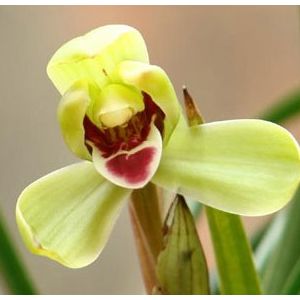
Cymbidium goeringii 'Red Lip Immortal', also known as 'Mutual Longing', variety introduction
In 1994, it was collected from Lishui, Zhejiang, selected by Lin Jie of Suichang County, Zhejiang, and later sold to Fang Yongjun for cultivation; Mr. Fang called it "Chuzhou Immortal." It is said that when it was collected there were two plants, one named "Red Lip Immortal" and the other named "Mutual Longing." At first, local orchid enthusiasts called it "Mutual Longing Immortal." New shoots are bright purplish red, leaves are 26-28 cm long, 1....
条件筛选