-
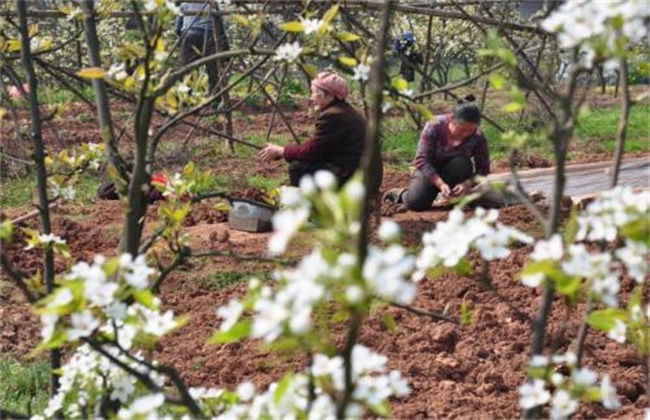
Precautions and Key Technical Points for Intercropping in Pear Orchards
Precautions for Intercropping in Pear Orchards
-

Detailed Explanation of the Key Technical Points of Jujube-Grain Intercropping
1 Scientific Basis of Jujube-Grain Intercropping 1.1 Seize the time difference between the growth of jujube trees and intercrops to make full use of fertilizer and water resources. The jujube tree is a fruit tree that sprouts late, sheds its leaves early, and has a relatively short annual growth period. It generally begins to sprout in mid-April and sheds its leaves in mid-to-late October, while wheat is sown in late September and harvested in early June of the following year. The symbiotic period of jujube trees and wheat is about 80 to 90 days. From mid-May to early June is the period when wheat flowers, fills grain, and matures, mainly absorbing phosphorus and potassium fertilizer, with nitrogen fertilizer as a supplement. And the jujube tree is precisely in the period of growing leaves, differentiating young buds
-
How to grow jujube intercropped with cotton? Detailed key points of orchard-style cultivation
In the Aksu region, a three-dimensional planting method of orchard-style jujube-cotton intercropping is practiced, which both promotes the growth of young jujube trees and ensures the yield of intercropped cotton, making it a relatively good cultivation model for improving planting economic benefits. 1. Cultivation indicators 1. Cotton The suitable variety is Zhongmian 35, with an average harvested plant number of 11,000-12,000 plants/667 sq m, 5.5-6 bolls per plant, 5.0-5.5 g per boll, a lint percentage of 38%-40%, a pre-frost flower rate of >=85%, and a lint cotton yield per 667 sq m of
-
High-yield cultivation technique for three successive crops intercropped in jujube orchards
The jujube tree (Ziziphus jujuba) has relatively strong growth adaptability and is a tree species that prefers warmth and light. When the spring temperature reaches 13-15°C, it begins to sprout branches; when the monthly average temperature is above 17°C, flower buds begin to differentiate; when it is above 2O°C, it flowers; the suitable temperature for fruit ripening is 18-22°C; when the temperature drops to 15°C, it begins to shed leaves. Because of its characteristics of late sprouting, early leaf fall, and little shading, it is suitable for intercropping with grain, cotton, and vegetables, and the economic benefits are very considerable. The following introduces the high-yield technique for interplanting three successive crops in one year in a jujube orchard. 1. Key points of jujube cultivation techniques
-
What should be noted when intercropping in a peach orchard?
Points to note when intercropping in a peach orchard: after the peach trees are planted, the trees are still small, so tall-stemmed crops are not suitable for the intercropped land; peanuts, root and tuber crops, and legumes are preferable. Intercropped crops must not be planted too close to the tree trunks. Generally, for newly planted trees, a tree plate of about 1 sq m can be left, and for trees that have just begun to bear fruit, a tree plate of about 2 to 3 sq m should be left, to prevent the intercropped crops from competing with the fruit trees for fertilizer and water. To increase soil organic matter, green manure can be interplanted between the rows of peach trees. Interplanting green manure is an important way to resolve the competition between fruit trees and grain crops for fertilizer.
-
Key points of pruning techniques for jujube-grain intercropping trees
In the jujube-producing areas of northern China, the practice of jujube-grain intercropping has long been customary, and it is a good way of producing jujubes and grain in plain regions. Jujube trees intercropped in grain fields should not be planted too densely, and the trunk should not be too low; a planting density of 150-210 trees/hectare and a tree height of about 6 m are appropriate. In this way, the light received by the grain field is only 1.2%-2.2% less than that of a pure grain field. According to the characteristics of jujube-grain intercropping, in order to give play to the yield-increasing potential of jujube trees, apart from trunk height, a sparse tree form is preferable, so as to maintain strong light for the crops under the trees
-
High economic returns from intercropping apricot trees with Chinese medicinal herbs
In recent years, farmers in the rural areas around Luoyang, Henan, have adopted the "forest-medicinal herb intercropping" method to plant trees and grow medicinal herbs, becoming wealthy through both the "forest" and the "medicinal herbs." The soil in the Luoyang area is very high in potassium, so the kernel apricot, a potassium-loving plant, finds the necessary soil conditions to grow there. Moreover, the light, heat and moisture conditions here all suit the growth requirements of kernel apricot. Kernel apricot is cold-tolerant, light-loving and tolerant of poor soil, making it suitable for planting on semi-arid hilly slopes. After planting, kernel apricot can bloom and bear fruit in two to three years, and in four to five
-
Detailed Explanation of the Key Technical Points for Jujube-Grain Intercropping
The key technique of jujube-grain intercropping is to properly regulate the conflicts between jujube trees and intercrops over fertilizer, water, and light, so as to achieve mutual benefit and reciprocity between jujube and grain and realize a double bumper harvest of both. 1. Master an appropriate planting density. Row spacing has a marked effect on air temperature, humidity, light, and wind speed, and is also an important factor affecting jujube and grain yields. Therefore, overall arrangements should be made according to cultivation purposes and local conditions. For jujube-oriented planting, a row spacing of 6 m is best; for grain-oriented planting, a row spacing of 15 m is best; for giving consideration to both jujube and grain, a row spacing of 8 m is best. 2. Select
-
Intercropping strawberries has high economic returns and is a planting model worth trying
1. Intercropping in greenhouse strawberry fields: Fengxiang or Mingbao strawberries are planted by early September. Before the cold wave arrives from late October to early November, greenhouse film is covered. In winter, straw curtains are added outside, and plastic film plus small tunnels are used inside. Other management is the same as for greenhouse strawberries. On November 20, tomato and bell pepper seedlings are raised, and all seedlings are sold before April 20 of the following year. On March 5...
条件筛选