-

Gansu Jinchang City Seed Work Conference Convened
On December 11th, the municipal government convened the citywide seed work conference. Attendees included leaders in charge from the municipal, county, and district governments, members of the "Jinchang City Special Rectification Action Leading Group for Illegal Acts Involving Seeds", the municipal procuratorate, the municipal administration for industry and commerce, leaders in charge of public security and courts at the county and district levels; county and district
-
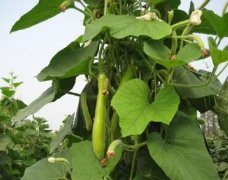
What is Bottle Gourd? How to Pinch and Prune When Growing Bottle Gourd
Bottle gourd is also called hu gua (calabash). Bottle gourd is a very popular vegetable, so do you know how it is grown? Would you like to learn about it? 1. Cultivation season: Although bottle gourd can be cultivated year-round in Taiwan, China, the central and northern parts are best planted in March to April, while the southern part is best planted between December and January of the following year, because at this time the temperature gradually rises, and plant development and reproduction are better than with autumn planting, with higher yields as well.
-
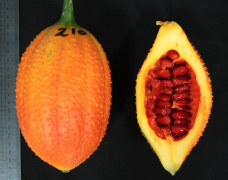
Is Taiwan Momordica cochinchinensis a fruit? Detailed explanation of nutritional value and uses
Is Momordica cochinchinensis a fruit? How should it be eaten? In order to promote the native specialty crop Momordica cochinchinensis, the Taitung District Agricultural Research and Extension Station of the Council of Agriculture, Executive Yuan (hereinafter referred to as the Taitung Station) held the "Native Specialty Crop Momordica cochinchinensis Multifunctional Application Presentation," presenting the research and development results of "Excellent Seedling Propagation Technology for Native Momordica cochinchinensis," "Creative Cuisine with Momordica cochinchinensis," and "Simple Juice-Making Technology for Momordica cochinchinensis." It is hoped that through multifunctional technological development and application, from primary agricultural production, combined with secondary crop processing and tertiary product promotion, and integrating indigenous cultural experiences and tourism, the added value of the emerging crop Momordica cochinchinensis can be created.
-
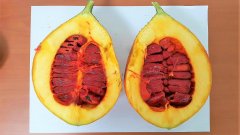
Taiwan, China's Momordica cochinchinensis fruit is rich in lycopene. How does this unusual plant reproduce?
What an unusual fruit! The fruit surface is spiky, and when mature it becomes a bright red-orange berry that looks like rows of lanterns from afar. Up close, the green unripe fruit looks like an oversized spiky passion fruit. It turns out that not only is its fruit shape unusual, but because its seeds look like a soft-shelled turtle,
-
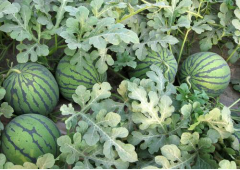
Is Jincheng No. 5 watermelon high in sugar? Variety introduction and water-uptake characteristics explained
Have you ever eaten the Jincheng No. 5 watermelon variety? This watermelon is a superior variety from Lanzhou, Gansu, and its most notable feature is its yield. This variety has a very high yield, with an average yield of 5700 kg per mu. Jincheng No. 5 watermelon has stress resistance comparable to
-
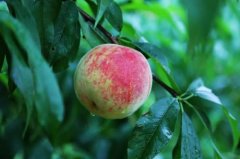
When is the best time to bag peaches? Detailed explanation of fruit thinning and pinching methods
Bagging peaches can be discussed in several parts, and I hope it will help farmer friends who grow peaches. Let's take a look together! 1. Central region: because the cold snap each winter differs, the bagging time also differs slightly. (Generally, the time for pruning peach branches. The older generation taught me that it is within 10 days before and after the winter solstice, that is, from December 12 to January 2 of the following year.) February 24, 2009. In 2010 it was February 26. In 2011 it was March 10. It changes a little almost every year.
-
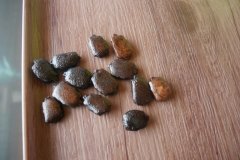
Taiwan Specialty Plant and Fruit: Gac (Momordica cochinchinensis) - Morphological Characteristics, Nutrients, and Can the Seeds Be Eaten?
The fruit from heaven - "Heaven Fruit" - its appearance gives no hint of heaven at all, yet it is a good friend to the eyes. People in Vietnam and South Asia call gac (Momordica cochinchinensis) the "fruit from heaven," and it is a treasure for young women to keep their skin rosy and radiant.
-
How much is Asparagus cochinchinensis selling for per jin right now, and what are the benefits of drinking it as an infusion?
Asparagus cochinchinensis, also known as Tian Dong Cao, is a perennial herbaceous plant that grows on the edges of mountain forests. Its tuberous roots have high medicinal value, and regular consumption can clear internal heat, relieve coughs, nourish yin and moisten dryness. So how much is Asparagus cochinchinensis bought for per jin? What are the benefits of drinking it as an infusion? 1. Asparagus cochinchinensis
-
How to Grow and Care for Purple Heart (Tradescantia zebrina)
Summary Soil: For purple heart (Tradescantia zebrina), you can use a mix of 20% river sand, 40% garden soil and 40% leaf mold. Light: It fears direct strong light during the growing period and needs to be kept in semi-shade. Temperature: The suitable temperature for growth is 18-30°C; it fears cold and frost, and in winter when the temperature falls below
-
Asparagus cochinchinensis yields 6,000 to 8,000 jin of fresh roots per mu, and 600 to 800 jin of dried roots.
Abstract The yield per mu of Asparagus cochinchinensis is mainly determined by its growing environment and cultivation techniques. Generally, Asparagus cochinchinensis needs to be grown for 2-3 years before it can be dug up. The yield of fresh Asparagus cochinchinensis roots per mu is about 6000-8000 jin, and the yield of dried Asparagus cochinchinensis roots per mu is about 600-800 jin. I. Yield per mu of Asparagus cochinchinensis
条件筛选