-
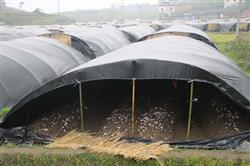
What are the methods for growing button mushrooms in rice fields?
How are button mushrooms grown in rice fields? Please explain. Button mushroom cultivation in rice fields is a planting method that uses rice straw and other materials as the main raw materials, which are composted and fermented to make the growing substrate, utilizes the temperature and light resources of autumn, winter and spring and the idle seasons, and adopts open-field cultivation of button mushrooms in rice fields after the rice harvest. 20...
-
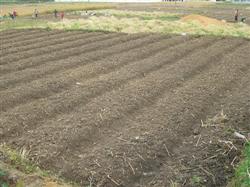
What are the key technical points for planting bamboo fungus (Dictyophora indusiata) in open fields?
How do you plant bamboo fungus in open fields? Here is a detailed introduction. For open-field planting of bamboo fungus, you can refer to the following methods: 1. Cultivation season. "D89 Dictyophora indusiata" is a mesophilic fungus, and the cultivation period is when the local temperature is stable at 8-28 degrees C. In our city, February to April is generally the sowing period, and May to October (temperature not lower than 16 degrees C) is the mushroom growth...
-
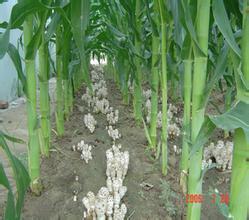
Key Technical Points for Intercropping Shaggy Mane Mushrooms in Pepper Fields
Intercropping shaggy mane mushrooms (Coprinus comatus) in pepper fields is a good way to cultivate them in a semi-wild manner. It can save the expense of building mushroom houses, does not take up extra space, and can greatly increase the economic benefit per unit of land area. Generally, after the peppers are planted, trenches are dug in the middle of the pepper rows, material is laid, and mushroom spawn is scattered. For the convenience of managing and harvesting the mushrooms...
-

Detailed Explanation of the Key Cultivation Techniques for Growing Golden Mushrooms in Rice Fields
In the townships of Dongchan, Fenshui, Shidong and others in Anju District, Mianyang, Sichuan Province today, when people mention "open-air mushrooms in rice fields," it can be said that everyone knows of them. "Growing mushrooms in rice fields is great! It doesn't affect the rice and brings very good returns." Uncle Yin from Shuangbaishu Village in Dongchan Town always speaks highly of field mushrooms, "Now, apart from growing mushrooms, I probably can't find any other cash crop that brings in more money than this." It is reported that "open-air mushrooms in rice fields" use wheat straw, rapeseed stalks, corn stalks, rice straw and other materials as raw materials,
-
Detailed Guide to Intercropping Oyster Mushrooms in Rice Fields
During the growth and development of rice, intercropping oyster mushrooms using the spaces between rice rows and the special conditions under the shade of rice clumps can provide suitable temperature and humidity conditions for the growth of oyster mushrooms (large temperature difference between day and night, good shading, sufficient scattered light, etc.), enabling high yields of oyster mushrooms, filling the market off-season when few mushrooms are available in summer, enriching summer vegetable varieties, and increasing rice farmers' income. I. Crop rotation arrangement and field plot design: Rice varieties should be selected with strong lodging resistance, tall plants, thick stalks, and resistance to rice planthoppers. Sowing in late May, transplanting in late June, with a density where
-
How to Cultivate Mushrooms in Winter Fallow Fields? Detailed Technical Points
Using winter fallow fields to cultivate mushrooms is a good way to increase income. At the same time, it helps to build soil fertility and increase grain yields. The technical points are: 1. Material preparation. For every 100 sq m cultivated, prepare 1250 kg of rice straw, 1750 kg of cow manure, 45 kg of peanut bran (select well-composted), 15 kg of urea, 40 kg of lime, 25 kg of superphosphate, and 25 kg of gypsum. 2. Pile composting and fermentation. Generally, start piling the material 1 month before sowing, that is, around early October, and the composting period is about 1 month,
-
Growing button mushrooms (Agaricus bisporus) in winter-fallow rice fields delivers good returns
In 2004, our county carried out cultivation demonstrations of growing button mushrooms (Agaricus bisporus) in winter-fallow rice fields across 16 townships. After the late rice harvest, rice straw and other materials were used as the main raw materials and composted and fermented into growing substrate, making use of the winter temperature and light resources and the idle winter season of the rice fields; open-field cultivation of button mushrooms achieved notable returns. Chen Yeru, a farmer at the Lixian Institute of Agricultural Sciences, is a button mushroom cultivation demonstration household, with a family of 4 people and 2 laborers, and had never previously cultivated edible fungi. After technical training at the Lixian Edible Fungi Research Institute, he set up on his own contracted field
-
Key Technical Points for Mushroom Cultivation and Management in Winter Fallow Fields
Using winter fallow fields to cultivate mushrooms with rice straw and manure as the main raw materials can greatly increase income, and the spent substrate after cultivation can be returned directly to the field or used as raw material for bio-organic fertilizer. The winter fallow field mushroom cultivation technique is introduced as follows: Substrate formula: when stacking materials, calculated per square meter of mushroom bed, use 12.5-13.5 kg of dry rice straw, 0.8 kg of rapeseed cake powder, 0.45 kg of gypsum powder, 0.45 kg of superphosphate, 0.45 kg of compound fertilizer, and 0.45 kg of lime powder. Per mu
-
Do not make these mistakes when growing button mushrooms (Agaricus bisporus) in paddy fields for high yields
In actual production, farmers often make certain mistakes that affect the profitability of cultivation. First, insufficient pre-wetting. Rice straw must be fully soaked before it can decompose well. Straw that has not been soaked sufficiently needs a large amount of water added during turning, and if the water cannot be replenished before the second turning, it will be very difficult to make up later, which seriously affects the growth of mushroom mycelium. Second, uneven turning. It should be done according to the principle of "raw material in the middle, cooked material on both sides; the middle goes to the two ends, the two ends go to the middle." Some growers, when turn
-
How should you select mushroom spawn for high yields when cultivating Agaricus bisporus in paddy fields?
Give priority to granular wheat grain spawn with good yield performance and strong stress resistance, followed by manure-straw bag spawn. To plant 1 mu of field mushrooms, about 400 bottles of wheat grain spawn are needed, with an investment of 800-900 yuan; or 800-1000 bags of manure-straw bag spawn, with an investment of about 1000 yuan. Farmers should be especially reminded that when buying spawn, they must go to a spawn farm with a good reputation.
条件筛选