What are the key technical points for planting bamboo fungus (Dictyophora indusiata) in open fields?
How do you plant bamboo fungus in open fields? Here is a detailed introduction. For open-field planting of bamboo fungus, you can refer to the following methods: 1. Cultivation season. "D89 Dictyophora indusiata" is a mesophilic fungus, and the cultivation period is when the local temperature is stable at 8-28 degrees C. In our city, February to April is generally the sowing period, and May to October (temperature not lower than 16 degrees C) is the mushroom growth...
How do you plant bamboo fungus in open fields? Here is a detailed introduction
For open-field planting of bamboo fungus, you can refer to the following methods:
1. Cultivation season. "D89 Dictyophora indusiata" is a mesophilic fungus, and the cultivation period is when the local temperature is stable at 8-28 degrees C. In our city, February to April is generally the sowing period, and May to October (temperature not lower than 16 degrees C) is the mushroom growth and harvest period.
2. Field selection. Open-field bed cultivation of bamboo fungus has relatively strict requirements for the field. When selecting a field, you should choose: fertile soil, rich in organic matter, good air permeability, convenient drainage and irrigation, and convenient transportation, such as paddy fields, orchards, and forest land, and where bamboo fungus has not been planted in the previous two years (including fields through which the water source needs to flow), so as to avoid contamination by competing fungi.
3. Cultivation materials. The raw materials that can be used for open-field bed cultivation of bamboo fungus are relatively wide-ranging. Mainly bamboo shavings, bamboo chips, wood shavings, rice husks, reeds, bean stalks, peanut vines, corn stalks, and other by-products and waste materials of agricultural and sideline products with relatively hard texture and high lignin and cellulose content can all be used as materials for bamboo fungus cultivation. Each mu requires 4000-5000 kg of materials. Various materials should be mixed with both coarse and fine textures, with diverse types, avoiding a single type.
4. Preparation and fermentation of materials. Per mu, use 1500-2000 kg of dry bamboo shavings, 1500-2000 kg of wood shavings, 1000 kg of rice husks, 50 kg of urea, 25 kg of calcium carbonate or superphosphate (use calcium carbonate when there is more bamboo powder in the materials, and use superphosphate when there is more wood powder), and 50 kg of gypsum. In one corner of the field, choose a field area of about 40 sq m, open drainage ditches around it, and use it as the place for stacking and fermenting materials. When stacking the materials, spread 20 cm of rice husks, 15 cm of wood shavings, and 15 cm of bamboo shavings on the bottom layer, then sprinkle a layer of urea (about 15 kg), calcium carbonate (about 5 kg), and gypsum (about 10 kg) and pour a small amount of water. Next, spread another layer of rice husks, a layer of wood shavings, and a layer of bamboo shavings, 50 cm thick, then sprinkle another layer of urea, calcium carbonate, and gypsum and pour a small amount of water. Continue in this way, making 3-4 layers, with a stack height of 1.5-1.8 m. After the material stack is built, pour 60 kg of water per 100 kg of dry material, watering the stack thoroughly. After that, turn the stack once every 10 days, for a total of 3 turns. When turning the stack, the compost inside and outside, upper and lower, must be exchanged in position so that the compost ferments evenly and consistently from top to bottom and inside to outside.
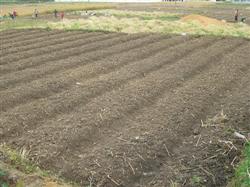
5. Cultivation method. Choose a north-south orientation, with a bed width of 70 cm and a ditch width of 30 cm. Arrange the fermented compost in beds 55 cm wide and 15 cm thick, using 20-25 kg of material per sq m, and then sow. Make one hole every 10-15 cm, and place about 30 g of bamboo fungus spawn in each hole. Use 500-600 bags of spawn per mu (14*28 spawn bags, about 0.5 kg each). After sowing, cover with raw materials and press flat, then dig up the soil from the ditch positions as covering soil. The covering soil should be finely crushed, with a thickness of 5-6 cm. After covering with soil, the bed width should be 68-70 cm and the ditch width 30 cm. After covering with soil, cover the bed surface with 1-2 cm of rice straw. When the rice straw absorbs water and becomes soft (2-3 days), cover with plastic film to keep warm and moist.
6. Management. After covering with soil, dig deep ditches around the field to prevent water accumulation. Bamboo fungus is afraid of both drought and waterlogging. From sowing to harvest, the covering soil must be kept moist. After the Beginning of Spring, when the temperature is higher than 28 degrees C, remove the film. During summer and autumn droughts, frequently irrigate the field ditches with running water. About 60 days from sowing, mushroom buds the size of rice grains will grow on the bed surface. Ten days before budding, use herbicide to kill the weeds on the bed surface. When a few mushroom buds begin to grow on the bed surface, start using shade netting to build a shade shed 2 m high and as wide as the field, requiring three parts sunlight and seven parts shade. After each batch of mushrooms is harvested, dissolve 7.5 kg of imported compound fertilizer per mu in 600-1000 kg of water and spray it to supplement nutrients for the bamboo fungus.
7. Harvesting and drying. From budding to harvest takes about 20 days. Harvest when the fruiting body is fully mature, the indusium is fully opened, and the spore fluid has not yet flowed down (that is, when the stipe tip breaks through the mushroom ball). Harvesting method: use a small knife to cut the mycelial cord, and never pull it upward by hand, so as to avoid damaging the immature mushroom buds and mushroom eggs. Then remove the cap and volva, do not damage the mushroom, place them neatly on a bamboo sieve in time, and put them into the drying room for drying.
8. During drying, control the temperature in the two stages well and remove moisture in time: 7.1 Moisture removal and shaping stage. Arrange the harvested bamboo fungus neatly on bamboo sieves and put them into the drying room for drying. At this time, open the skylight on top of the oven (open it fully) and burn a large fire, requiring a temperature of 60-65 degrees C for moisture removal and shaping. If the early temperature is too low and moisture removal is too slow, the bamboo fungus tubes will shrink. 7.2 Drying and color-setting stage. When the bamboo fungus is 70-80% dry, moisture removal and shaping have been completed. Open the drying cabinet door and take out the bamboo sieves. Tie the bamboo fungus neatly into bundles each about 20 cm in diameter, then stand them up and put them into the drying cabinet for drying and color setting. At this time, keep the temperature at 50-55 degrees C. It must not be too high, otherwise the mushroom indusium is likely to turn yellow and affect quality. Put the dried bamboo fungus product into sealed transparent polypropylene film bags, tie the bag openings well, and store in a cool, dry place, and it can be marketed and sold.
Click to get more bamboo fungus cultivation techniques
Click to get more edible mushroom cultivation techniques