Key Technical Points for Intercropping Shaggy Mane Mushrooms in Pepper Fields
Intercropping shaggy mane mushrooms (Coprinus comatus) in pepper fields is a good way to cultivate them in a semi-wild manner. It can save the expense of building mushroom houses, does not take up extra space, and can greatly increase the economic benefit per unit of land area. Generally, after the peppers are planted, trenches are dug in the middle of the pepper rows, material is laid, and mushroom spawn is scattered. For the convenience of managing and harvesting the mushrooms...
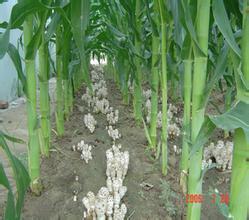
Intercropping shaggy mane mushrooms (Coprinus comatus) in pepper fields is a good way to cultivate them in a semi-wild manner. It can save the expense of building mushroom houses, does not take up extra space, and can greatly increase the economic benefit per unit of land area. Generally, after the peppers are planted, trenches are dug in the middle of the pepper rows, material is laid, and mushroom spawn is scattered. For the convenience of managing and harvesting the mushrooms and peppers, 3 pepper rows can be intercropped continuously, with one pepper row left as a walking path. In the center of the pepper row used for intercropping shaggy mane mushrooms, dig a trench 17 cm wide and 25 cm deep, with a length equal to the length of the pepper row. The trench length x width x the number of trenches dug in that area equals the total area for intercropping shaggy mane mushrooms in that area, with 20 kg of material and 3 kg of spawn per sq m (that is, the spawn rate is 15% of the raw material). For intercropping shaggy mane mushrooms in pepper fields, the culture material should be treated first, then trenches should be dug, disinfected, and the material laid and spawn scattered for cultivation. The technical requirements are as follows:
Culture material treatment To save costs and have sufficient raw material, whole straw (rice straw, wheat straw) can be used directly to treat and cultivate shaggy mane mushrooms. The treatment method is: tie dry, mold-free whole straw into small bundles of about 5 kg, soak them in batches in 3% lime water for 15-20 minutes, take them out and drain until no strings of water droplets drip down, then build a pile for fermentation. Spread a bottom film flat on a cement floor or cultivation site, place 10-15 cm thick wooden sticks on the film as a base, and lay the straw bundles horizontally on the wooden sticks to form a pile. Cover the whole pile with film and tie it together with the bottom film to ferment; when the pile temperature rises above 60°C, keep it for one day, then turn the pile. Spread another bottom film and transfer the straw bundles directly onto the bottom film to form a new pile, remove the wooden sticks from the original bottom film, and cover the new pile together with the bottom film, tying it tightly to continue fermentation. When the pile temperature rises above 60°C again, keep it for one day, then loosen the tying rope and open the film; cultivate when the temperature drops to about 30°C.
Intercropping technique Before cultivation, dig trenches on the ground of the pepper rows and pour 3% lime water to disinfect. Before laying the straw, first scatter a layer of sieved dry livestock manure on the bottom of the trench, then spread the straw bundles open and lay the whole straw evenly along the length of the trench. Lay about 5 cm of straw on the bottom layer, sow 3% spawn, and scatter a layer of dry livestock manure moistened with 3% lime water; lay about 10 cm of straw in the middle layer, with a sowing rate of 5%, and scatter a layer of dry livestock manure; lay about 10 cm of straw on the top layer, with a sowing rate of 7%, and scatter a layer of dry livestock manure. Flatten and compact the bed surface with a shovel and wooden board, cover with 3-4 cm of moist vegetable garden soil, spray with 0.5% lime water to moisten the covering soil, and scatter a layer of plant ash on top. Manage according to pepper growth, but irrigation should wait until the shaggy mane mushroom mycelium has penetrated the straw material and broken through the soil.
Points to note ① If peppers have missing seedlings, they should be filled in promptly so that the shaggy mane mushrooms receive good shade. ② If peppers are treated with pesticides for disease, first cover the shaggy mane mushroom cultivation area or growing area with plastic film, and remove it after the pesticide liquid has dried, so as to avoid pesticide damage.