-

Dongxing City, Guangxi organizes experts to measure and verify the yield of a new cassava variety
On December 18, the Dongxing City Agriculture Bureau of Guangxi organized agricultural science and technology personnel to go to the tuber crop experimental demonstration base in Hezhou Village, Dongxing Town, to conduct yield measurement and acceptance for the high-quality edible cassava new variety Huanan 12, which Dongxing City introduced from Hainan in 2015. After calculation, the average yield per plant of Huanan 12
-
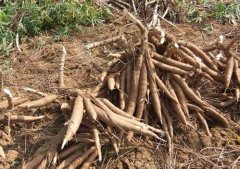
What Is Cassava? The Benefits and Effects of Cassava and Whether It Is Yam
Organic Cultivation of Cassava. Cassava, an erect shrub, 1.5-3 m tall; tuberous roots cylindrical. Leaves papery, outline nearly circular, palmately parted almost to the base, lobes 3-7, oblanceolate to narrowly elliptic, apex acuminate; petiole 8-22 cm long, slightly peltate, with inconspicuous fine ridges; stipules triangular-lanceolate, entire or with 1-2 bristle-like fine lobes. Panicles terminal or axillary, bracts linear-lanceolate; calyx purplish red with a white powdery bloom; male flowers: calyx about 7 mm long, lobes oblong-ovate, subequal, hairy inside; stamens 6-7 mm long, anthers tipped with short white hairs; female flowers: calyx about 10 mm long, lobes oblong-lanceolate, stigma recurved, fan-folded. Capsule elliptic, surface rough, with 6 narrow wavy longitudinal wings; seeds about 1 cm long, more or less trigonous, seed coat crustaceous, mottled, smooth. Flowering period September-November.
-
What is cassava flour, and how much did it cost per jin in 2019?
Cassava flour is a commonly used ingredient in daily life, often used to make desserts such as taro balls. When cassava flour is mixed with water and cooked, it becomes transparent and has a somewhat chewy, bouncy texture. So, what is cassava flour? How much did cassava flour cost in 2019?
-
Cassava (yuca) planting time and planting methods!
Cassava is native to Brazil and is now widely cultivated in tropical regions around the world. Cassava can be harvested for many years after a single planting, has strong adaptability to the environment, and produces high yields. Its tuberous roots are rich in starch and are one of the raw materials for industrial starch. Below is an introduction to cassava (yuca)
-
How to control cassava pests and diseases? Latest technical methods tutorial
Cassava is one of the three major tuber crops in China, and it is grown over a fairly wide area in the country, but during cultivation, certain pests and diseases commonly harm its yield and quality. So how should cassava pests and diseases be controlled? Let's take a look. 1. Bacterial wilt Bacterial wilt
-
What are the precautions for growing cassava? A detailed explanation of the latest key points
Cassava is cultivated all over the world, and China has a history of cultivation for over a hundred years. Its tuberous roots are rich in starch and are one of the raw materials for industrial starch, with relatively high economic returns. So what should be noted when planting it? Let's take a look. 1. Deep plowing to improve the soil In
-
Latest Key Technical Points for Cassava Field Management
You may not have eaten cassava, but you are certainly familiar with cassava flour. The bread and other foods we eat every day contain a great deal of cassava flour, and cassava is mainly used as the primary raw material for various industrial starches. At present, the cassava planting area is relatively large, but there are still
-
A Detailed Guide to the Latest Cassava Planting Methods and Timing
Cassava can be harvested for many years after a single planting. It is a relatively easy plant to grow, highly adaptable to its environment, and generally produces a fairly high yield. Its economic value is quite affordable, and it usually appears in powder form. Many people quite enjoy eating it.
-
Detailed Explanation of the Latest Key Technical Points for Fertilizing Kudzu
Kudzu is a plant very similar to cassava, but kudzu is a Chinese medicinal herb with both medicinal and edible uses. In our daily lives, kudzu is often used to reduce fever, stop diarrhea, promote body fluid production and quench thirst, and to promote eruption of rashes, and it is also very effective when used for dry heaving.
-
What are the propagation methods for variegated cassava? A detailed guide
Variegated cassava is a foliage plant quite suitable for indoor cultivation, and artificial cultivation is not difficult. Variegated cassava requires a wintering temperature above 15°C, so in winter it needs to be moved indoors to overwinter. Artificial propagation of variegated cassava can be done by cuttings and sowing
条件筛选